Turkey Tracks: Ailey’s Pillow

Turkey Tracks:  December 7, 2011

Ailey’s Pillow

Tami is learning to sew.

She bought a used machine up here in Maine two summers ago–from Marge at Mainely Sewing.  Marge carries Janome and will help you get a used machine or trade up for you.  Tami’s Janome is a sturdy, beginning machine which will carry her a long way before she’s ready to upgrade–if she keeps sewing more than household repair, etc.  We got her a darning foot for free-motion quilting and a walking foot at People, Places, and Quilts–an outstanding quilt store, in Summerville, South Carolina–on our “escape” day this trip.

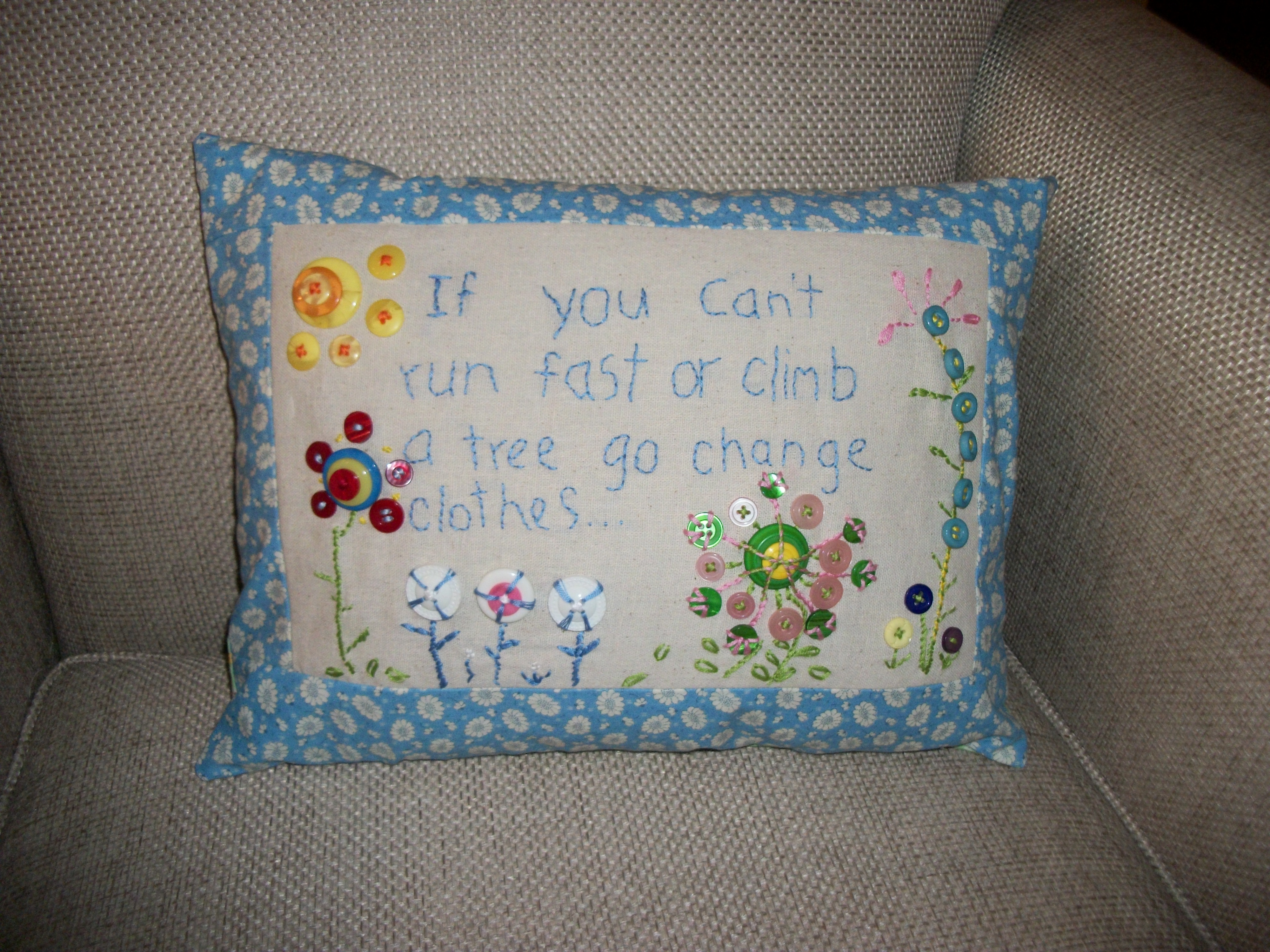
Here’s her first project:  a pillow for Ailey’s first birthday:

People, Places, and Quilts sells terrific kits for pillows and books filled with “sayings.”  The kits come with buttons, needles, and embroidery thread as well–and they are so much fun to use, as you can see.  Tami bought a selection of 1930s fabrics last year–for the sides and back of the pillows–but she needed some help to actually get started on a project.

Also, to see more of this kind of project, look at the Carol Boyer entries under the craft project section of this blog.

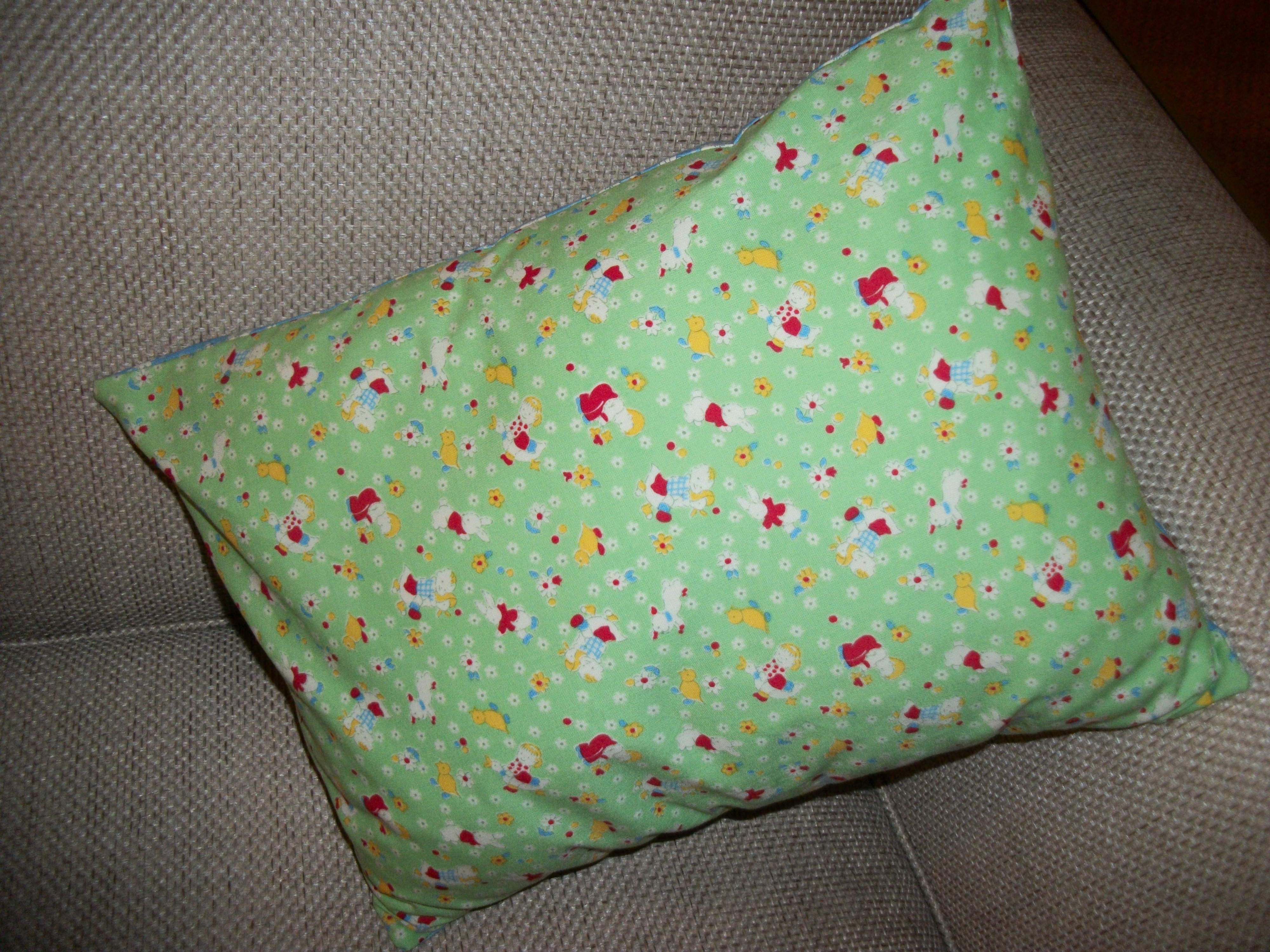
Here’s the back–a nice little 1930s print:

Here’s Tami closing up the stuffed pillow–the final step:

It’s so cute, this pillow!  Ailey will have this gift long after her childhood toys have disappeared.

I’ll be making some more pillows as well for gifts or for our Coastal Quilters’ auction next November.  I LOVE many of the sayings that People, Places, and Quilts have put into their books.

And, here’s the birthday girl, Miss Ailey, on the day of her first birthday:

Turkey Tracks: Thanksgiving Highlights

Turkey Tracks:  December 3, 2011

Well, here we are–past Thanksgiving and moving toward Christmas.  I’ve had some trouble with posting pictures to this blog–Wordpress made some technical changes that have flummoxed me, so I’m a bit behind.  Or, it’s that I’m away from home…  But, I did promise to post several of the family’s recipes and a few pics.  So, here goes.  You’ll find below the Bryan family’s famous Chocolate Chess Pie–updated and perfected by Bryan Enright–with a crust I love for all my pies–and recipes for our poultry dressing and gravy.

Mike and Tami hosted the gathering.  They have a long table and a long room that will fit the 20+ people gathering to celebrate.  Bryan and I cooked for two days at his house, while Mike cooked in his kitchen.  Prior to any cooking, however, there is the gathering up phase–which starts with collecting/finding recipes, planning menus, assigning cooking tasks, and gathering food.

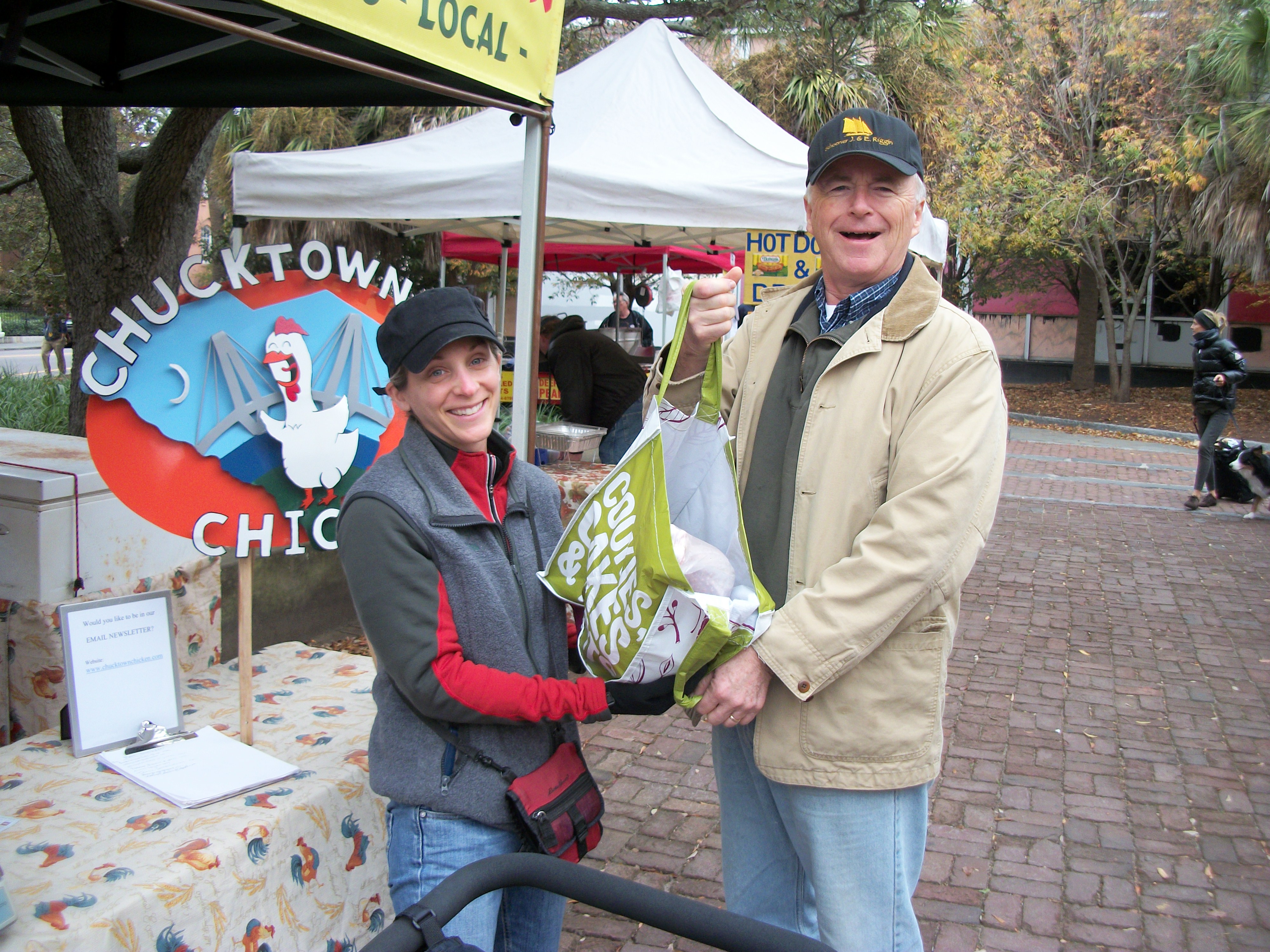
Corinne and I always hit the Charleston Farmers’ Market (5th best in the nation) the Saturday before Thanksgiving.  We picked up one of the two turkeys there, pie apples, and Brussel sprouts.  Corinne also bought a flat of kiwis, which grow abundantly in the Charleston area.

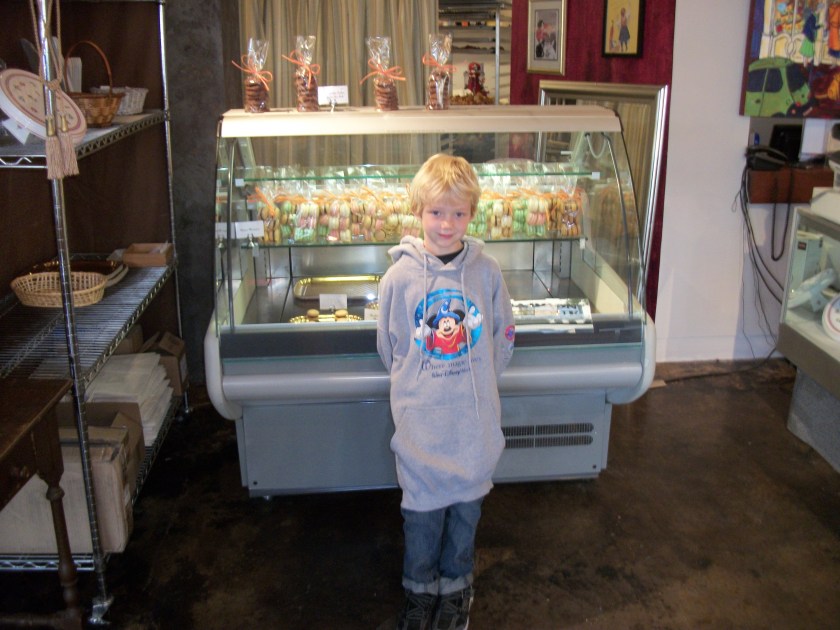
Part of the Farmers’ Market trip involves getting a big cup of coffee or tea at the market and chocolate croissants from a nearby bakery–called Macaroon something or other .  Here’s Kelly waiting for the croissants to be bagged.  He had never had them before, and he really liked them.  It was REALLY cold this morning, and Kelly, who spent the night with us at Bryan and Corinne’s, didn’t have a jacket, so we improvised.  Kelly was appalled that he had to wear a sweatshirt with Micky Mouse on it, but he went along, however reluctantly because he’s that kind of a kid.
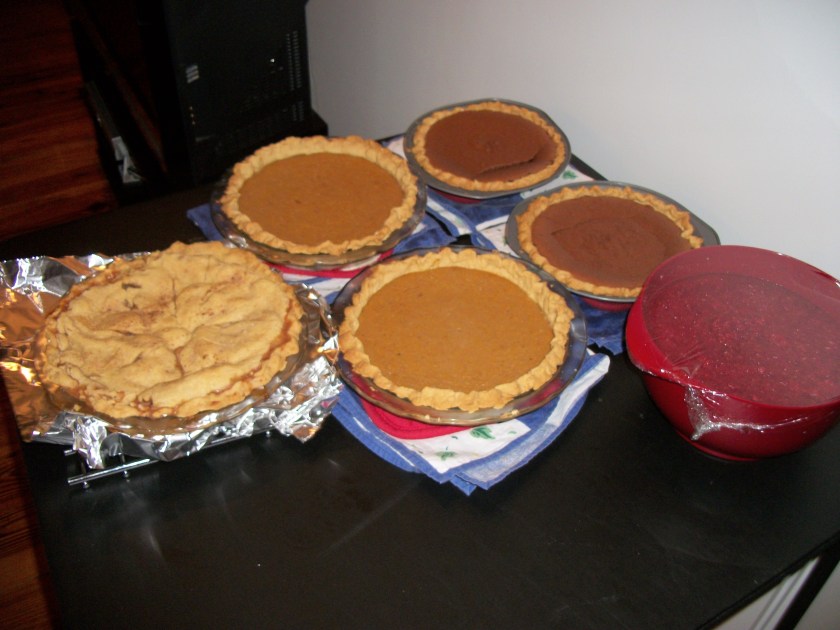
Bryan and I made 5 pies, the stuffing, cranberry relish, and the Brussel sprouts.  Here’s a picture of the finished pies–two chocolate chess (recipe below), two pumpkin (recipe given in an earlier blog post), and an apple.  We will serve them with MOUNDS of REAL whipped cream:
PIE CRUST

My favorite recipe for pie crust comes from Deborah Madison’s LOCAL FLAVORS (387).  You can mix it by hand, but it is so very easy in a food processor.  It makes enough for two 9-inch pies, or one 10-inch double with crust, or one large galette.

2 1/4 cups all-purpose flour

1/2 tsp. sea salt

3/4 cup (1 1/2 sticks) plus 2 Tablespoons unsalted butter

1 egg yolk

1/2 teaspoon vinegar (I usually use apple cider)

scant 1/2 cup of ice water

Put the flour, salt, and butter into the food processor and pulse 4-5 times to break everything up.

Combine vinegar and egg yolk in a measuring cup, mix, and add iced water to make a SCANT 1/2 up.  You may not use all the liquid.

While pulsing, add water mixture in a slow stream until dough crumbs start to come together.  Don’t let them come into a full ball, but combine them into a ball with your hands, wrap, and refrigerate for at least 30 minutes.  These crusts freeze well, too.  Think of future quiches…

Divide into two equal parts for 2 pie bottoms, or cut one large and one smaller piece for the bottom and top of a covered pie.

I roll out pie pastry on a silicon mat.  Often, I use a piece of waxed paper for the top.  Without the mat, I use two sheets of wax paper.

BRYAN FAMILY CHOCOLATE CHESS PIE

“Chess” pies are a big dessert feature in the south.  There are chocolate ones, lemon ones, and so forth.  All of them are delicious!  I think our family pecan pie is also a version as it’s made with brown sugar rather than corn syrup.

Bryan Enright took the family recipe that we had been trying to double as pie pans have gotten bigger and modified it to perfection.  Here’s what he does for TWO 9-inch pies.  Believe me, you will want TWO pies.  You can always give one to a good friend.

Use GOOD butter and eggs and REALLY GOOD chocolate.  This year we used Schaffen Berger, and we could really tell the difference.

2 1/2 cups brown sugar

1 1/2 cups white sugar

dash salt

2 1/2 sticks of butter

5 eggs

1/2 egg shell filled with milk–TWICE

2 1/2 teaspoons vanilla

4 ounces chocolate

Melt the butter and the chocolate together on very low heat.

Mix dry ingredients together.

Add chocolate/butter and mix in well.  Add vanilla.

Add eggs and milk and mix.

Pour mixture into two shells and cook at 325 degrees fir 35 to 45 minutes.  The middle will puff slightly.  Don’t overbake; the pie should be a little shaky in the middle when done.

Serve with mounds of REAL WHIPPED CREAM.

ENRIGHT FAMILY TURKEY DRESSING

This dressing has evolved over the years.  The cornbread and sage came from my grandmother Philpott; the sausage came from John’s mother in Boston; and the celery and onion came from lots of places.

There are FOUR tricks to making good stuffing:  a good stock, really dry bread/cornbread, lots of eggs, and fresh sage.

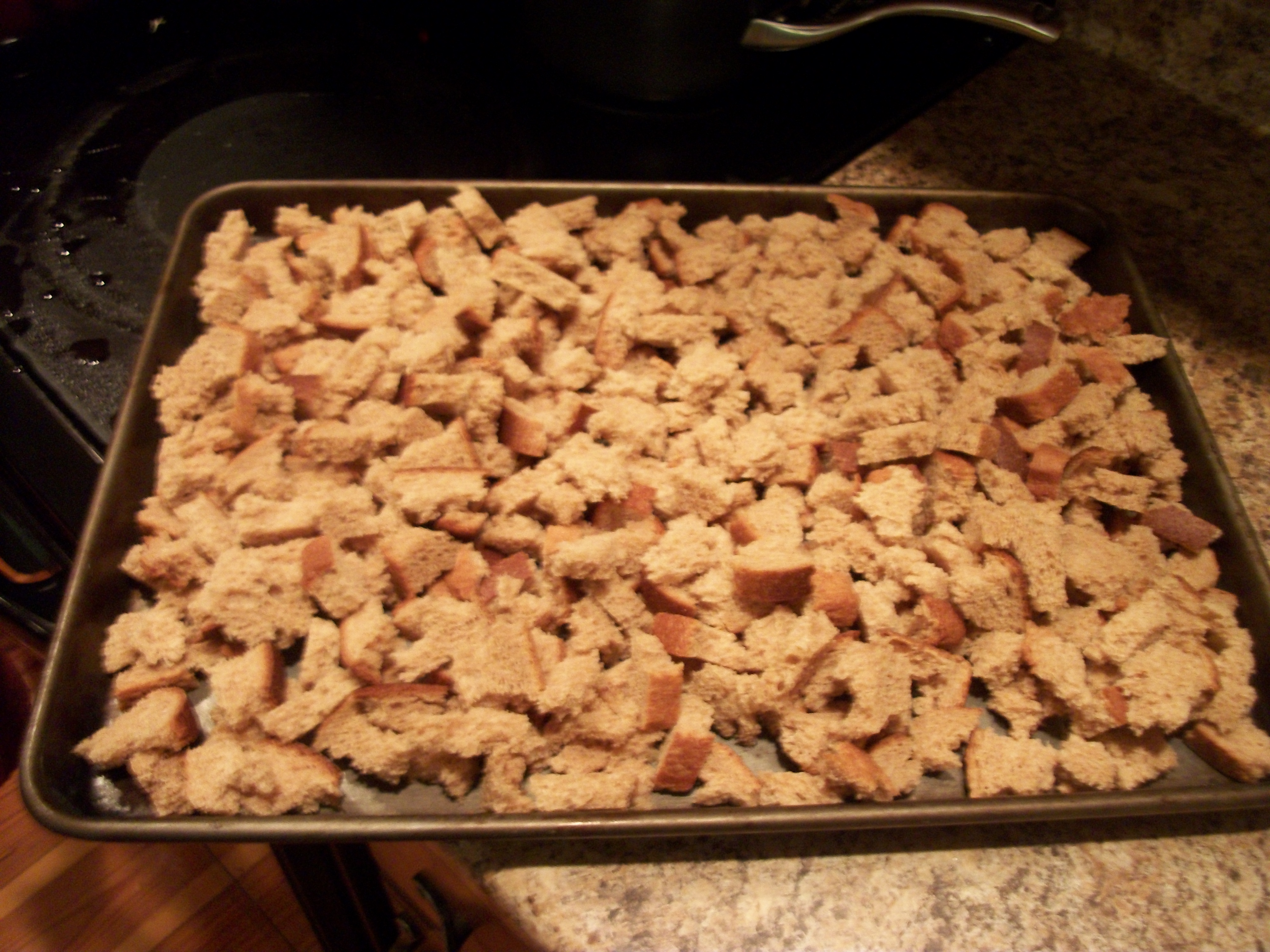
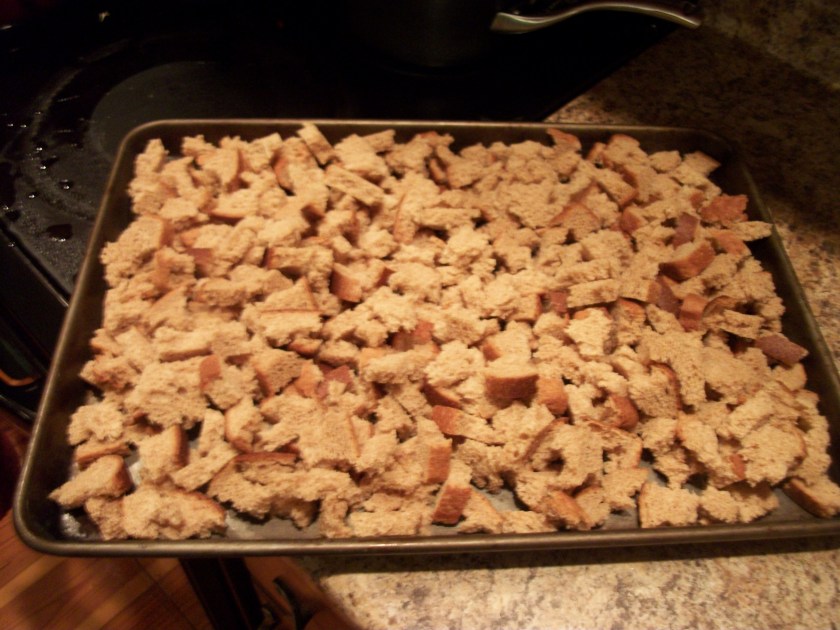
We start drying the wheat bread and cornbread at least four days before Thanksgiving day.  Tear a small loaf of really good wheat bread into small pieces and lay them on a flat pan to dry out.  I start the wheat bread first and the next day bake two pans of cornbread (no sugar please)–using a plain recipe on any cornmeal bag.  Don’t add too much baking powder–this year a batch called for 4 teaspoons–that’s too much.  Don’t add more than two.  If the wheat bread is slow drying, put it into the oven for the night with the oven light on.  If you can preheat a cast iron skillet in your oven for the cornbread, with some butter in the bottom, that makes really good crunchy cornbread for stuffing.

Here’s the torn wheat bread drying out:
Here are the rough ingredients–and this makes a HUGE pan of stuffing–plenty for our 20+ guests–with leftovers.  If I don’t have a huge crowd, I freeze a few large squares for later meals.

1 wheat bread

2 cornbread mixtures baked

Fresh sage to taste–yes, taste the stuffing as you go along when you’re mixing it, and a whole bunch of fresh Italian parsley chopped fine

Sea salt

2 pounds of fresh sausage

18 eggs

2 bunches of celery chopped fairly fine

1 BIG onion chopped fairly fine–1/4-inch pieces or less.  Two if you like onion.  You can tell if you’ve got enough in the mixture.

2 sticks of butter

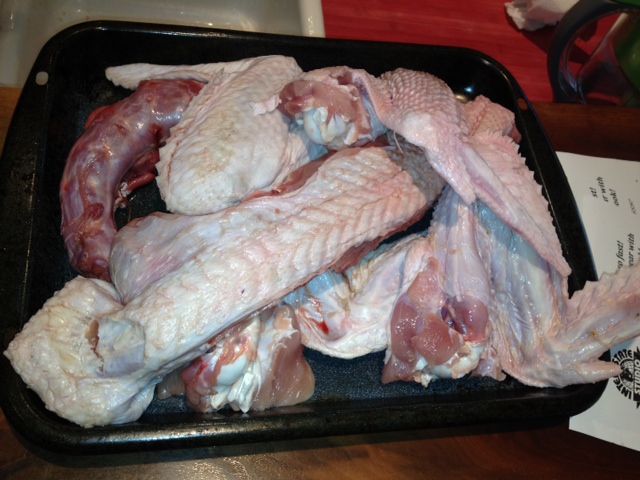
2 quarts of really good homemade turkey/chicken bone broth–we start this broth a few days ahead as well.  Use whatever organs, wings, etc., you can take from the turkey.  This year, Mike cut the turkey into parts to cook it, so I got some lovely bones for the stuffing and gravy stock.  Buy extra turkey or chicken parts if you need to in order to make a good stock.  You need lots of bones.  You can read how to make a good bone broth elsewhere on this blog.  Here’s a picture of the bones we used to make a BIG pot of stock for the dressing and the gravy:

DO NOT MIX dressing up ahead.  It will kill you.  Do not cook it hours ahead.  It will kill you if you leave it out for too long.  It takes about 45-6- minutes to cook a flat of stuffing–so mix it up and put it into the oven as the turkey comes out.

To mix, add all the eggs to all the above ingredients in a VERY BIG BOWL and start adding broth and mixing until everything begins to stick together a bit.  But, don’t get it too wet or it will be gummy.  Put it into pans with 2 to 3-inch sides–the shallower the pan the quicker the dressing cooks, which is not necessarily a good thing–put pats of butter over the top every few inches and cook at 350 degrees until it’s clearly done.

ENJOY!

Turkey Gravy

You need a really good bone broth!  Use can cut off the wings, use the neck, and the organs.  And, you can add extra turkey or chicken parts purchased separately.  Take out the organs (liver and gizzard) after about 30 minutes and chop them fine if you want giblet gravy.  Or, add them about 30 minutes before you want to strain the stock.  Add them back into the gravy at the last.  John’s mother also used the stringy meat from the long-cooked neck, which I love in the gravy.

The proportions are 5 cups of liquid to 1/2 cup each of butter and/or fat and flour.

Salt

The secret is to put the fat and flour in a heavy bottom pan and heat them slowly while stirring and stirring until the flour turns a lovely bisque/tan color.  Add the warmed stock slowly, whisking as you add so you don’t get lumps.  Cook gently until the gravy thickens to where you like it.  You can always thin it if you get it too thick.

The Turkey

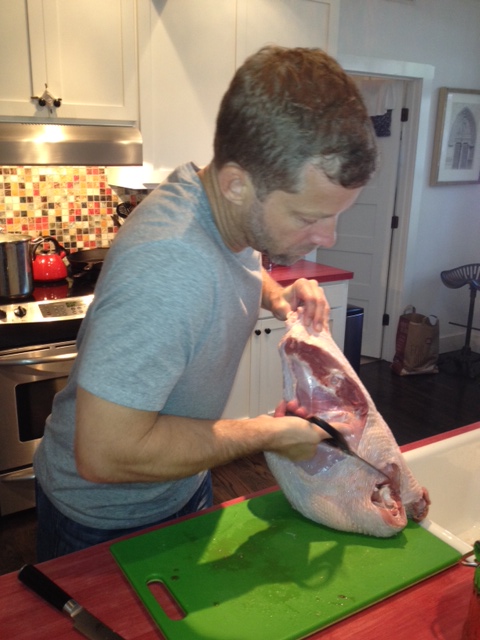
Cooking a turkey is really tricky.  It’s hard to get the legs/thighs done without overcooking the breast.  Mike has evolved a recipe where he removes the legs/thighs in one piece, bones them, and rolls and stuffs them with amazing stuffings that vary from year to year.  This year I tasted pate and chestnuts.  These boned, stuffed legs cook sitting in a rich vegetable broth that we later use for soup.
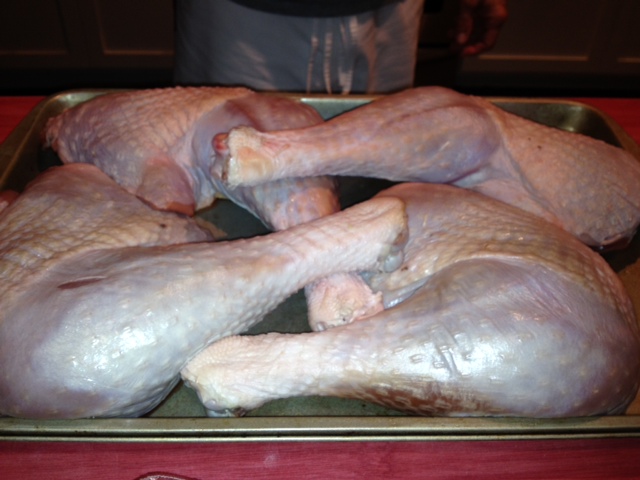
Mike cuts the breasts free and cooks them on his grill, which can heat like an oven.
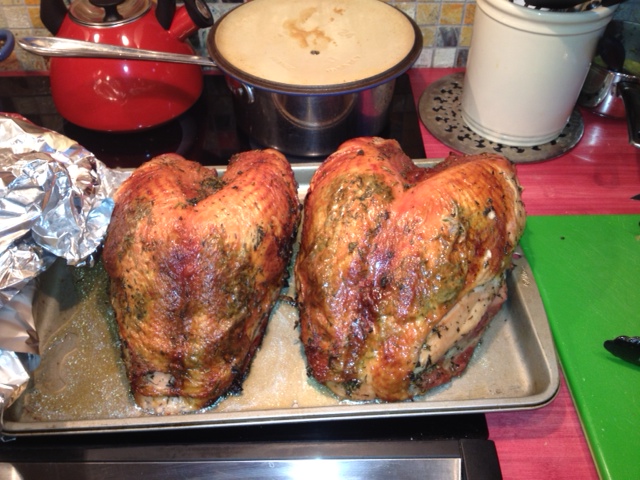
I didn’t get a picture of the cooked rolled legs, but here are the turkey breasts about to be carved.  The meat was very tender and moist:
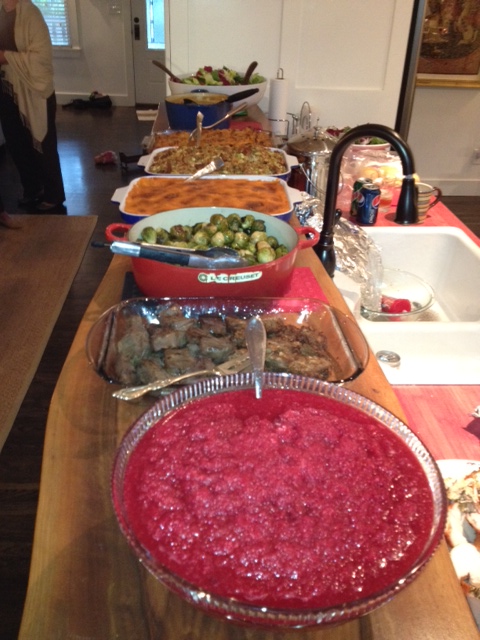
And, here’s the food starting to be lined up for serving:
I was having too much fun to slow down and take a picture of Tami’s beautiful table–which I now regret.  I should have gotten a shot of everyone seated too, but you know how that goes.  Food needs help getting to the line-up, and children need help with plates, and before you know it, the moment is missed.

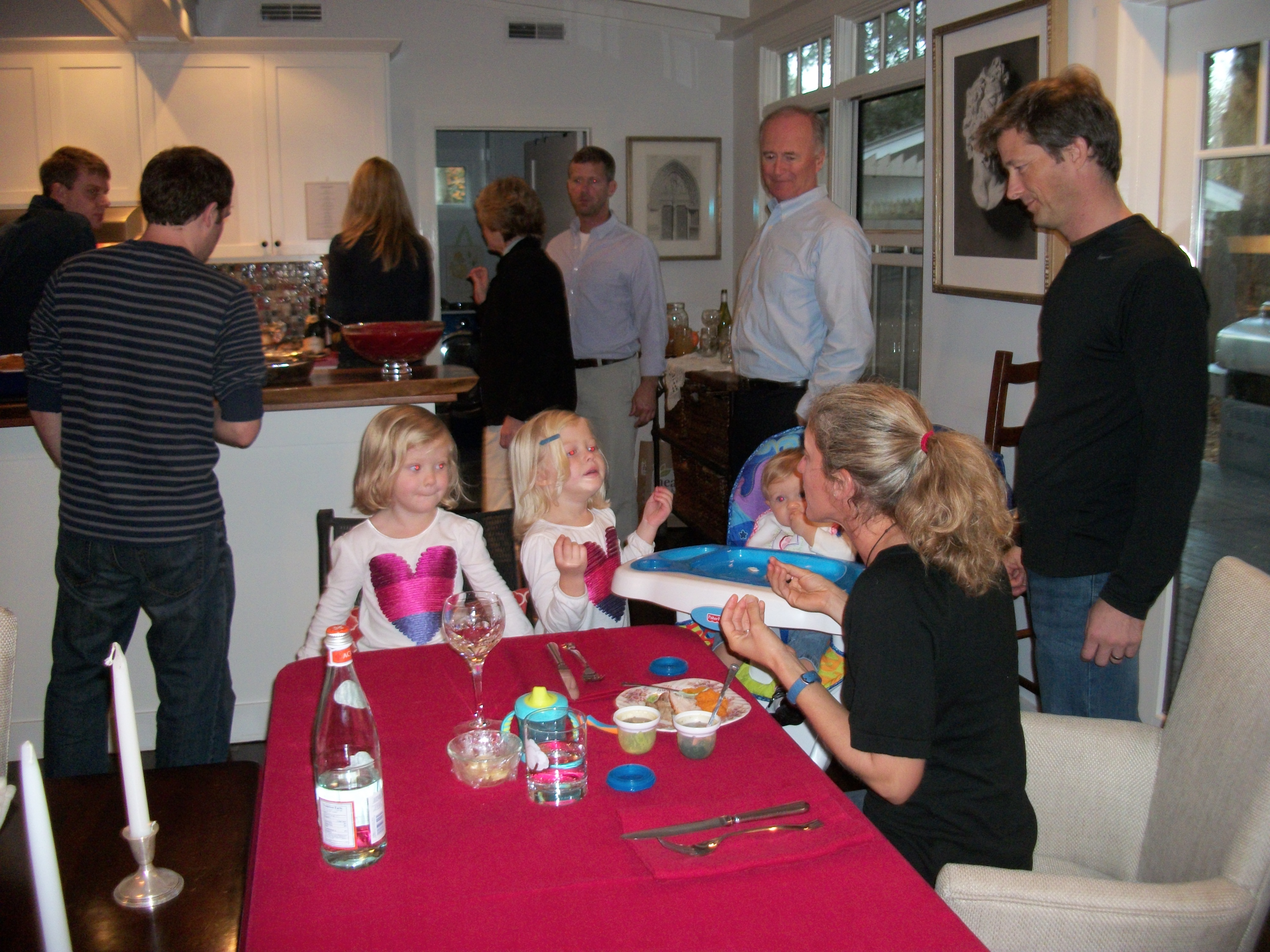
But, here’s one end of the table with Bryan, Corinne, and Ailey (who LOVES to sit in her high chair and eat), with Talula and Wilhelmina:

TURKEY LOVE to all, as Tami says!
Turkey Tracks: Lunch in Wiscasset

Turkey Tracks:  November 18, 2011

Lunch in Wiscasset

The day before we fly out of Portland, Maine, we usually drive the 2 hours south to Portland and spend the night in a Portland motel–where we leave our car during our trip.  The motel takes us to the airport the morning of our flight, and we don’t worry about mishaps getting to the airport and about not having a place to park in the airport parking garage.  We have time to poke around what used to be a Borders Book Store and which is now something called Books A Million, or BAM, and the Maine Mall.  We could, but have not yet, seen a movie.  And, we have dinner out.

We always start out around late morning and have lunch on the road.  This time we stopped in Wiscasset, which calls itself “the prettiest town in Maine.”  It IS a pretty town, and we enjoy spending an hour or so there.  This time we ate at Le Garage, which is at the end of the same street where the restaurant called Sarah’s sits.  Sarah’s, which has lovely fresh food, sits on a prominent corner in Wiscasset–across from Red’s Eats–an outdoor stand that is truly famous for its lobster rolls.  Sarah’s always has three huge vats of homemade soups and platters of homemade bread of many types–alongside many other menu choices–like fabulous pizza.  And, Sarah’s desserts are also fabulous!

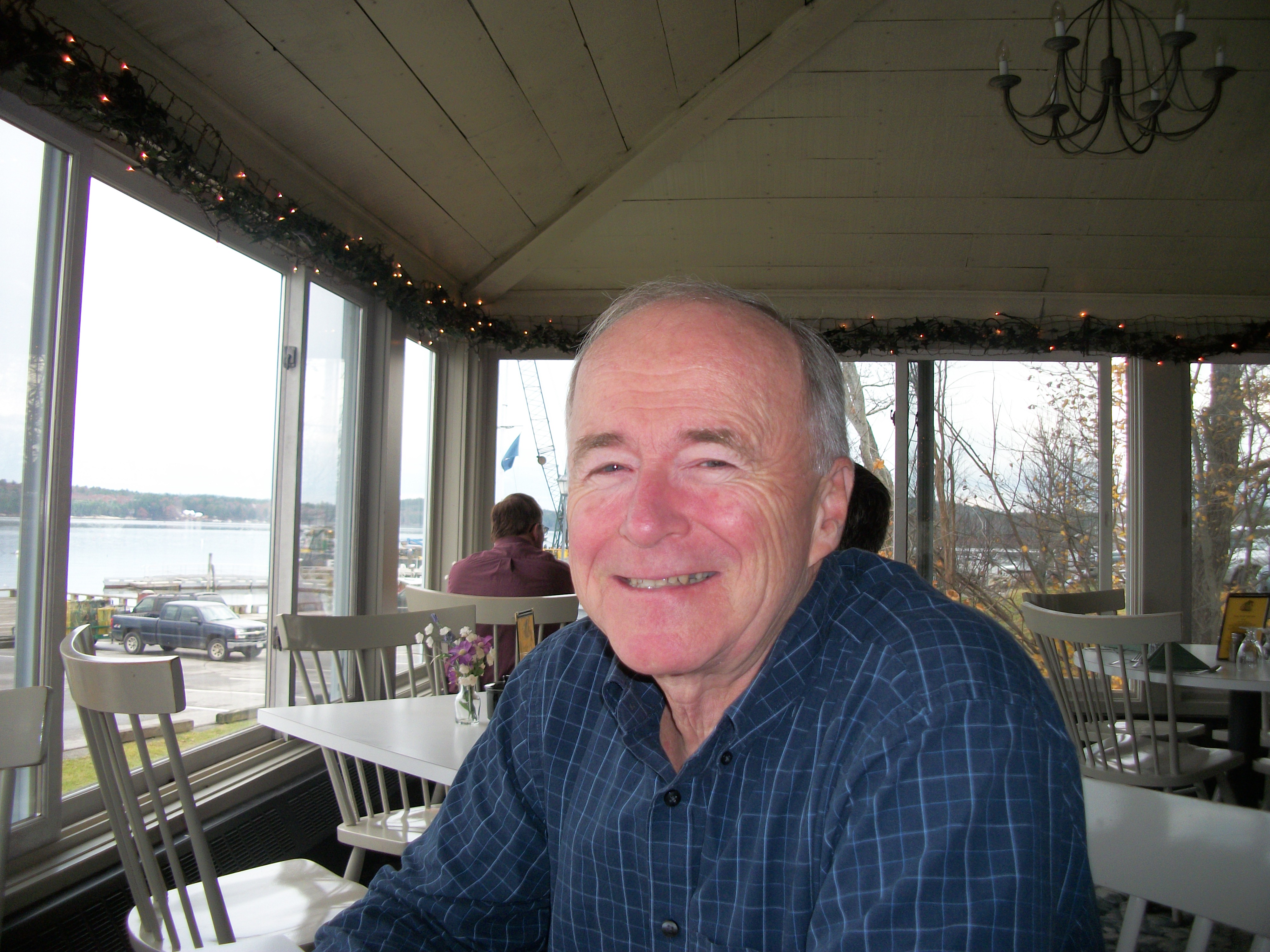
Here’s John inside Le Garage:

Here’s the view from the restaurant windows out over the Sheepscot river.  Most of the lobster boats are now gone, and while we ate, we watched several lobstermen loading hauled traps onto their dockside trucks.

Le Garage is kind of a funny restaurant.  The menu reads really well, but the food that arrives is short of expectations.  For instance, my French Onion Soup had a delicious broth capped with a just-right size of toasted French bread that was coated with lovely melted cheeses.  But, the onions inside the soup had not been carmelized enough, so I was eating square pieces of onion, rather than slivers that should be nearly melting into the broth, that tasted undercooked and harsh.  The expensive dessert crepe, nearly $6, wasn’t tender and soft with a layer of ice cream inside.  Rather, it was as hard as a large, tasteless cannoli, and it was stuffed with way too much ice cream and smothered with a bought, nasty caramel sauce and fake whipped cream.  There’s really no excuse for faked whipped cream in Maine where we can get heavenly real, raw heavy whipping cream.  My salad lettuce was right out of a package–or it seemed that way–and the “lemonade” dressing had no oil in it and was tasteless.

My instinct is that Le Garage could be quite good with just a bit of a push into a more discerning direction.  Certainly, one feels its heart is in the right place…

The railroad tracks go right by the river, which would make for a scenic journey.  Here’s the view just outside Le Grange:

Books a Million, or BAM, is a big bookstore, much like the former Border’s.  Except its political section was so radically imbalanced that we opted not to buy anything in the store.  I’ve never seen so many far-right, highlyl charged texts in one place before.  No wonder large sections of the country are so intolerant of any other viewpoints if they are not exposed to any kind of balance in their reading materials!

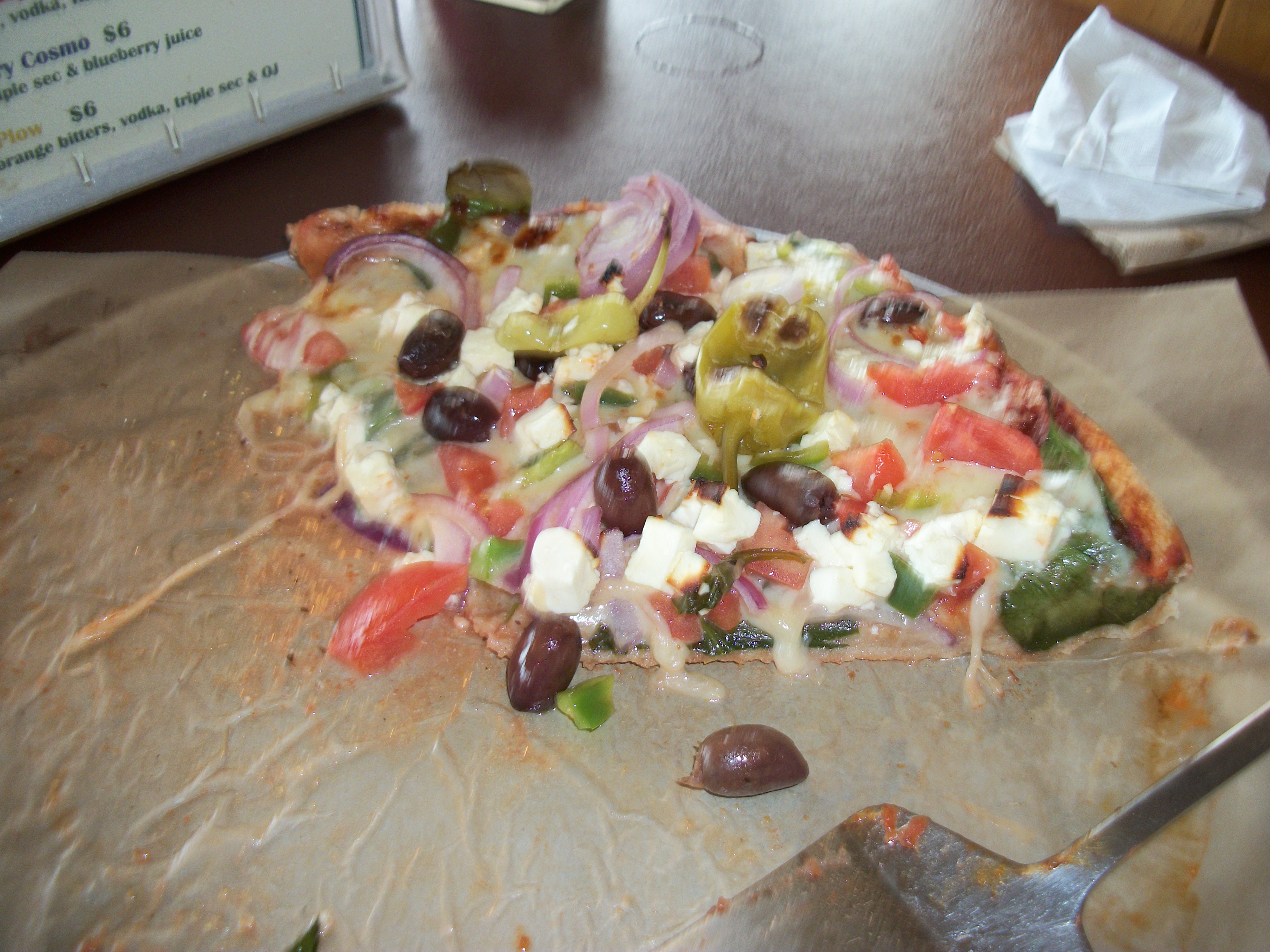
PS:  On our way home, we stopped in Sarah’s for pizza.  Here’s what we took home:

Mainely Tipping Points 37: Statins: Profitable Toxins

Mainely Tipping Points 37

STATINS:  PROFITABLE TOXINS


Stephanie Seneff is a senior research scientist in the EECS (Electrical Engineering, Computer Science) department at the Massachusetts Institute of Technology (MIT).  Her degrees–a B.S. in biology, and an M.S., E.E., and Ph.D. in EECS—were awarded by MIT.  She researches within the interdisciplinary intersections of medicine, computer science, and electrical engineering, or the highly-respected biomolecular discipline.   

Seneff’s article, “Cholesterol:  The Essential Molecule–and The Adverse Effects and Overuse of Statins” (Well Being Journal, November/December 2011, 13-24), is the most complete, chemical explanation I have read of why statins are not a solution to the prevention of heart attacks. Statins, Seneff explains, create a situation where muscles are destroyed and where, eventually, the whole body is seriously at risk. 

Once again, drug industry researchers and medical doctors only looked at one piece of an illness puzzle—prevention of heart attacks–without understanding the actual causes and without acknowledging the long-term impact of their drug (statins) solution.  (Surely they know the harm statins do and are ignoring this harm because statins are so profitable.)  After exhaustive research, Seneff says the following:  “I will…make the bold claim that nobody qualifies for statin therapy, and that statin drugs can best be described as toxins” (13).  And, “I would in fact best characterize statin therapy as a mechanism to allow you to grow old faster” (22).

In addition, the drug industry and doctors have played a game I think of as “medical math.”  Seneff notes that a meta-study reviewing seven drug trials and 42,848 patients over a three- to five-year period did show a 29 percent decreased risk of a major cardiac event.  But as heart attacks were “rare among this group, what this translates to in absolute terms is that 60 patients would need to be treated for an average of 4.3 years to protect one of them from a single heart attack.  However, essentially all of them would experience increased frailty and mental decline….” (14).       

Seneff’s article describes the chemical components within the body when cholesterol is fully present and when it has been compromised.  Her explanations are clear and fully understandable, but complicated.  If you are taking statins or are contemplating them, I urge you to read Seneff’s article.  Meanwhile, I will do my best to synthesize the high points so that you can understand why it is so dangerous to use statins to reduce cholesterol in your body. 

Furthermore, many, many studies—some of them long-term studies—clearly show that people—and especially women–with high cholesterol counts live longer than those with low cholesterol counts.  This information is readily available, and it is a mystery to me why our doctors continue to ignore it.

 Statins interfere with the synthesis of cholesterol, a nutrient, explains Seneff, that has been demonized by the drug industry and doctors, but which is essential to human health.   “Cholesterol is absolutely essential to the cell membranes of all our cells, where it protects the cell not only from ion leaks but also from oxidation damage to membrane fats” (14).  Reducing cholesterol “places a much bigger burden on the body to synthesize sufficient cholesterol to support the body’s needs, and it deprives us of several essential nutrients” (14).       

Further, Seneff notes, “there are three distinguishing factors that give animals an advantage over plants:  a nervous system, mobility, and cholesterol.”  Cholesterol, which is “absent from plants, is the key molecule that allows animals to have mobility and a nervous system” (14). In a nutshell, when statins reduce cholesterol, they force the body to jerry-rig alternative chemical systems that lead eventually to body-wide damage (20).

One mythology today is that elevated serum levels of LDL (low density lipoprotein) cholesterol is a problem.  But, Seneff explains, “LDL is not a type of cholesterol, but… [is] a container that transports fats, cholesterol, vitamin D, and fat-soluble anti-oxidants to all the tissues of the body.”  Because these nutrients are not water-soluble, they “must be packaged up and transported inside LDL particles in the blood stream.”  Thus, “if you interfere with the production of LDL you will reduce the bioavailability of all these nutrients to your body’s cells” (15).

The LDL package, explains Seneff, is “vulnerable to attack by glucose and other blood sugars, especially fructose.”  If “gummed up” by sugars, “the LDL particles become less efficient in delivering their contents to the cells,” they “stick around longer in the bloodstream,” and the “measured serum LDL level goes up” (15).  But, worse, after the LDL particles have delivered their contents, they “become small dense LDL particles, remnants that would ordinarily be returned to the liver to be broken down and recycled.”  However, “the attached sugars interfere with this process…so the task of breaking them down is assumed instead by macrophages in the artery wall and elsewhere in the body.”  These “small dense LDL particles become trapped in the artery wall so that the macrophages can salvage and recycle their contents, and this is the basic source of atherosclerosis” (15). 

The liver, explains Seneff, produces the LDL particles.  Statin therapy “greatly impacts the liver, resulting in a sharp reduction in the amount of cholesterol it can synthesize.”  Also, the liver breaks down fructose and converts it into fat.  So, when there is a lot of fructose in the system, the liver becomes burdened with the task of converting it to fat and cannot “keep up with the cholesterol supply.”  Both conditions mean that “fats cannot be safely transported”(16).

Additionally, as the liver is burdened with handling the fructose, “it produces low quality LDL particles” (16).  So, harmful chain reactions begin to occur, such as the following:  fructose builds up in the blood stream, which causes more damage; the skeletal muscle cells are severely affected; and the brain, which houses 25 percent of the body’s cholesterol, is impaired.  Diabetes and arthritis are also associated with statin therapy (19, 21).   

When overburdened, the liver shifts the processing of excess fructose to the muscle cells, explains Seneff.  The muscle cells themselves begin to use an alternative fuel source that requires an abundance of fructose and which allows the production of lactate, which is a high-quality fuel for the heart.  This desperate production of lactate is why statin therapy can lead to a “reduction in heart attack risk.” (17).

But, continues Seneff, “the muscle cells get wrecked in the process” (17).  In effect, the muscles “can no longer keep up with essentially running a marathon day in and day out.”  The muscles “start literally falling apart, and the debris ends up in the kidney, where it can lead to the rare disorder rhabdomyolysis, which is often fatal” (20).  The drug industry readily admits to muscle pain and weakness with statin use (17).

The dying muscles also “expose the nerves that innervate them to toxic substances, which then leads to nerve damage such as neuropathy, and ultimately amyloid lateral sclerosis (ALS), also known as Lou Gehrig’s disease, a very rare, debilitating, and ultimately fatal disease that is now on the rise due (I believe) to statin drugs” (20).

Also, as the cells struggle with ion leaks caused by insufficient cholesterol, they begin to replace a potassium/sodium system with a calcium/magnesium-based system.  The result is the “extensive calcification of artery walls, heart valves, and the heart muscle itself.”  Indeed “research has shown that statin therapy leads to increased risk of diastolic heart failure” (20). 

Seneff is very interested in the role of cholesterol sulfate.   Cholesterol sulfate is “very versatile.  It is water soluble, so it can travel freely in the blood stream, and it enters cell membranes ten times as readily as cholesterol, so it can easily resupply cholesterol to cells” (24).

Cholesterol sulfate, explains Seneff, is produced by the skin in large quantities with sun exposure.  Seneff  thinks that “the natural tan that develops upon sun exposure offers far better protection from skin cancer than the chemicals in sunscreens.”  And, Seneff thinks we should eat foods “rich in both cholesterol and sulfur”—“eggs are an optimal food, as they are well supplied with both of these nutrients” (24).     

To avoid heart disease, Seneff suggests cutting back on fructose intake, eating whole foods instead of processed foods, and eating foods which are good sources of lactate (sour cream, yogurt, and milk products in general).  (One can use goat-milk products if cow’s milk is a problem.)  Strenuous physical exercise helps “get rid of any excess fructose and glucose in the blood, with the skeletal muscles converting them to the much coveted lactate” (23) 

Seneff further advises:  “spend significant time outdoors; eat healthy cholesterol-enriched, animal-based foods like eggs, liver, and oysters; eat fermented foods like yogurt and sour cream; eat foods rich in sulfur like onions and garlic.  And, finally say `no-thank-you’ to your doctors when they recommend statin therapy” (24).

Turkey Tracks: Charleston Bound

Turkey Tracks:  November 15, 2011

Charleston Bound

Time has moved forward, and the day has come when we start leaving for Charleston.  We are anticipating a delicious visit with our two sons’ families.  I say start leaving because today we will drive to Portland, ME, which is 2 hours away, where we will stay in a local Comfort Inn very near the airport.  They will get us to the airport for our flight tomorrow and will keep our car while we are gone.  No worries that way.  No stressing about getting to the airport on time and about finding a parking spot when you’re on a short leash in terms of time.  We’ll poke about the mall, have dinner nearby, get a good night’s sleep, and enjoy having nothing to do but enjoy ourselves.  Isn’t that what a vacation is all about?

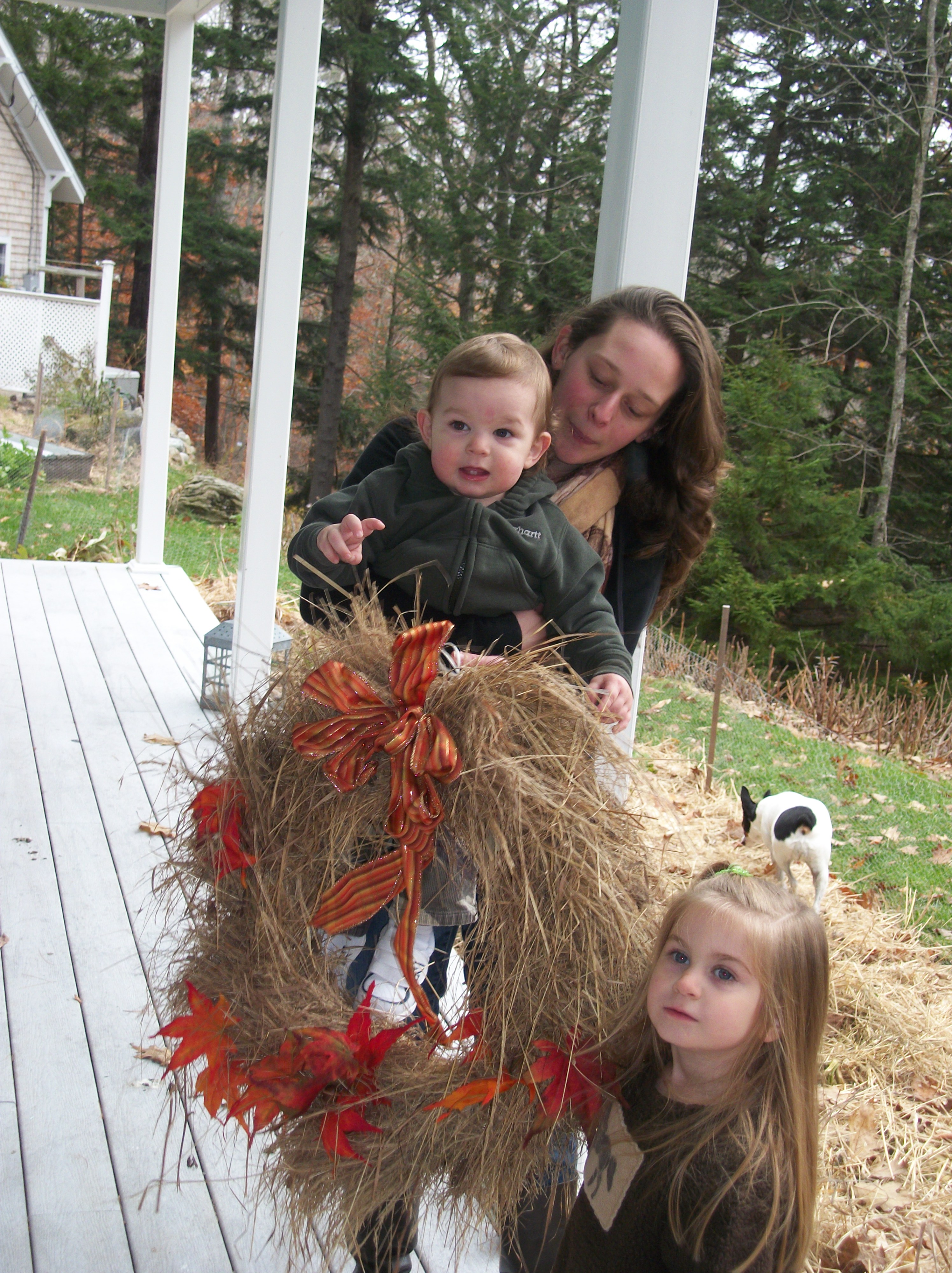
The house, dogs, and chickens will be in the capable hands of Jessica Pendleton–who now has two adorable children:  Mariah and Eli.

It has been a true pleasure to watch this young woman meet the right man, agree to raise his little girl, have a child of her own, move into their own house, and become a wonderful mother.  You go, Jessica!

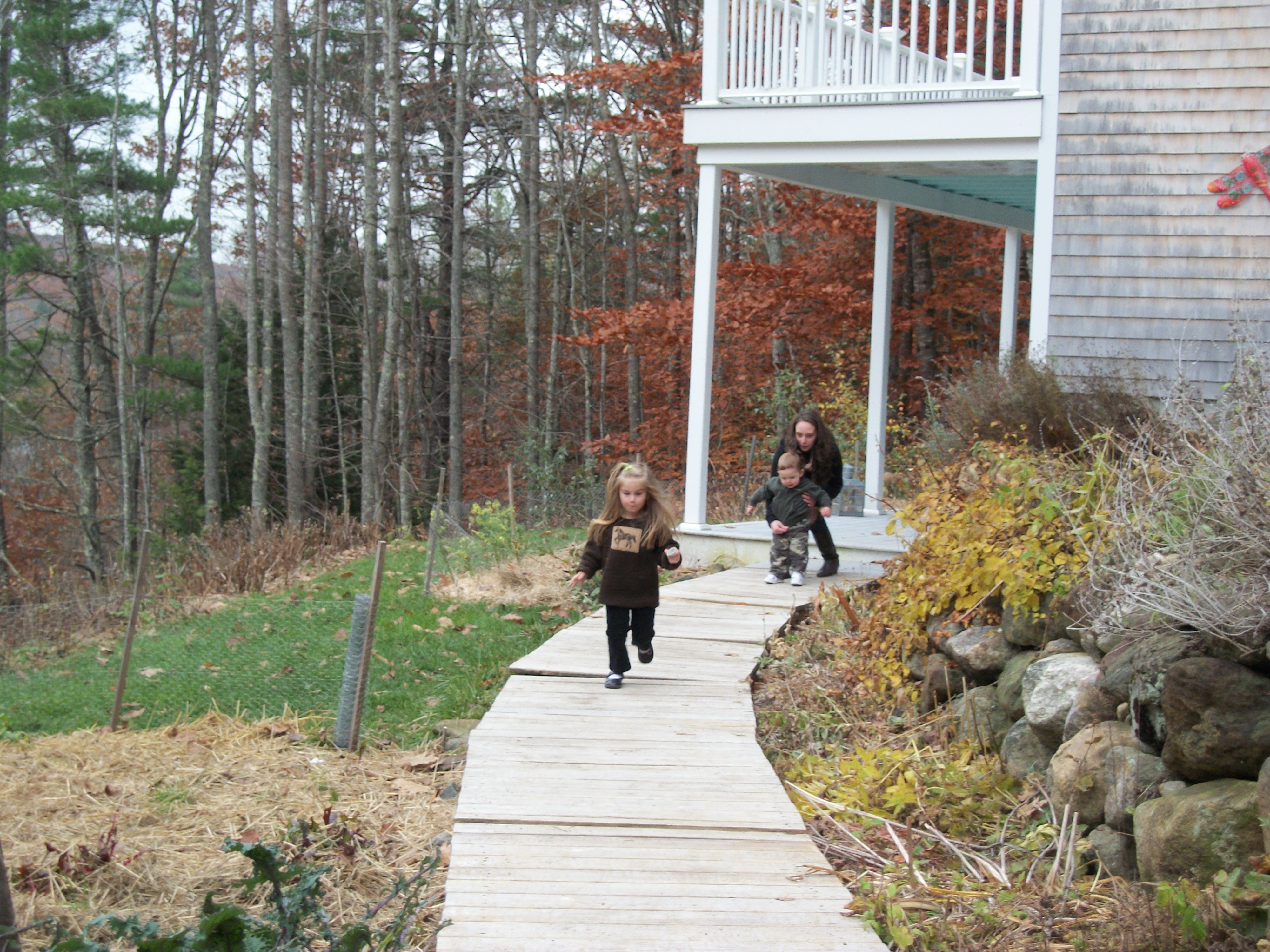
Here they are running the boardwalk:

Eli gradually worked up his courage to step over the cracks rather than crawl over them.

Here’s Mariah peeking around the corner of the house from the top of the bench that stores bird seed and chicken bedding:

She LIKES the chickens and is fascinated about getting eggs out of the chicken coop.

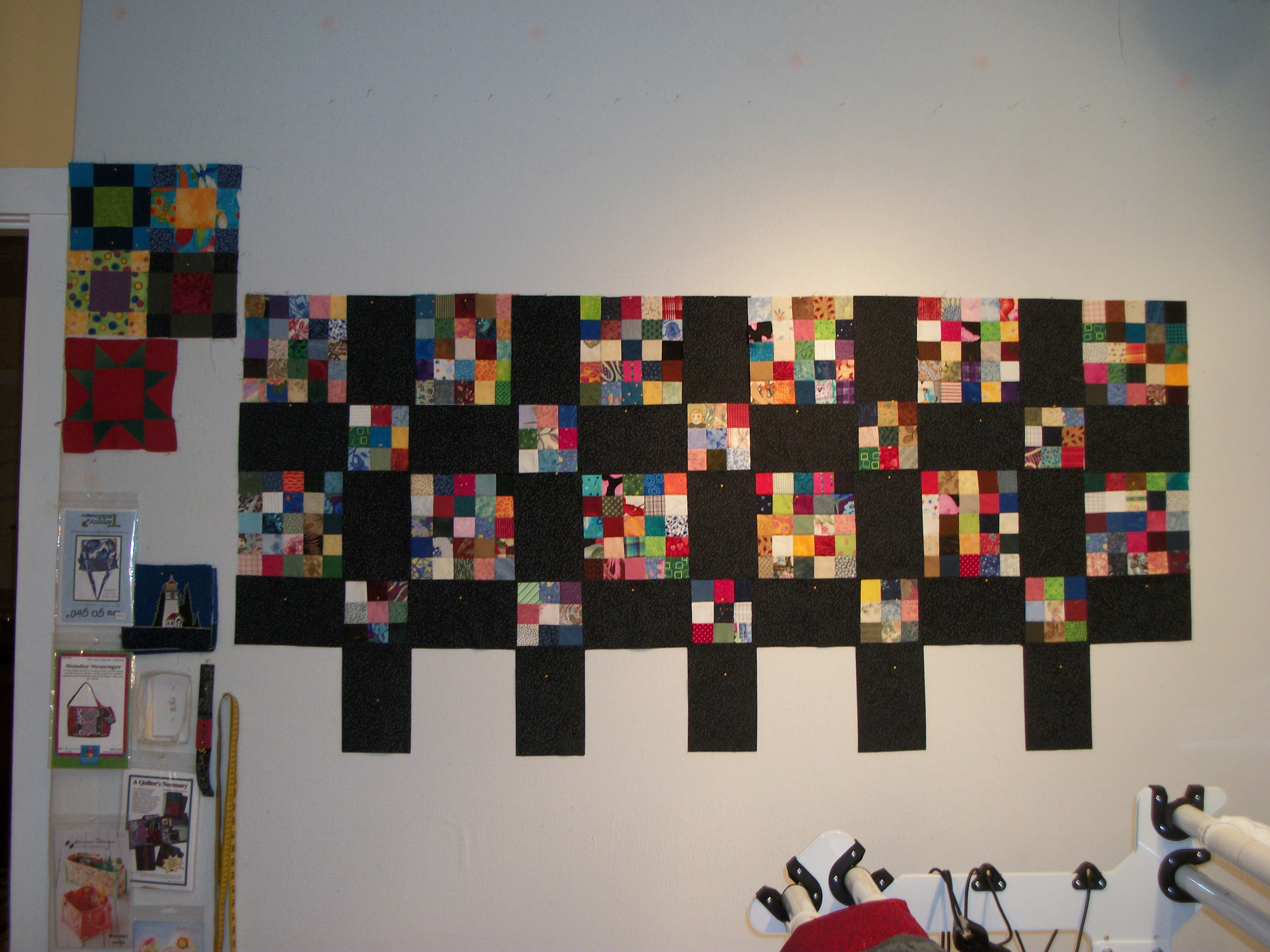
Here’s what I’m leaving behind–an in-progress quilt:

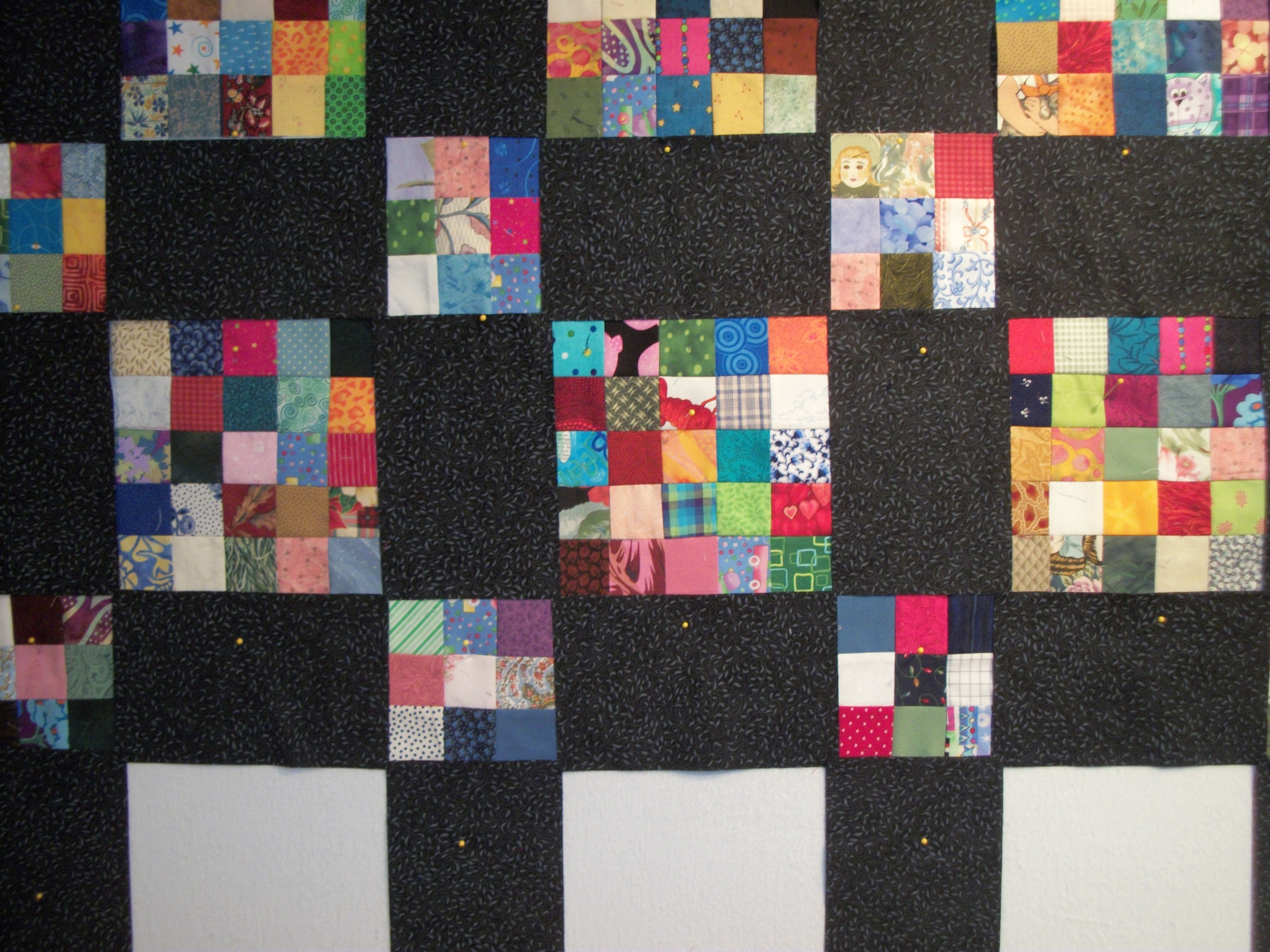
This quilt, which may be called “Two Bits,” is being made from the 2-inch blocks I’ve been cutting out for the past ten years.  Whenever I finishe a quilt, I take any small leftover pieces and cut them into the largest squares I can–up to 6 1/2 inches.  I now have two bags of 2-inch squares, so when I saw this idea for using them–I’ll do a proper citation when I finish, but I think the pattern was in American Patchwork and Quilting, and I know it was called “Mourning Glory”–after the type of heritage fabric.  Basically, black or white or tan can all operate as neutrals, and that’s what’s going on here.

Here’s a detail:

So, John is waiting downstairs, so I ‘ve got to close.  The computer is going to Charleston, so I’m sure I’ll post from there.

Turkey Tracks: Sun, Sea, Sand Quilt

Turkey Tracks:  November 15, 2011

Sun, Sea, Sand Quilt

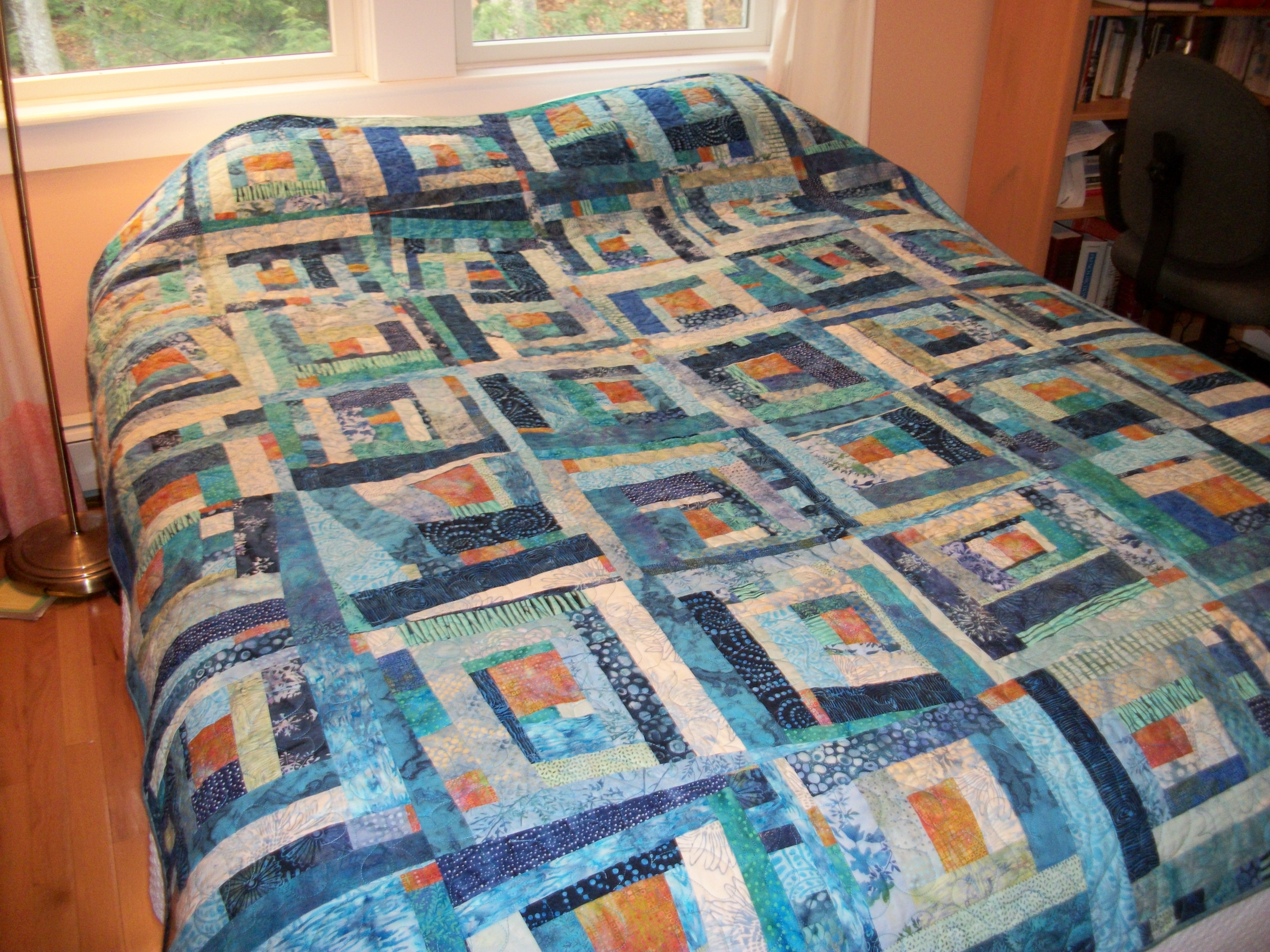
Well, here it is all finished–a La La Log Cabin method, as designed by Rhea Butler of Alewives Quilting in Damariscotta Mills, Maine.

Basically, you start with a funky center, build out, and trim up your blocks to a set size.  I trimmed these at 12 inches.

This kind of quilt is a fabulous way to knock back your stash–and I’m on a mission to do that these days.  For every quilt I plan and BUY, I’m trying to make–at least the tops–out of my stash–where many beautiful, beautiful fabrics reside.

This quilt is made entirely out of batiks.  I did buy the backing, which I loved at first sight.  But I got the fabric 20% off–thanks to a sale at Alewives!

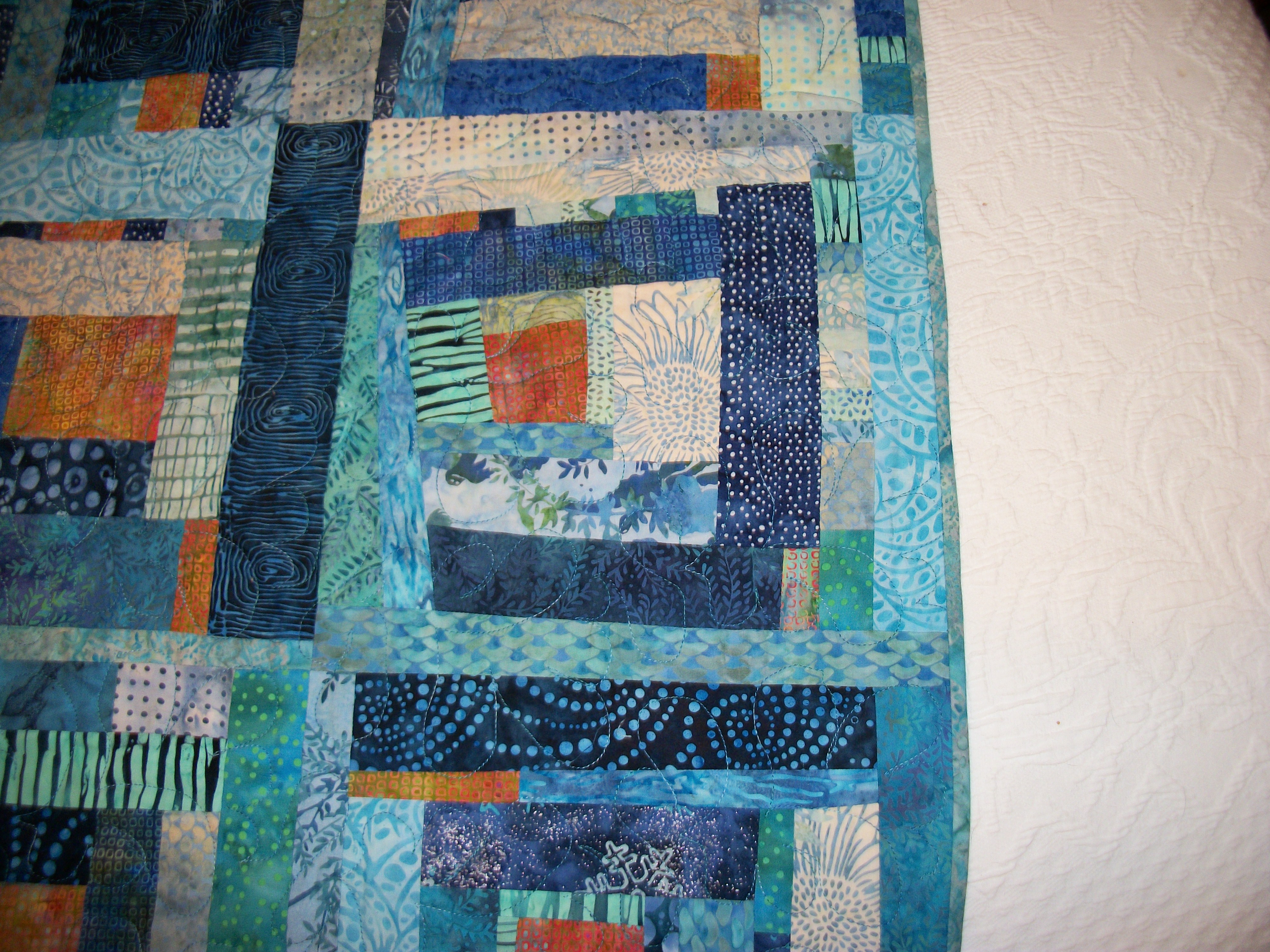
Note, too, the light binding.  I almost always finish with a dark binding, but this quilt seemed to want to just keep going and not be bound by a dark line…   It’s certainly full of good, good energy, isn’t it?

Here’s a close up of the binding effect:

Here’s a close-up detail:

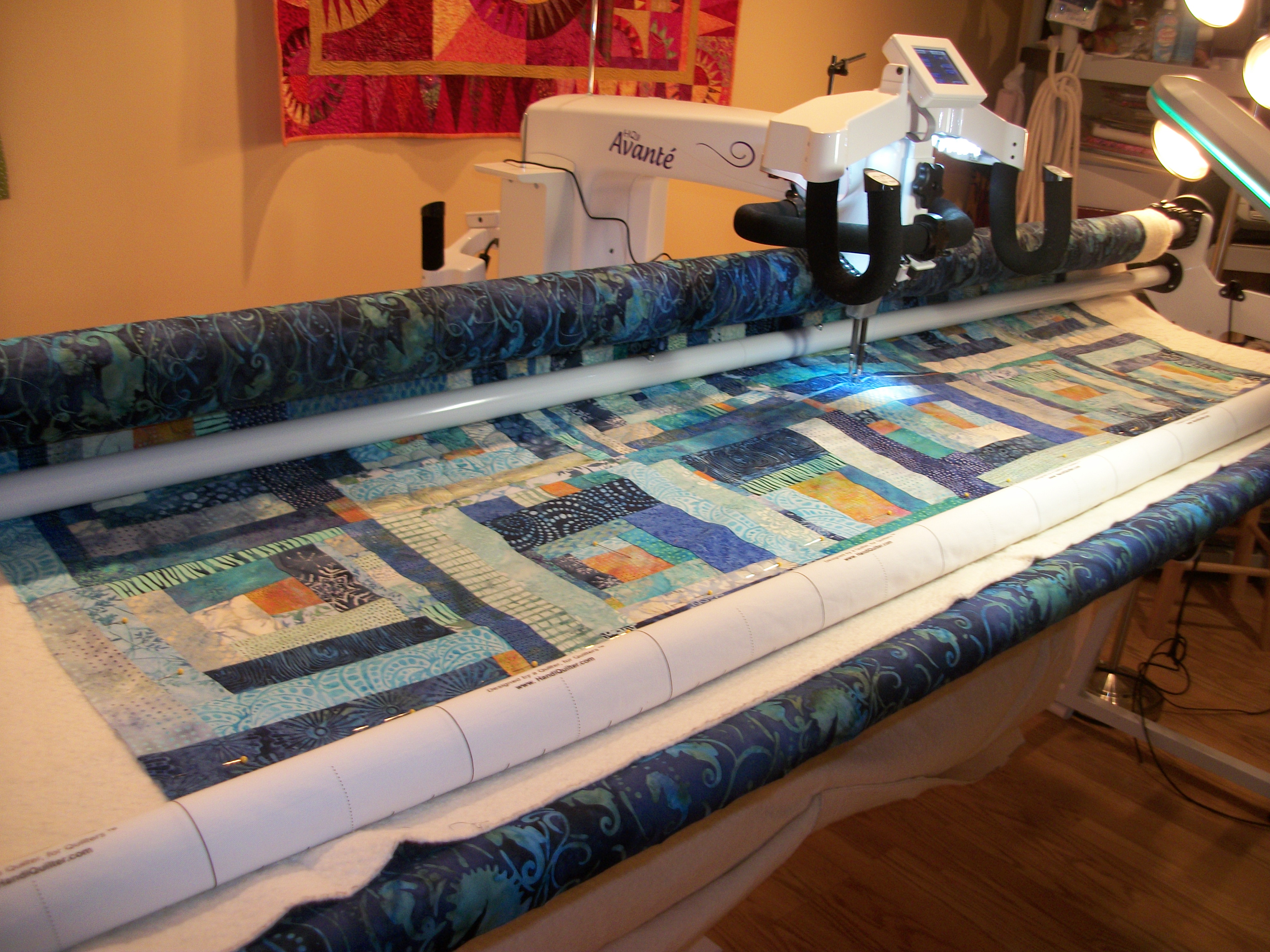
And, here’s what the long-arm looks like with a quilt loaded and being quilted:

One can quilt from the front of the machine–which one does if one is working with templates or one’s own designs.  If one is working from a paper pattern–called a pantograph–the quilting is done from the back of the machine.  One follows the pattern with a laser light beam.

I wanted a quilting pattern that was curvy, since there are so many straight lines in the quilt.

Lucy is a Handi-Quilter, Avante.  She has an 18-inch throat, which gives me lots of room for big patterns.  And, it means one doesn’t have to roll up the quilt so often.

I love this machine.  The learning curve has been awesome–and I’m only now feeling like I’m getting some bit of competency.  Working with a long-arm is very different from working with a domestic machine.  I still struggle with getting the tension to behave–but that’s a learning curve, too.  The bobbin adjustments are opposite a domestic machine, for one thing.  But, I learn nothing more than learning all about something new–so I’m quite happy.  And, of course, my ability to make LOTS of quilt tops–I LOVE TO PIECE–is getting fed every day.


Turkey Tracks: Pie Pumpkins and Pie

Turkey Tracks:  November 13, 2011

Pie Pumpkins and Pie

The best pie pumpkins are long–like a huge salami.  They’re dark green that starts to turn orange in patches–they turn orange when you cook them.

I usually get one from our CSA, Hope’s Edge.  And I buy a few more, roast them, and freeze the meat–for winter pies.  Organic, of course.

Just slice the pumpkins in half, scoop out the seeds, put them on a shallow pan that has some sides–the roasting pumpkins can give off juice–and roast them for at least an hour at 350 degrees.  You’ll know when they are done–they’ll smell delicious and will fork easily.  Let them cool, scoop out the meat, and freeze or make a pie.

It takes about 2 cups of pumpkin to make a 9 or 10-inch pie.  Each of these halves makes about two cups.  Convenient, huh?

My favorite recipe comes from NOURISHING TRADITIONS, by Sally Fallon and Dr. Mary Enig.

Start with a flakey pie crust of your choice.  (Use butter or really good lard–not any of those fake fats like vegetable lards or margarine.)

2 cups pumpkin

3 eggs–if small, use 4 eggs

3/4 cups rapadura–which is dried cane juice.  I also use organic sugar.  The rapadura has a stronger taste, but the pumpkin can take it.

1 tablespoon fresh grated ginger

1 teaspoon cinnamon

1/4 teaspoon each salt, powdered cloves, nutmeg

grated rind of lemon

1 cup piima cream, or creme fraiche–piima is a cultured cream.  You could also use sour cream.

2 tablespoons brandy

Mix everything together well, pour into your pie shell, and bake at 350 degrees for 35-45 minutes.  The time will depend on the size of your eggs and the liquid in your pumpkin.  I used 3 small eggs, and the pie took more like an hour to puff in the middle.  If it takes longer, cover the  pie with some parchment paper to prevent burning.  (Don’t use aluminum foil!  For anything!!)

 This pie is as light as a feather and absolutely delicious.

Serve with REAL whipped cream.

Turkey Tracks: Blueberry Jam

Turkey Tracks:  November 13, 2011

Blueberry Jam

Talula is coming for Christmas.

Talula loves blueberry and blackberry jam.

This year she’s going to get POPOVERS with her homemade jam.

Popovers are dead easy:

Put the following combination of flour, eggs, milk, and salt into a blender, blend it up, and pour the mixture into butter-greased TALL popover forms–filling each 3/4 full.  (If you don’t fill the form 3/4 full, the resulting popover is mostly air inside the crust, rather than having a middle that is still soft and yummy and altogether satisfying.)  I have two popover pans, each with 6 forms.  They look like big muffin tins–only each stands alone since the rising popover needs a lot of space around it.

This recipe is for about 9-10 popovers.  You can halve it, or add to it, for 12 popovers.  If you like cheese popovers, throw some cheese in–about a cup I’d say, for 6 popovers.

4 eggs, 2 cups of AP flour, 2 cups of milk, some salt.

For 12, I’m going to try 6 eggs, 3 cups each of flour and milk, and salt.

Easy, right!

Yes, it’s a white flour-based recipe, but I use really good eggs and our raw milk, so I think it’s ok to have popovers as a special treat.

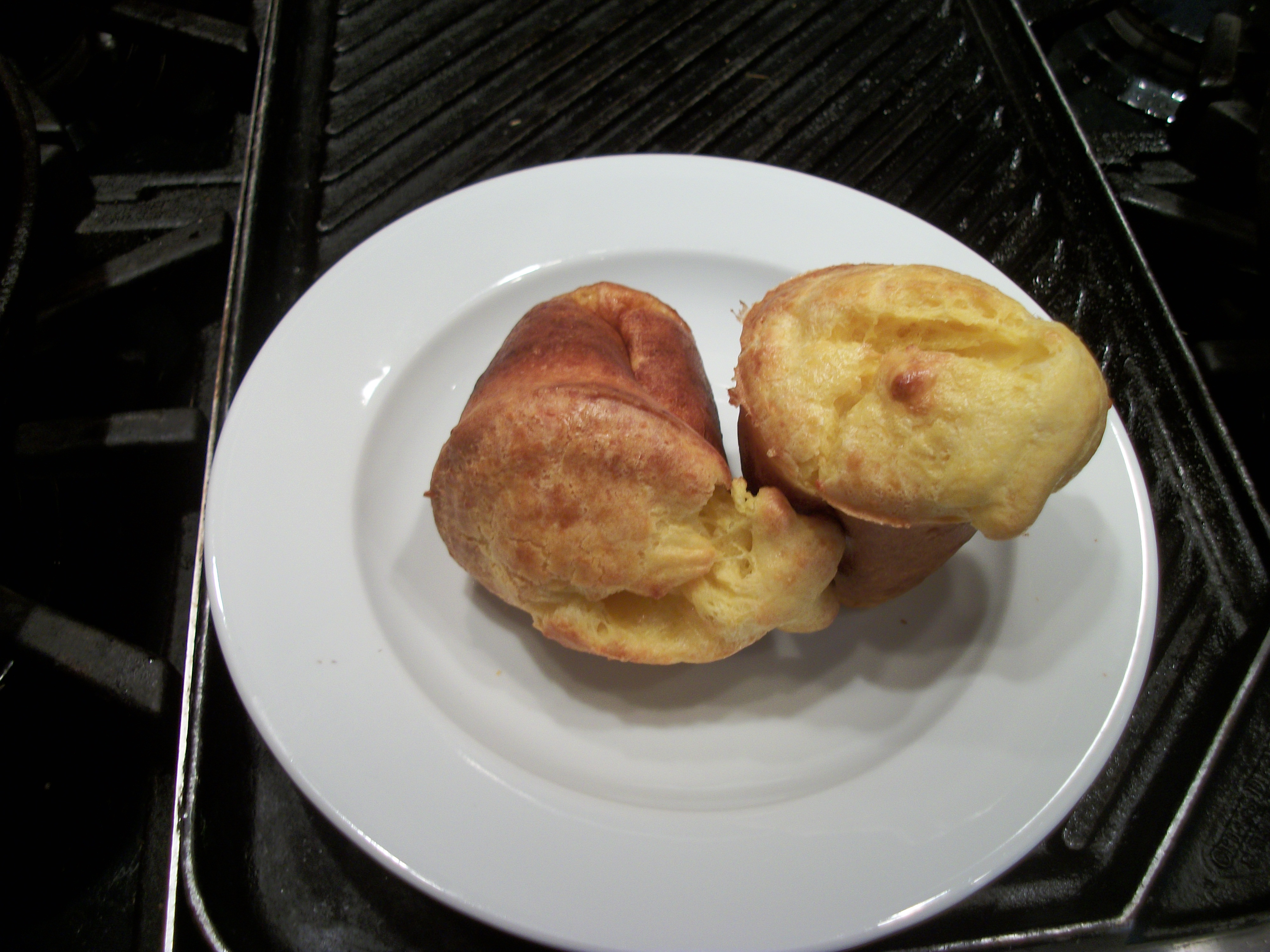
Here’s a picture of cold cheese popovers–which we ate with our dinner after having their mates for breakfast.   They do shrink a bit when cooling.  So, eat them HOT–and 2 of them with butter and jam is a filling breakfast.

As for the blackberry jam–there is one jar to spare before next summer, when there will be one more.  Talula comes in July, and the blackberries are ripe in August, so we have to hoard and parcel out what’s left of the jam on hand–especially since 2010 was very dry and as this year we didn’t get any blackberries as it was the year to cut back the patch and let it grow anew.a

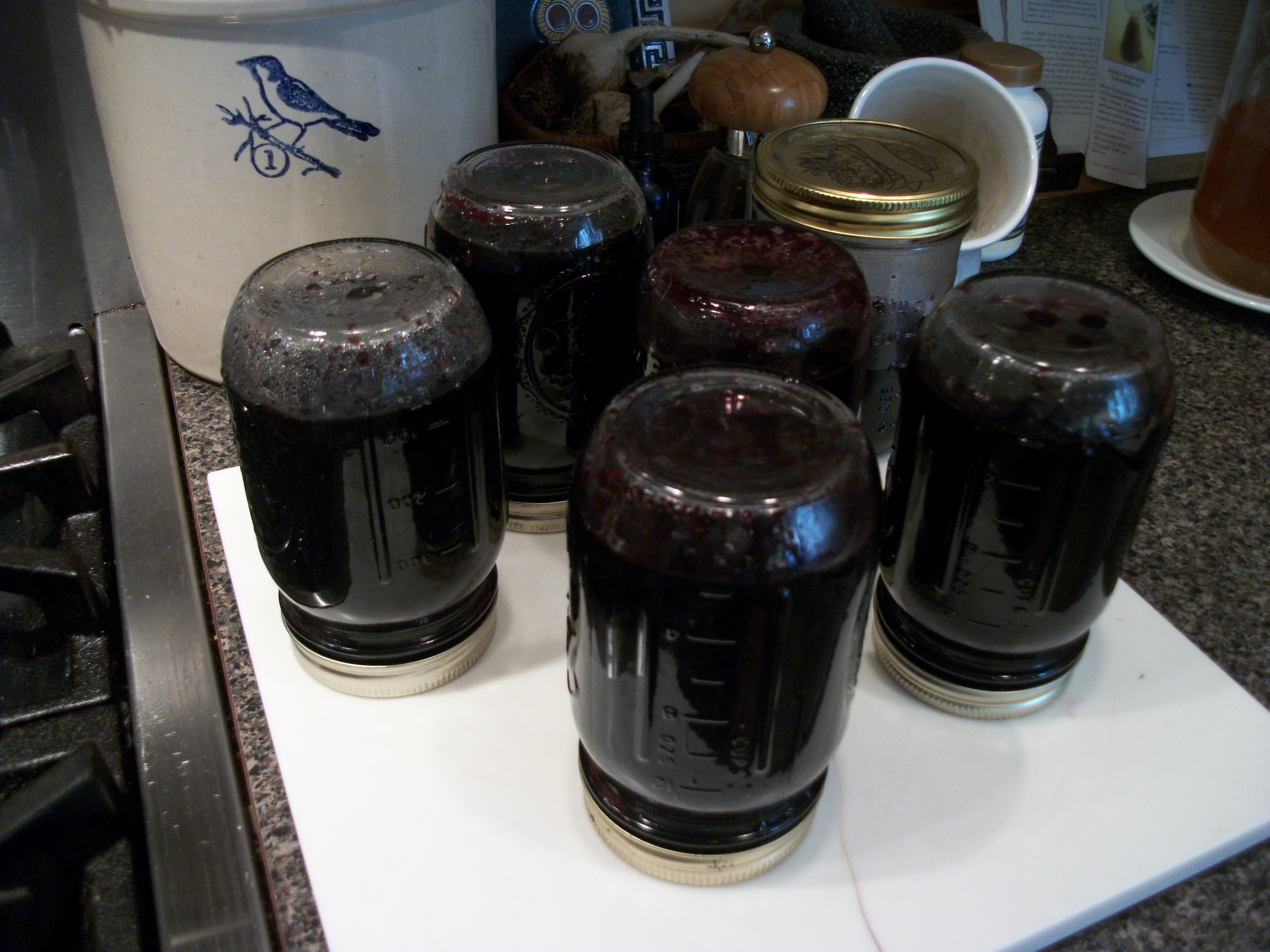
As for blueberry jam, I’m all set for Talula–and her father, mother, brothers, and sister:

Making blueberry jam is easy.

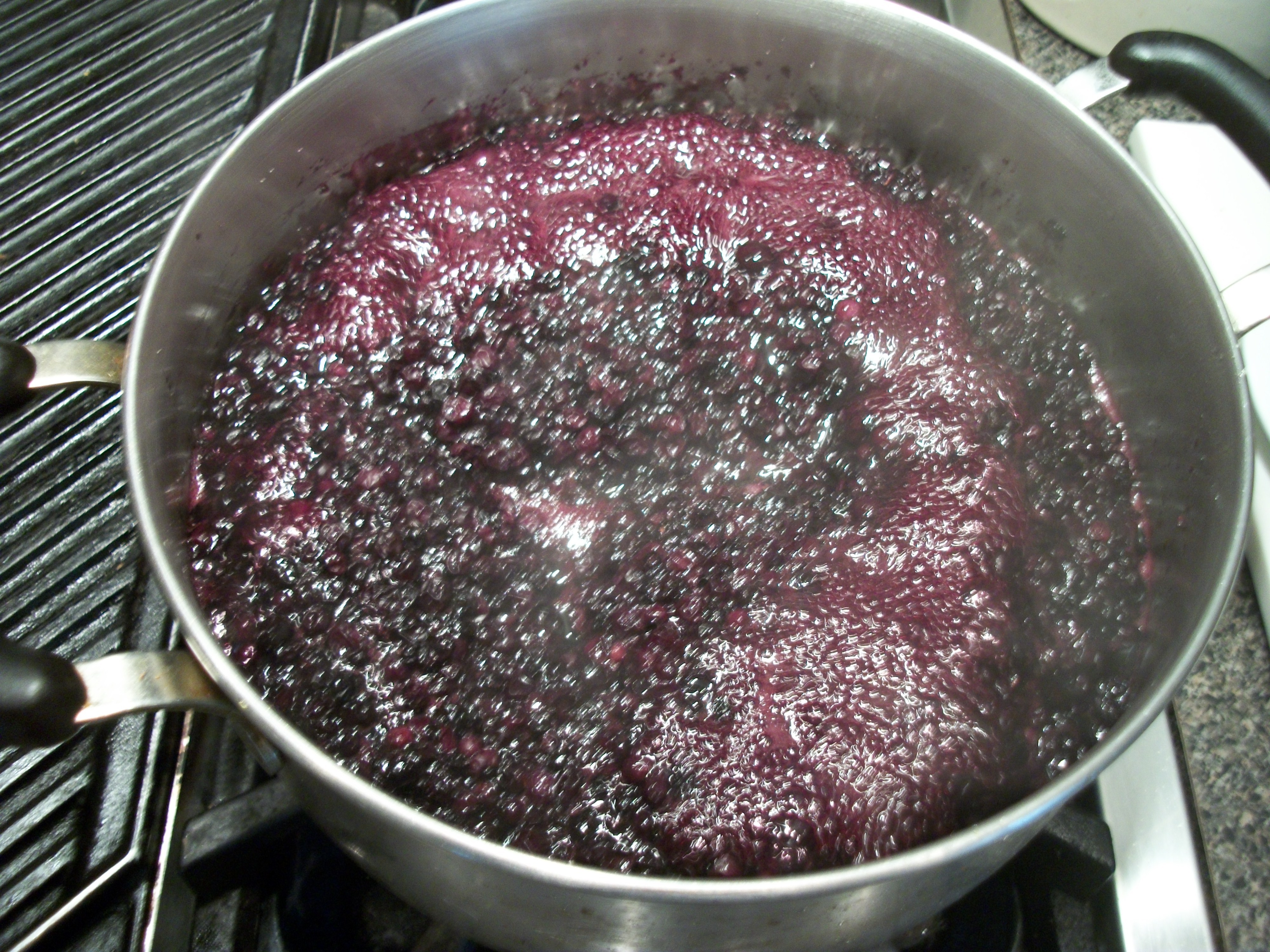
You just fill a heavy pan about 1/2 full of organic berries.  (We have the tiny, very flavorful Maine blueberries–and you can take “wild” out of that title since they are VERY cultivated.)  I use about a cup of sugar to 3-4 cups of berries, and I grate in the rind of one lemon for a batch this size.  Sometimes I add the juice too, but go slow as the mixture can get very lemony.  Taste the jam as you go along–if it isn’t sweet enough, add more sugar.  But, start with less since too much sugar really ruins the whole batch.

Then, you just cook it down until the juice begins to jell on the spoon you use to stir it with every now and then.  You can see that the mixture is bubbling pretty hard.  Let some of the juice dribble on a plate, let it cool, and you can tell if the juice is starting to thicken up.  You really don’t want blueberry jam to get too thick, so I fall off on the side of a looser jam that isn’t overly cooked to death.   (With blackberries, I am more particular and do use a candy thermometer–but that involves figuring out what the jam point is in your area, which involves how above sea level you are, and so forth.  Any good canning book–like the Ball Canning Book–can walk you through that exercise–and it is a good thing to do.)

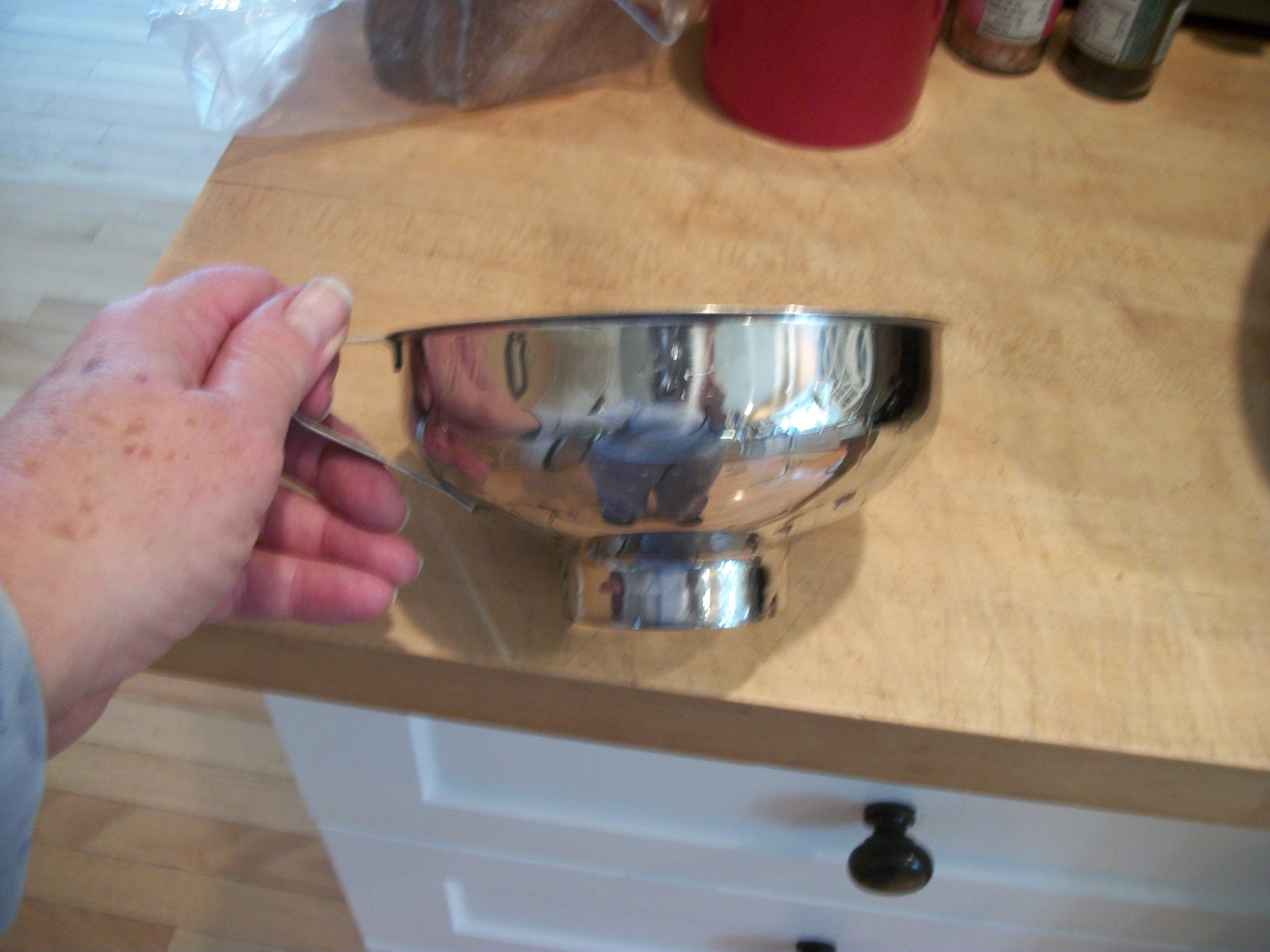
It really helps to have a canning funnel when you start to put the jam into clean Mason jars.  The wide mouth accepts a full ladle of hot jam, and the small bottom keeps it all going into the jar.  Here’s what one looks like:

 O

Once you start to make jams and jellies, it’s hard to go back to the store bought.  Most of them are so full of pectin that they taste like rubber.   If I’m going to eat that sugar, I at least want to have it accompanied by real fruit, not by fillers.

I put the hot jars upside down–which helps the top to form a vacuum–until they cool–as you can see from the picture.

Interesting Information: Fluoride for Breakfast–How’s Your Thyroid

Interesting Information:  November 13, 2011

I am fortunate to have met a new Camden resident:  Dr. Judith Valentine.  Here’s a mini-bio of her experience:

Dr. Judith Valentine is a PhD nutritionist with over 20 years working with doctors and patients in the field of clinical nutrition and wellness. She has lectured at many businesses and governmental agencies including the USDA, NSA, FortMeade, Kaiser Permanente, Whole Foods, Barnes and Noble, and various hospitals and colleges in Maryland, DC, and in Maine. She has written many science-related articles and published a book with CO-author Dr. Janet Cunningham, Weight Solutions: The New Body-Mind-Spirit Approach.  Dr. Valentine lives inCamden,Maine.

Judith knows chemistry in a way that is truly helpful for people like me.  Here’s an essay she’s written on the chemistry of fluoride in relationship to the human body:

Fluoride for Breakfast – How’s Your Thyroid?

In January of this year the federal government proposed that the level of fluoride in drinking water be lowered to 0.7 mg/l, the lower end of the current recommended range of 0.7 to 1.2 mg/l. The Maine CDC will begin related rule-making this year. Some think we should remove fluoride totally from our public water and others feel safe with the new lower levels.

Whenever a health controversy arises, I always go to science. Particularly to unbiased chemists and biochemists not employed by industries directly related to the controversy. Independent experts evaluate the effects of compounds on living systems free from the temptation of the end justifying the means. Too often impartial experts are not sought out when we are struggling to make safe health decisions. In this article I present a pragmatic argument for totally removing fluoride from our drinking water and attempt to show, in understandable terms, how fluoride is harmful to the body.

A strong move was taken as far back as 1998 by hundreds of EPA scientists and professionals who voted unanimously to oppose the fluoridation initiative in California. “Our members’ review of the body of evidence over the last eleven years, including animal and human epidemiology studies, indicates a causal link between fluoride/fluoridation and cancer, genetic damage, neurological impairment, and bone pathology. Of particular concern are recent epidemiology studies linking fluoride exposure to lowered IQ in children.” [emphasis mine]

Although harmful effects of fluoride can occur throughout the body, a straightforward example is its injurious effect on the thyroid. While diagnosed thyroid diseases have been increasing rapidly over time, according to the Colorado Thyroid Disease Prevalence Study in 2000, up to 13 million Americans may have undiagnosed thyroid conditions. The root cause of damage to the thyroid and elsewhere in the body can be found by examining the characteristics of fluoride.

To better understand fluoride, it helps to remember the elemental chart. Perhaps you’ve been trying to forget it since high school or college. In the upper right, you find the so-called halogens. They are listed from top to bottom in this order: fluoride, chlorine, bromine, iodine, and astatine. The order sequences the most aggressive halogen to the least aggressive; fluoride being the strongest and iodine being much weaker.

Fluoride is not essential to the body but iodine is and is found in every cell. Iodine is necessary for healthy cell metabolism (activity) throughout the body and no other molecule can be substituted. The highest concentrations of iodine are found in the thyroid gland. Because iodine is weaker, cell uptake is often displaced at the receptor site by the stronger, very similar fluoride molecule if it is present. This pushing away of iodine leads to diminishing levels and the inevitable progressive failure of the thyroid system so dependent on iodine to function.

Why do we need Iodine? In biochemistry the iodine molecule is utilized to generate vital thyroid-related hormones such as TSH (Thyroid Stimulating Hormone), and T3 and T4 hormones active inside the thyroid gland. Underactive thyroid (hypothyroid) is directly connected to the low production of these hormones due in great part to depleted iodine levels. When considering this, I can’t help but think about the millions on Synthroid; the fourth most prescribed pharmaceutical drug in theUSthis year. What would a small amount of iodine do to help these individuals?

What’s so bad about fluoride?  Fluoride is found in its natural, elemental state or in combination with another compound. Because of its antagonism to iodine, it was discovered that fluoride could be used to treat thyroid hyperfunction (over activity). Experiments were run inEuropein the 1930’s using the fluoride compound, fluorotyrosine, for this purpose. As a result, thyroid function was greatly depressed. However, dosing levels were unpredictable and unfortunately many experienced total thyroid loss. As a result of those experiments, the strong compound was given a new role – as a pesticide.

Here’s why; fluoride’s pesticide effects are formidable because of its activity as an enzyme distorter. Enzymes are complex proteins that are necessary for all biological chemical activity. Enzyme-protein chains are connected by other compounds called amides. Fluoride molecules split and distort amides damaging the enzyme-protein chains. These breakdowns and distortions of vital proteins make them unrecognizable by the immune system which therefore attacks them. An unremitting biochemical alteration such as this within the immune system is one of the reasons we see so many autoimmune disorders today, including autoimmune disruptions of the thyroid.

An argument in support of water fluoridation states that while admitting to its potential harmfulness the dilution of one part per million offsets the potential damage. However, enzyme damage has been shown to occur at extremely low concentrations, even lower than 1ppm.

Unfortunately, fluoride levels build up steadily over time because the body can only eliminate approximately half of total intake. Levels also increase due to its prevalence in water, the air, foods, toothpaste and pesticide residues. The EPA was concerned enough to announce in January, “…the majority of foods will not be fumigated with sulfuryl fluoride beginning this year and all food fumigation…will end in three years.” This is a good start for the younger set, but what about our older community who already experience injurious effects of long term fluoride excess?

Given this article’s example of one of the many deleterious effects of fluoride, why would we want to continuously expose our bodies to additional levels? The precautionary rule would suggest that we eliminate fluoride from our water and consider other already available and safe ways to reach our goal of fewer dental cavities.

A pertinent question was asked by Dr. Barry Durrant-Peatfield in his capacity as medical advisor to theUnited Kingdom when fluoridation was being considered there. “I would like to place a scenario in front of those colleagues who favour fluoridation. A new pill is marketed. Some trials not all together satisfactory, nevertheless, show a striking improvement in dental caries. Unfortunately, it has been found to be thyrotoxic, mutagenic, immunosuppressive, cause arthritis and infertility in comparatively small doses over a relatively short period of time. Do you think it should be marketed?”

If we were to ask the same question in Maine, what would our answer be?

Interesting Information: Fluoride Stays in Damariscotta and Newcastle

Interesting Information:  November 13, 2011

Fluoride Stays in Damariscotta and Newcastle

The citizens of Damariscotta and Newcastle voted–by a very small margin–to keep fluoride in their water system.  Local people conjecture that the overwhelming reason is that local doctors and dentists came out strongly in favor of keeping fluoride.

When reading the letters and the statements of our local health professionals–which have appeared in local papers and which were made at local informational meetings–it’s clear that their reasoning is solidly located in their own, anecdotal, belief systems and in their faith in the positions taken by major health groups, like the national pediatric association–none of which–famously– have done any work of their own in this area.  What has resulted is a host of endorsements–not science.

It’s clear that these health professionals want to do the right thing.  But, it’s also clear that they have not done their own due diligence–and for that lack of personal work–they have a lot for which to answer.

One of the most egregious examples of the above would be that the 2006 EPA-commissioned NRC report–which was critical of fluoridation and which raised countless red warning flags about fluoridation–was quoted by local health officials as if it supported continued fluoridation.  Another example would be that they ignored the ignominious history of how fluoridation started in the first place.  Another would be the almost total lack of study of the impact of fluoride on human bodies–even though 42% of children today have dental fluorosis.  Another would be the numerous studies–often coming from other countries–of harm being done by fluoride.   Another would be that the EPA recently lowered the acceptable levels of fluoride in water and is moving to ban fluorine-based chemicals on foods.  (It probably helped that they were faced with a powerful law suit if they didn’t act.)

Traditionally, our health professionals are people to whom many look for good information, and in this case of fluoridation, these people have let down their communities in a very fundamental way.  Indeed, it’s actions like this one that have resulted in my own pretty much total lack of faith in our current medical system and the people who staff it.  I realize that they, too, are caught in a system that requires them to order tests and drugs that are not needed and that are, too often, harmful. But, the end result is harm–for people who have sworn to “first, do no harm.”