Interesting Information: Vitamin B12 Deficiency

Interesting Information:  December 8, 2013

Vitamin B12 Deficiency


My father’s body stopped being able to use the B12 vitamin in his later years–which is a malabsorption issue.

He got B12 shots, but he slipped into dementia (not Alzheimers) anyway a few years later.

The Spring 2013 issue of The Weston A. Price Foundation’s journal Wise Traditions, Nutrition and Behavior, discusses at length the connections between human violence and other behavioral issues and the lack of nutrients–vitamins, minerals, enzymes, and so forth.

Sylvia Onusic, PhD. CNS, LDN, in “Violent Behavior:  A Solution in Plain Sight” (Wise Traditions, Spring 2013) discusses the lack of B12.

Here’s the link:  http://www.westonaprice.org/environmental-toxins/violent-behavior-a-solution-in-plain-sight

Here’s what Onusic said about the lack of B12:

Vitamin B12 deficiency has a well-known correlation with mental disorders, including irrational anger.  A higher incidence of low B12 is found in mental patients than in the general population.  Deficiencies cause mental symptoms ranging from poor concentration, depression and severe agitation to hallucinations [citation here].  Deficiencies are caused by pernicious anemia, an autoimmune condition; they are also found in vegetarians and vegans, those with low animal protein intake, and individuals with leaky gut.  Drugs including anesthetics can deplete B12 [citation here].

My dad, as I said above, had some sort of malabsorption going on.  He was thin as a rail though my mother, a great cook, fed him very well.  He took a boat load of drugs for allergies and asthma.  (We know now that most food allergies and asthma can be associated with foods and an impaired immune system–not to mention all the chemicals washing over our world these days.  My dad lived across the road from an agricultural field that held skull-and-crossbones signs at its four corners.)  He probably had leaky gut…

Anyway, this article is interesting…

And gives us a lot of information to contemplate.


Turkey Tracks: Lacto-Fermenting Project

Turkey Tracks:  December 7, 2013

Lacto-Fermenting Project


I got it into my head that I needed to make a good bit of lacto-fermented foods right away.

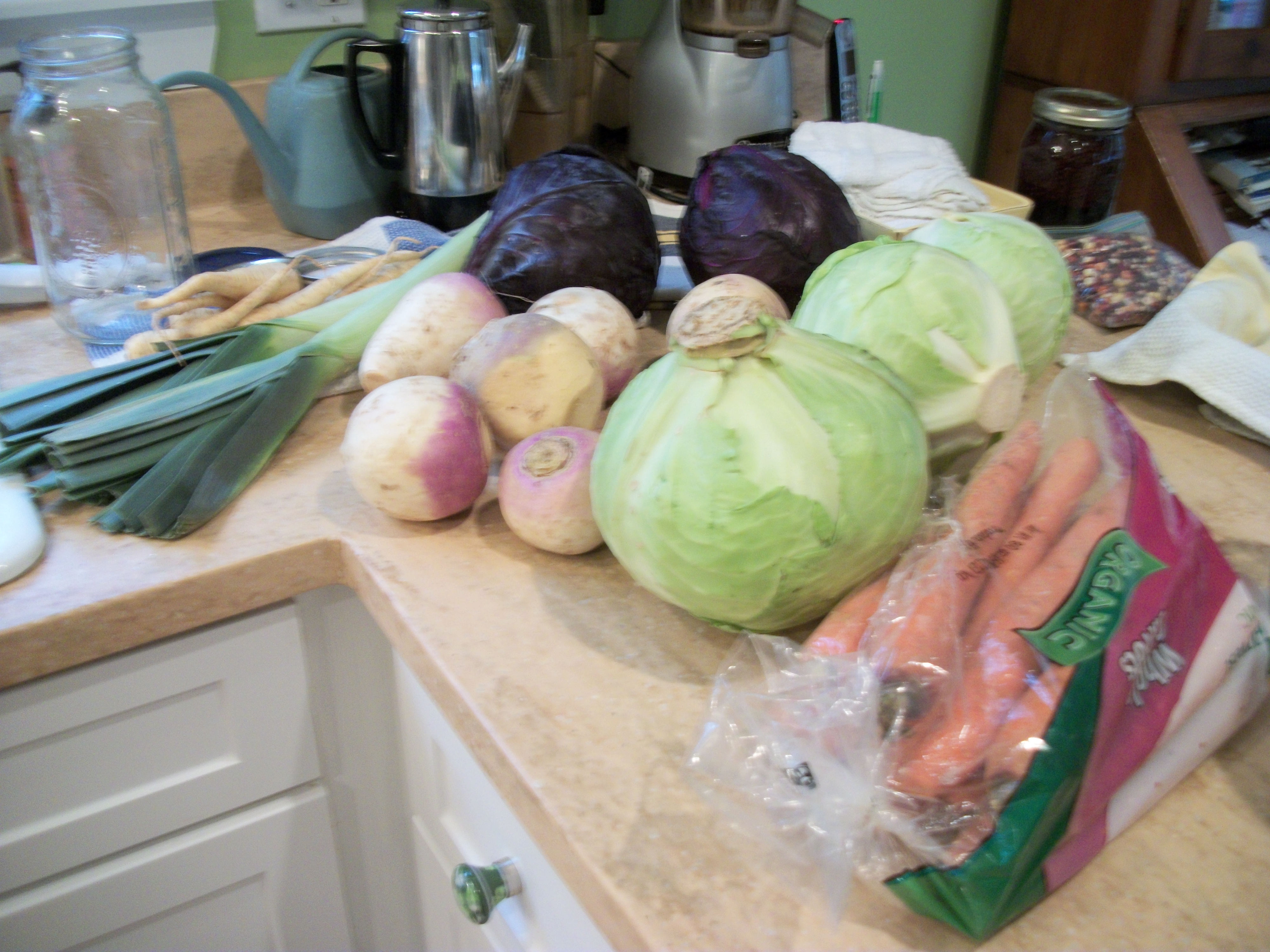
Thursday saw me buying a huge bag full of cabbages (red and white), leeks, turnips, rutabegas, and parsnips.  I already had a big bag carrots.  And the garden is full of kale.

Veggies to Lactoferment

Here’s the spread:

Veggies on counter

And the kale from the garden.  I also brought in handfuls of the last of the sage, which is a bit more winter hardy than the other herbs:

Kale from garde

On Friday, I started food processing.  I had two projects:  to make a new batch of the root veggies I LOVED over the past few months.  The first batch was just turnips, carrots, garlic, and sage.  This batch would have also parsnips (very sweet) and rutabegas and red onion.

I don’t know how to describe the taste of this turnip mixture.  It does not taste like turnip.  It does have a bright, fresh taste that is delightful–much as Sandor Ellis Katz promised in his book WILD FERMENTATION.

The second project was some mixtures of cabbage (red and white), leeks, onions when I ran out of leeks, kale, carrot, one had a turnip, more garlic, and sage.  I decided to do at least two mixtures of just cabbage, carrot, and caraway seeds–the traditional mixture from NOURISHING TRADITIONS (Sally Fallon Morell and Dr. Mary Enig of The Weston A. Price Foundation) with which I started this journey.

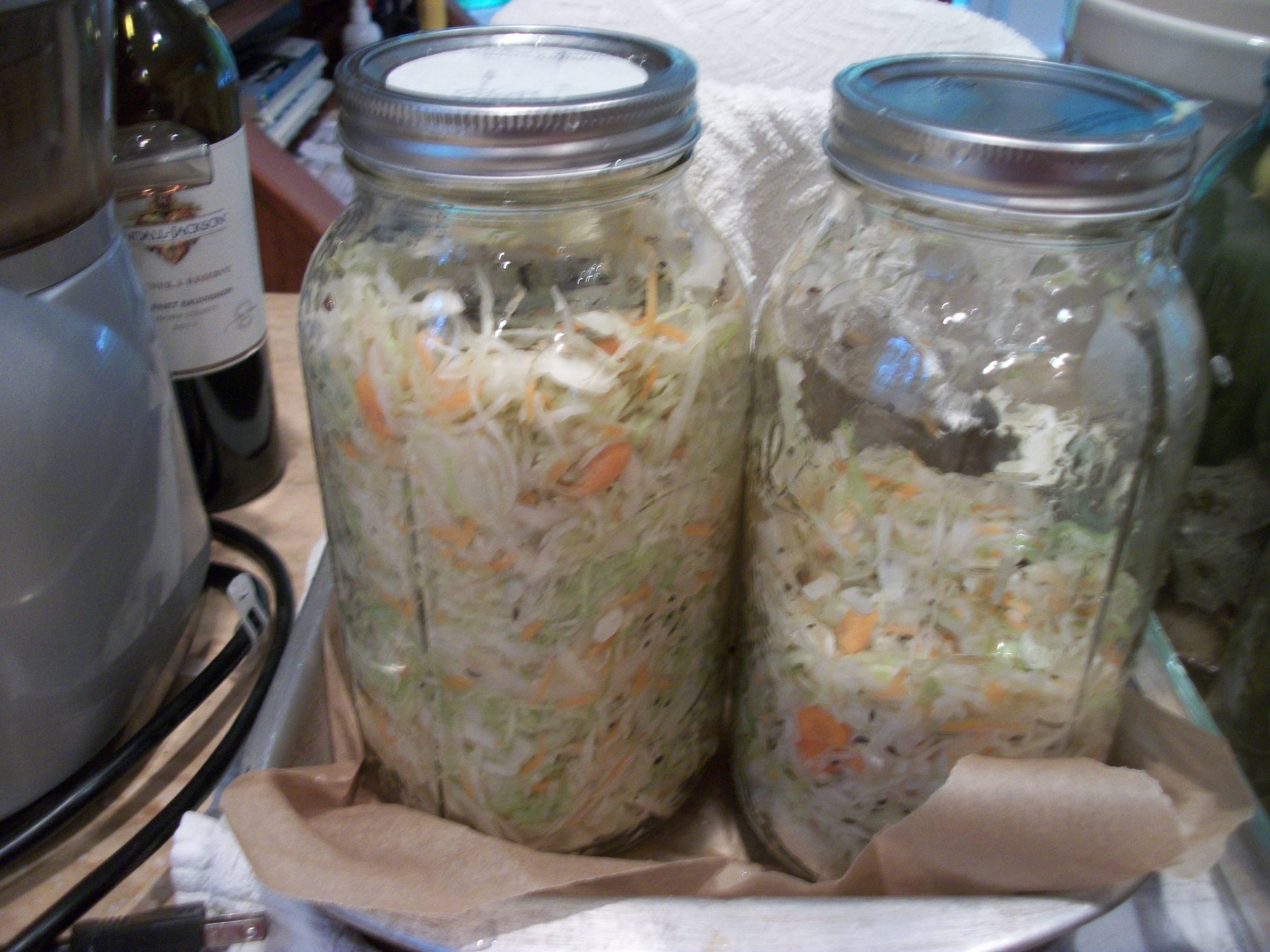
The project went rather well:

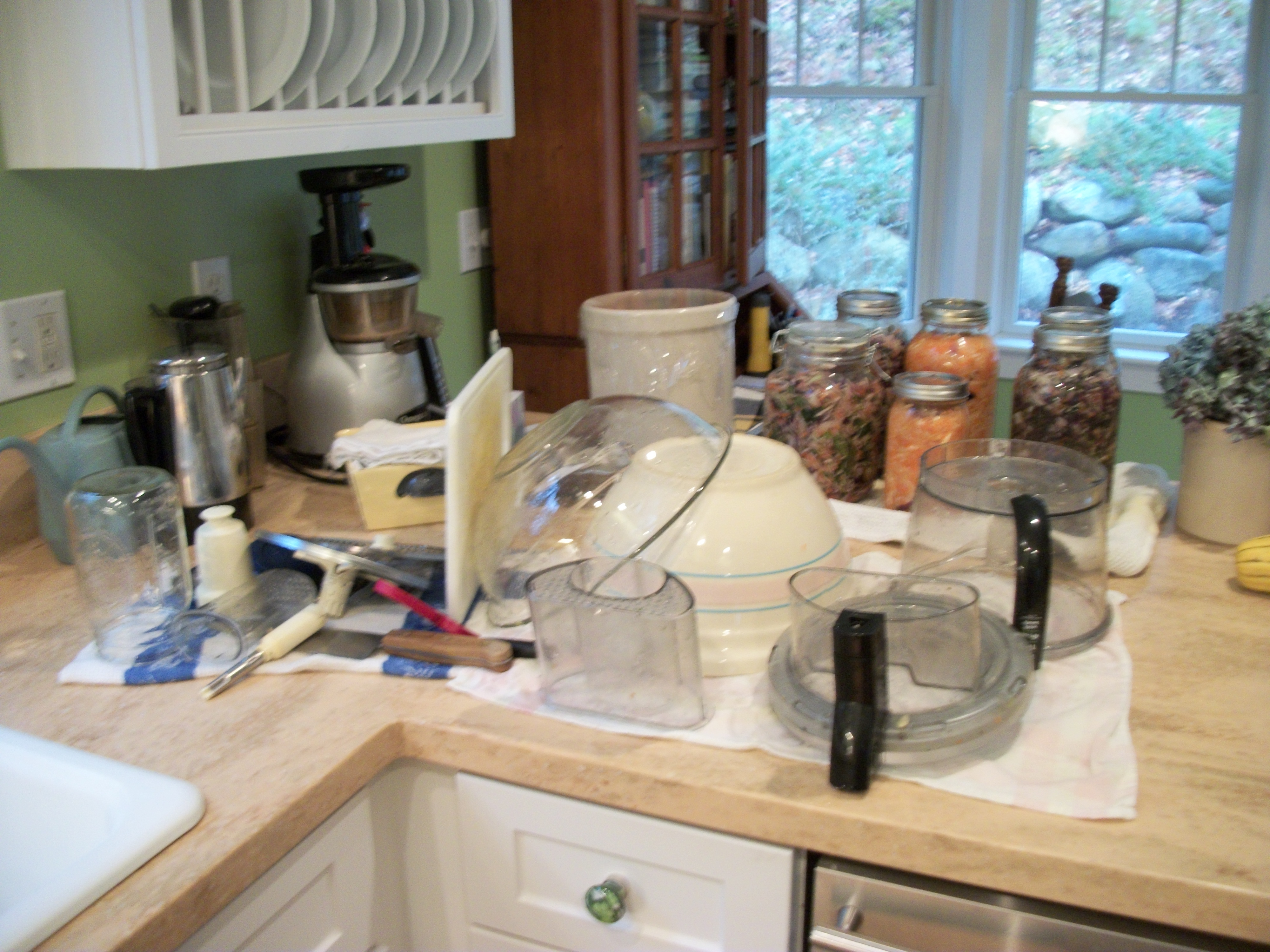
Lactofermented veggies, 4 gallons

There is a gallon of fermented cabbage in the crock.  I transferred it to jars this morning.  So I have almost 4 gallons of delicious food.

The orange is the root veggie mixture.  The cabbage mixtures will turn bright rosy pink in a few days–from the red cabbage effect.

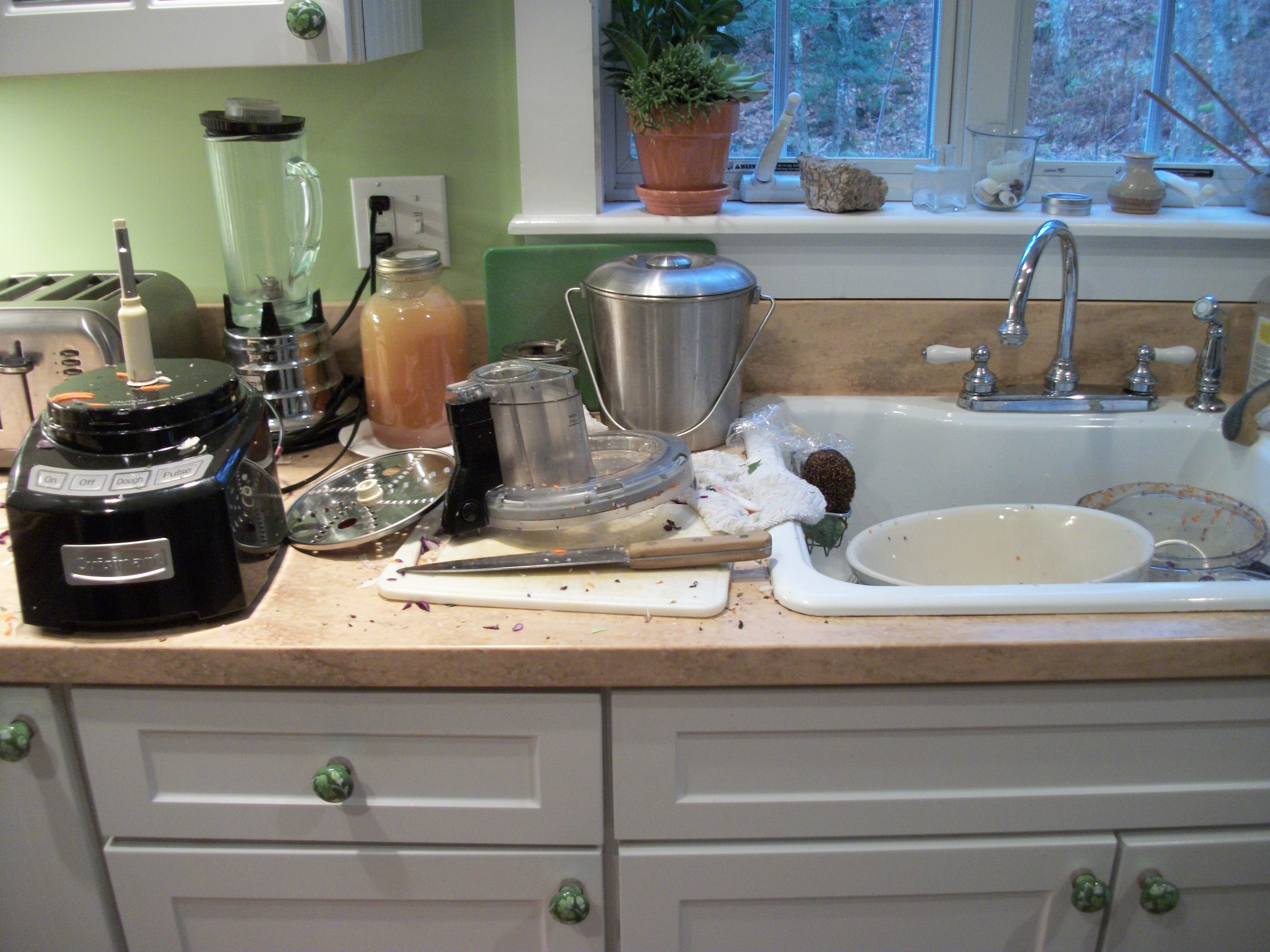
The kitchen was a mess when I was done.  (You should have seen the floor.)

veggies, kitchen wipeout

But it cleaned up quickly as no grease was involved:

Kitchen clean-up

Hint:  the jars will be so pretty with a red ribbon and a Christmas Card attached, don’t you think?

Shhhhhh…..

And I’m not giving away the big root veggie jar or the jar with the hinge.  They’re for ME!!

Interesting Information: Vaccines In Your Body: How They Really Work (Or Don’t)

Interesting Information:  December 4, 2013

Vaccines In Your Body

How They Really Work (Or Don’t)

I’ve looked for some time for a simple explanation of how vaccines work (or don’t) in your body.

Shane Ellison, also known as The People’s Chemist, explains in his Over-The-Counter Natural Cures that vaccines come through the “back door” of the body–through a puncture wound–which breaches the body’s first line of defense:  the skin.  Vaccines are supposed to “trigger” the immune system, but because they are entering the body through the back door, “they fly below our immunity radar, rendering many of them ineffective” (96).

Ineffective at least in part means a short shelf life.  I’m beginning to read that drug companies and most doctors are realizing that vaccines have a limited range of effectiveness–maybe up to two years.  So now, in my opinion, they have a conundrum:  should they recommend booster shots,  a practice that would mean more money, but which would certainly increase the harm from vaccines, which could result in everyone stopping drinking this particular koolaid mixture, which would mean no money.  I’m betting they will play around the edges of keeping the status quo.

But what goes on inside the body once a vaccine has entered it? 

Why is the vaccine response ineffective?

I finally got my answer in an article by Thomas S. Cowan, MD, in the Spring 2013 edition of The Weston A. Price Foundation’s journal, Wise Traditions.

The link:  Preventing and Treating the Flu – Weston A Price Foundation.

Dr. Cowan explains that we have two immune systems:  the cell-mediated or Th1 (thymus derived) immune system and the Th2 immune system which targets extracellular (outside the cell) infecting agents (like worms) or foreign proteins and which “produces antibodies that call for a killing response before the offending agent gets into our cells and makes us sick” (50).

Dr. Cowan explains that the Th1 system is intracellular (inside the cell):

It primarily works through the production of white blood cells that essentially digest and then excrete cells (for example, in our throat or bronchial tubes) that have been infected with a virus or bacteria.  The consequences of a cell mediated response, that is, the digestion and excretion of dead and infected cells, are what we call sickness.  In other words, fever, rash, cough, mucus and so forth are not caused by the virus but by the body’s response to the virus.

When you get a naturally occurring infection “both immune systems respond, first the cell-mediated to clear the virus, then the antibody or humoral system to make antibodies to remember what happened so our cells don’t get infected with the same pathogen more than once.”

The degree of “severity of any particular illness is a function of how many cells are infected and the strength of our cell-mediated response.”  And, “whether we get repeated sickness is related to whether we can make an effective antibody response.”

So, and this part is important, if we have a strong immune system, we throw off infection quickly and gain immunity to that infection/illness for life.

Dr. Cowan writes that “the cell-mediated exercise is largely responsible for immunity to cancer, auto-immune disease and other chronic conditions.”

So, vaccines “deliberately” try to “bypass the cell-mediated immune system and only provoke a humoral response.   And Dr. Cowan notes with sly humor that “if a vaccine provoked the cell-mediated immune system, it would just make us sick and no one would agree to them.”

And, so, vaccines shift us into “what is called a Th2 dominant mode, an imbalance in which the humoral immune system is too strong and the cell-mediated immunity is suppressed.”

Here’s the kicker:

This leaves us with no avenue to clear the poisons that we have just been injected with from our tissues; it leaves us with chronic inflammation as our bodies struggle to clear these inflammatory toxins, such as mercury, formaldehyde and dead viruses, and an increased susceptibility to chronic disease.  An overactive humoral immune system often leads to auto-immune disease, where the humoral immune system attacks our own tissues.

Dr. Cowan goes on to name sugar and refined carbs as trouble in that they “blunt the immune response and should be avoided as much as possible.”

Dr. Cowan discusses preventative and helping strategies, like cod liver oil and elderberry extract.  For more detailed advice and remedies you many want to keep on hand, you can read the article for yourself.

Some questions to ponder:

If vaccines are hobbling the normal working of our immune system function, could that help account for the horrific rises in cancer?

Heavy metals like mercury and aluminum damage the brain–do vaccines set in place future cases of neurological diseases like Parkinson’s?  Especially if the body can’t clear these toxins properly?  Neurological diseases are also on the rise…

Interesting Information: Sugar and Inflammation

Interesting Information:  November 22, 2013

Sugar and Inflammation

Ellen Davis promotes ketogenic diets, which is a diet where fats provide most of the calories.  She has an article in the July/August 2012 issue of Well Being Journal entitled “Ketogenic Diets:  A Key to Excellent Health” (20-23).  Davis supports the ketogenic diet because she used it to reverse her own metabolic syndrome and to regain her health.  In the process, she lost over 80 pounds.  Her web site is www.healthy-eating-politics.com.  (I’ve written about metabolic syndrome in the essays on this blog.)

I am drawn to more of a balanced diet approach–as long as there are not digestive issues.  If there are digestive issues, then one needs to eat in a healing way for some time.  This ketogenic diet is very like Dr. Natasha Campbell-McBride’s GAPS protocol–which has a lot of good science and clinical practice results behind it.  (GAPS stands for Gut and Psychology Syndrome, and there are essays on this blog about GAPS.)

I do think that most Americans are eating way, way too many carbs–that their eating so many carbs is out-of-balance and is causing chronic disease.  (This statement does not address, also, the toll that toxic poisons in and on American foods, takes.)

And I do think that eating a lot of carbs is causing inflammation in the body–which is one root cause of disease.  For instance, Davis points out that a bagel “breaks down into about sixteen teaspoons of sugar in the bloodstream” (21).  So if you are going to eat one, be sure to put a lot of cream cheese or butter on it to help cut the sugar load–just as you would with a baked potato.  And remember that the cream cheese or the butter is not going to make you fat, but that the bagel will because it turns to sugar in your system.

Davis writes that “oxidative stress is what causes metal to rust, and cooking oils to go rancid when exposed to the air.”  This oxidative stress “can create molecules called reactive oxygen species, or ROS.  These molecules, commonly called free radicals, are chemically reactive and can damage internal cellular structures” (21)

She writes that “if inflammation is present, excessive amounts of ROS are created and overwhelm the cell’s defenses, causing accelerated damage and eventually cell death.  This is why inflammation is linked with so many types of disease processes.”

So, food choices are very important, says Davis:  “…high-carbohydrate foods provide much more glucose than the human body can handle efficiently.  Blood glucose is basically liquid sugar, and if you have ever spilled fruit juice or syrup on your hands, you know how sticky it can be.  In the body, this stickiness’ is called glycation.”  The process of glycation starts a chain of events that increases inflammation and creates “substances called advanced glycation-end-products (AGEs)”–which “interfere with cellular function, and are linked to the progression of many disease processes, including Alzheimer’s, cardiovascular disease, stroke, and autism.”  The “higher the blood sugar, the more serious the damage” (21).  And I wonder if there is a connection between inflammation in the body and the start of cancer–which may get a toehold when the immune system is overloaded.

Davis quotes Ron Rosedale, MD, from his book Burn Fat, Not Sugar to Lose Weight:

“Health and lifespan are determined by the proportion of fat versus sugar people burn throughout their lifetime.  The more fat that one burns as fuel, the healthier the person will be, and the more likely they will live a long time.  The more sugar a person burns, the more disease ridden and the shorter a lifespan a person is likely to have.”

While I am always leery of MDs who are writing about nutrition–since most have had no nutritional training whatsoever–what Rosedale is saying about fat being healthy is a fit with Dr. Mary Enig’s stance on fat in Eat Fat, Lose Fat, written with Sally Fallon Morell, both of The Weston A. Price Foundation.  Dr. Enig is an internationally recognized expert on dietary fats, and I have written about her work in many places on this blog.

And Rosedale’s statement is a fit with Gary Taube’s work on the hormonal conditions caused by eating too many carbs, in Why We Get Fat.

So, there you have it…

Some interesting information…

Turkey Tracks: How to Feed Your Gut

Turkey Tracks:  October 15, 2013

How to Feed Your Gut


More and more information is appearing daily about the importance of keeping your gut healthy.

You may recall from other postings on this blog that I compromised my gut health over the years–and have paid a pretty hefty price for doing so.  It turns out that I have a genetic sensitivity to gluten–tested by a reputable lab sanctioned by the government with a fecal test.  (Blood tests don’t often catch these kinds of food allergies.)  The hefty price is that when I harmed my gut by eating gluten and other foods that let the opportunistic gut flora and fauna we all carry get out of control–read sugars and too many carbs here–they perforated the walls of my gut and food particles began to escape into my bloodstream–which, in turn, created conditions where my body thinks it is being attacked and produces a classic histamine reaction.  My blood pressure drops, I lose all muscle control, and I pass out and have to be hauled off to the hospital where I recover in time.  It takes days to get my brain fully functioning again.

This falling domino sequence did not happen overnight.  It took years.  And I ignored all the warning signs:  reactions to red wine, allergic runny nose and sneezing after eating a food my body did not like, irritable bowel reactions that could strike without warning, the yo-yo effect of constipation followed by diarrhea, weight gain, and on and on.  I didn’t stop until I started passing out and my list of foods that would set off the reaction began to grow and grow until I was afraid to eat anything for fear of setting off an attack.

You can’t take a pill to “fix” this kind of thing.  The only way out is to heal your gut.  And to do that, you have to stop eating any kind of processed food and to start eating nutrient dense whole clean foods that nourish your body.

So, guess what is one of the very best things you can do?  Eat lots of lacto-fermented foods EVERY DAY at EVERY MEAL.  This food has more probiotics and enzymes than any probiotic product you can buy in a store.  Lacto-fermented foods are changed in ways that make them even better than they were when raw.  It’s how people used to store foods before canning and freezing came along.  And, note that canning kills foods and freezing is an energy drain.  I reserve freezing real estate for things like meat, local fruit, and roasted tomatoes, where it takes many tomatoes roasted down to fill a pint jar.

But, first, let me explain that “lacto” is from the wild ingredient that lives in the air, lactobacillus.  Cultured milk products also contain lactobacillus, so that’s where you might have first heard that term.  And I learned all that and how to make sauerkraut first from The Weston A. Price Foundation’s Sally Fallon Morell and Dr. Mary Enig’s book NOURISHING TRADITIONS (a must have in your library).  Then, I built on that knowledge after a few  years with Sandor Ellis Katz’s book WILD FERMENTATION.

Katz was the Maine Organic Farmers’ and Gardners’ Association keynote speaker at the Common Ground Fair this past September.  He has a new book out that is more comprehensive than WILD FERMENTATION.  The new book, I think it’s called THE ART OF FERMENTATION, includes fermenting meats–like corning beef, for instance–which is something I really want to try.

Thus, Katz was in our region, and that sparked other programs on lacto-fermentation.  One such was given by Ana M. Antaki at the Belfast Library–and Margaret Rauenhorst and I went.

Here’s Margaret outside the library–we got to the program a bit early.  Belfast had all sorts of clever benches done by various local artists and placed all over town.
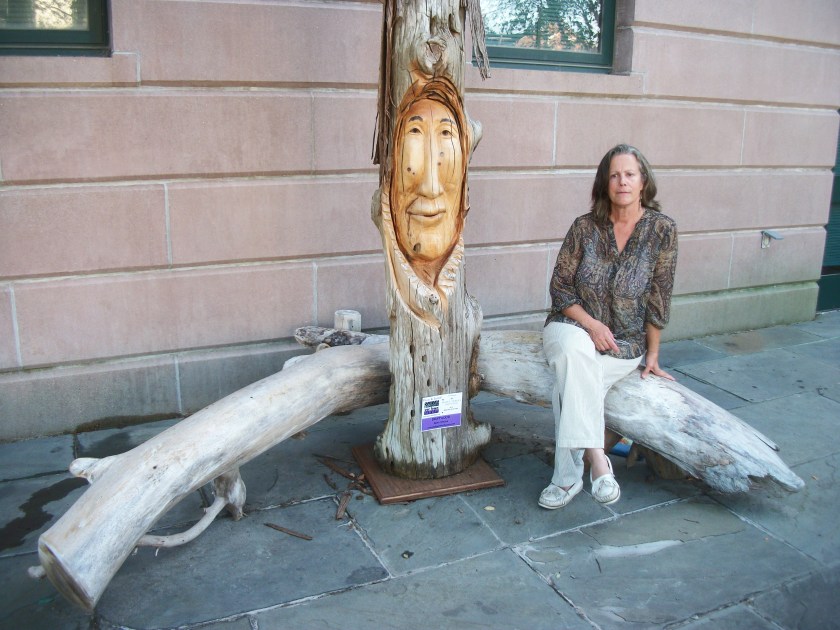
lacto-ferm, Margaret, Belfast library

Margaret is important here because her recipes differ a little from mine–and it’s important to realize that there are different ways to lacto-ferment foods.  For instance, I first learned to lacto-ferment cabbage into something we call sauerkraut (which bears little resemblance to cooked cabbage that’s fermented) from NOURISHING TRADITIONS–the excellent book from Sally Fallon Morell and Dr. Mary Enig of The Weston A. Price Foundation.  That recipe uses some whey drained from yogurt along with a bit of salt, whereas Katz does not use whey.  And Margaret, who does not refrigerate her sauerkraut at all, says the whey makes it go softer quicker.

And Ana Antaki uses glass jars with a bailer and rubber seal (Fido jars) to lacto-ferment, whereas Katz uses mostly crocks.  Ana likes the bialers and seals as she says they let out gasses that form but do not let in outside air.  I use, in addition to jars with rubber seals and bailers (FIDO jars) and crocks, half-gallon Mason jars because that’s what I have on hand and because I have the refrigerator room to store them so they stay cool.  The crocks require a bit more attention to keeping liquid levels high enough.  The Mason jars maybe need to have the gases inside let out from time to time if the jars are in places that are not cool enough.   I do have questions about the glass Fido jars not letting in enough “wild” organisms not so much to help ferment the foods, but to let even more of the “wild” of nature do even more work.

Ana and her husband Roy put up ALL of their produce from their Weeping Duck Farm every year using methods like lacto-fermentation and dehydration.  They do not buy any fresh produce all winter.  And it’s important to realize that the food inside the jars/crocks stays as fresh and bright as the day you put it into the container.  Ana has kept lacto-fermented jars for as long as five years before eating the contents.

Lacto-fermentation takes only two ingredients:  salt (real sea salt please) and water (no added fluoride or chlorine).  How simple is that?

And there are two methods:  one for foods you want to cut or grate into small pieces and one for foods you can preserve in larger chunks.

Both methods could not be simpler to make and are delicious.

Sauerkraut and Sauerruben (a mixture of grated root veggies) put grated veggies into a bowl.  One then adds salt and whatever spices or herbs one wants.  (Ana adds less salt than Katz, but Katz says to use salt to your own taste.  Ana adds 3 tablespoons of sea salt to about 5 pounds of veggies.)  NOURISHING TRADITIONS adds 4 tablespoons of whey dripped out from yogurt and 1 tablespoon of salt.  (I don’t know if the whey from commercial, processed yogurt would work–it is a dead food.)

Here’s a bowl of grated cabbage with bits of carrot–you could also fine-cut the cabbage with a knife.

Lacto fermented cabbage started

I started using a pestle to bruise the cabbage enough until it started rendering its liquid–until I saw a 6-minute video Katz put on utube that showed him using his hands to squeeze the cabbage.  That seemed to work a bit better.

Once the cabbage renders enough liquid, one just packs it into a jar and lets it sit.  I turn mine upside down a few times a day and refrigerate it after a few days as that slows down the fermenting action.  I still use 4 tablespoons of whey and maybe only one tablespoon of salt, but I don’t stress about it.  I add things like some caraway seeds.  Garlic is good in anything.  You could add some herbs from the garden.  Use what sounds good to YOU.

You can start to eat any of these foods after a few days.  But the longer they ferment, the more they “develop” interesting flavors that are richer and deeper.  Refrigeration slows the reactions.

Here’s the sauerkraut packed into a jar:

Lacto fermented cabbage

After after a few days, I was able to put the contents of the half-filled jar into the full one…

If you use a crock, you need a plate you can push down over the top of the veggies  to make the liquid rise and cover them–and a weight to keep it pushed down–like a Mason jar filled with water–and a clean dish towel or cheesecloth over the top–tied around so fruit flies that are very present this time of year don’t get inside.  You want this food to be able to breathe.

The other method involves cutting up veggies, adding spices and or herbs (I put whole garlic cloves into everything as it is a great immune builder–and I eat them as I go along) and pouring some brine over the mixture until the jar is full.  Ana uses wooden popsicle sticks pushed down into the neck of her jars to keep the liquid covering the food–and that works really well.

The brine is simple–you can mix in 3 tablespoons of sea salt to one liter of water.  Katz uses about 6 tablespoons for about 8 cups and replenishes evaporated liquid with a mixture of 1 tablespoon salt to one cup of water.  You just put the salt into cold water, stir it around, and pour it over the veggies.

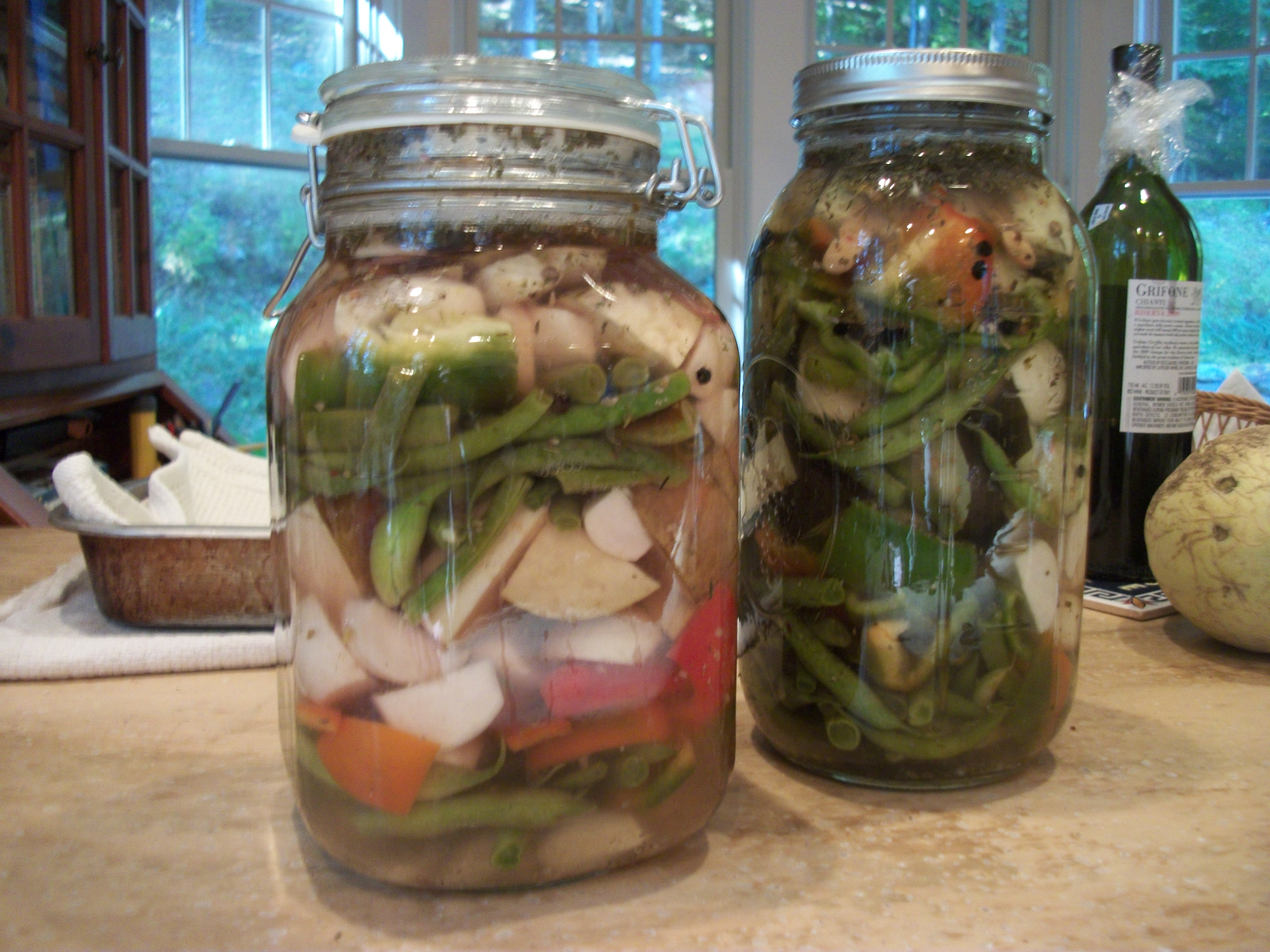
Here are my mixed veggies:

lacto-fermented mixed veggies 2

This batch has eggplant cut into chunks, carrots, beans, salad turnips, green peppers, red peppers, and so forth.  Green beans are delicious done this way.  And, of course, Katz has a recipe for New York garlicky pickles that is delicious!  I can’t get enough of them.

It’s wise to always put a fresh jar/crock into a pan or a container so that if there is overflow, it won’t ruin anything.  Especially with the crocks and especially if they are fullish.  With the jars, you will see bubbles rise to the neck of the jar and when you see a ring of bubbles–or bubbles rising if you pick up the jar and shake it–you know all is well.  Again, putting a jar into a cool place slows the reactions.

Remember that the veggies are in an acid environment–so will not go bad.  And remember if using a crock, it’s entirely normal for the top of the liquid to “bloom” with white bits and blue bits.  Just skim those off.  They don’t hurt anything any more than the white and blue bits in blue cheese.  It’s normal.  It’s WILD.

I just tasted a crock I did two weeks ago of grated turnips (about 4 pounds) and carrots (1 pound)–with added sage from the garden.  It is DELICIOUS!  It has no “turnipy” taste at all–is just clear and fresh and lovely.  I’m going to transfer it to a glass jar and think about doing it again and adding in some parsnips…  And, maybe, rutabega as I have some.  I might have grated in some Daikon radish and I did add garlic…   How healthy is that?

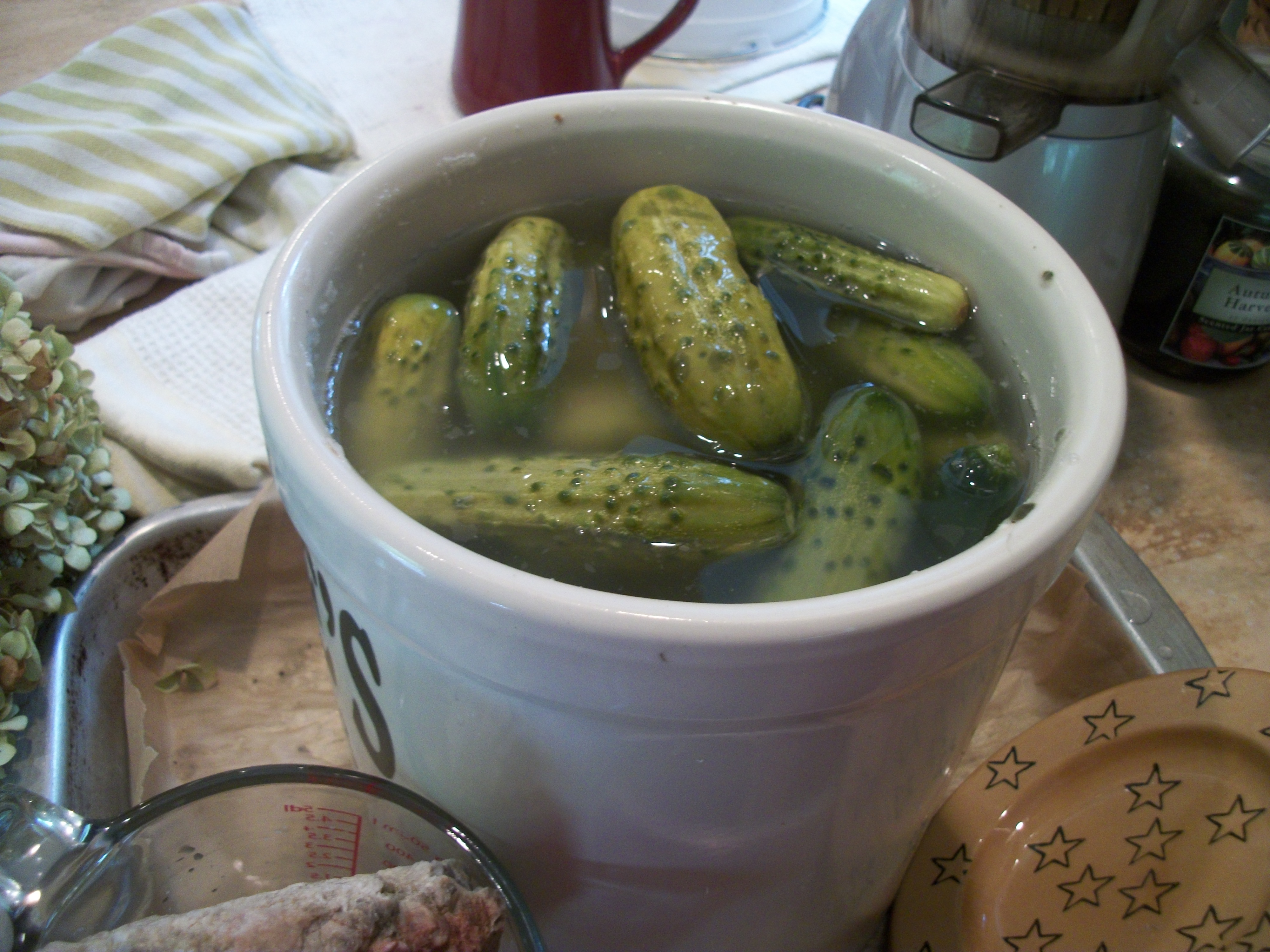
So, here’s a picture of the New York garlicky pickles this summer–lots of garlic, grape leaves to keep the pickles crisp, some peppercorns, and fresh dill:
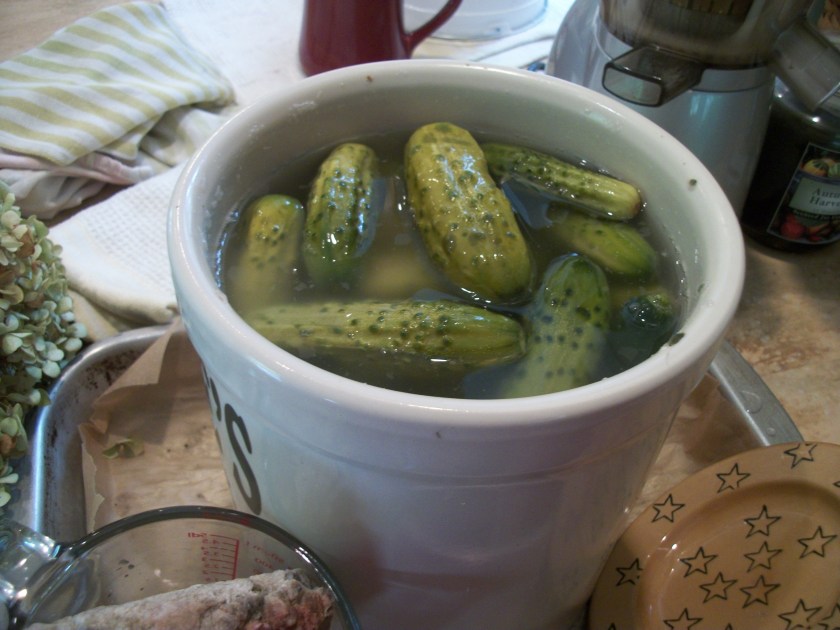
Sour Pickes in crock

And a summer favorite–a bacon, lettuce, tomato (from your garden), slivered onion sandwich with homemade mayo and with a pickle on the side:
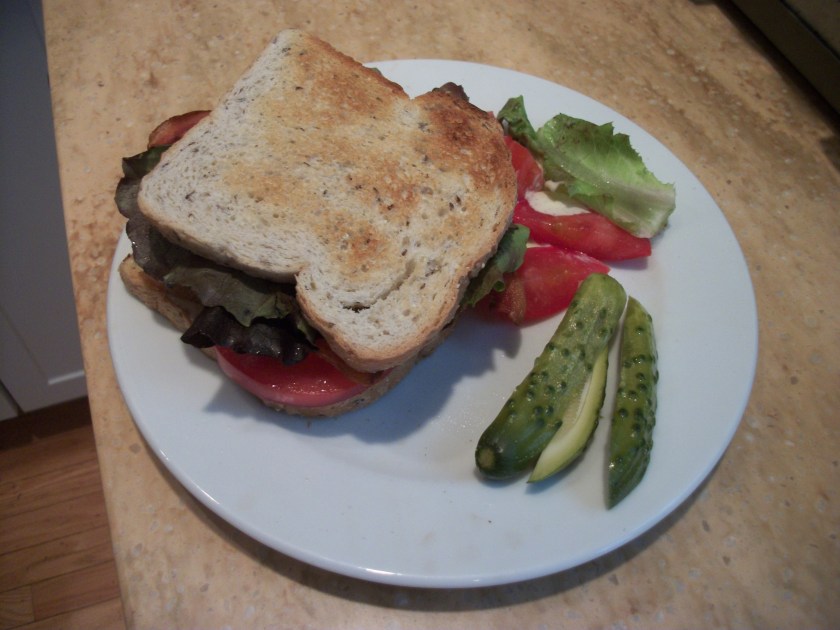
Sour Pickles

Interesting Information: A Horror Story

Interesting Information:  September 24, 2014

A Horror Story

I can tell this story now that my niece (and namesake) has delivered her beautiful second son and is home safely.

To tell this story before this event would have scared my niece to death.  Though she had chosen to use a midwife and to have her son in a birthing center, the birth still took place in a hospital.  And hospitals are not places one wants to be in these days.

Heather Ann (Woodward) Nichols, 29, grew up in Owls Head and Rockland.  She met husband Matt in Portland, and they married int he spring of 2011.  Heather went to one of our best state hospitals to have her first baby in early August.

The baby’s room was all ready, the couple was so excited about the birth of their first child, and the birth apparently went well.  Heather had an episiotomy during the birth process.  Heather went home with her daughter, Ruby Ann, and in a matter of hours, starting experiencing a lot of pain.  She went back to the hospital and died a few days later.  She had picked up a flesh-eating bacteria through the episiotomy–A Streptococcus, or necrotizing fasciitis.  These bacterias LIKE living in hospitals.

NPR’s Diane Rehm has had many programs on the overuse of antibiotics over the many years I’ve listened to her radio show.  She had another one last week (September 2013).  But, the herbalist Stephen Harrod Buhner says that it’s way too late now to try to cut back on the heavy use of antibiotics–most of which are used on the animals in our food supply–to promote growth in overcrowded conditions.  The barn door is already open, and we can’t go back.  Worse, there are no magic drugs in the pipeline that can control the super pathogens that we now face.

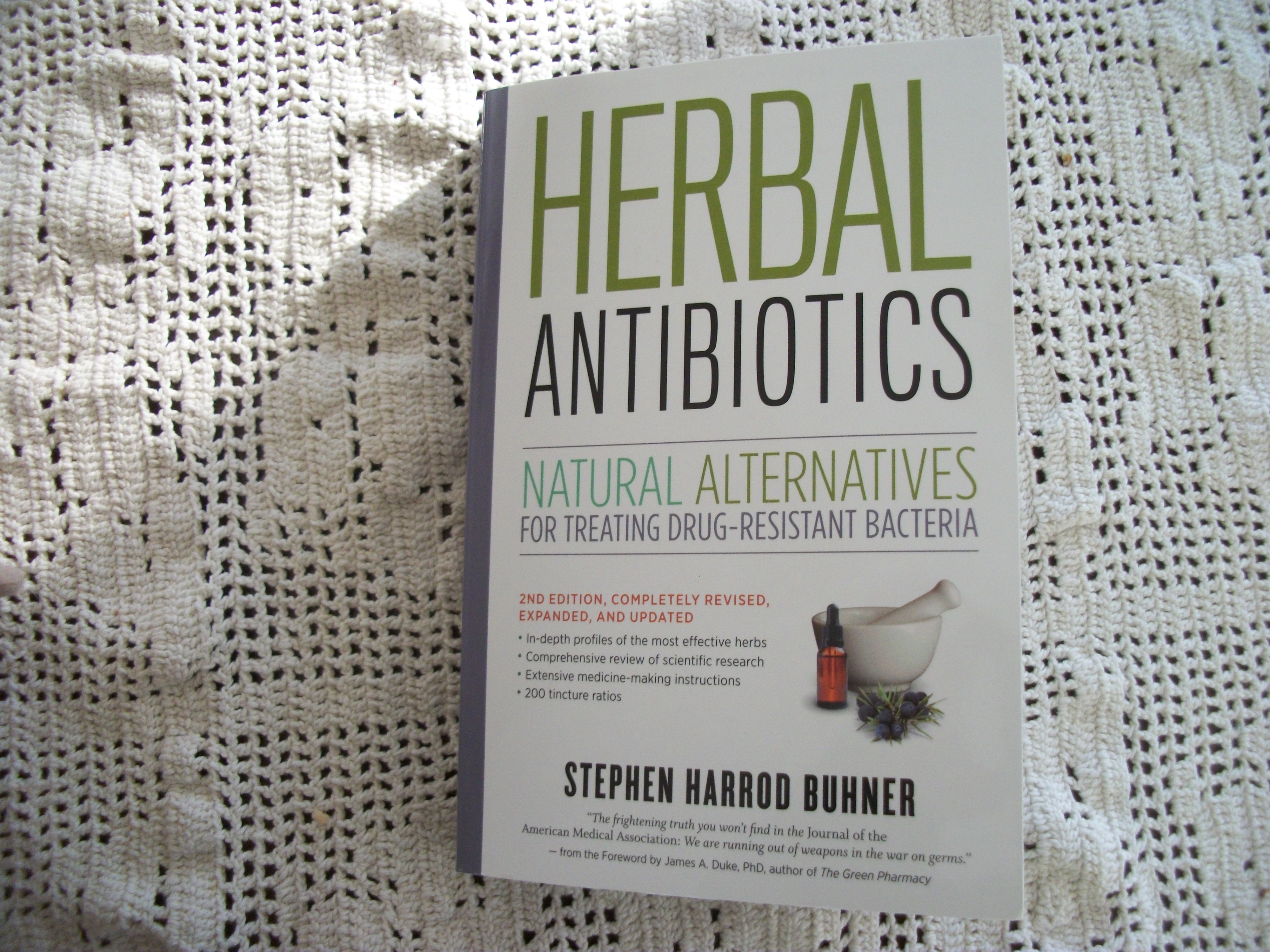
Herbal Antibiotics

Here’s a quote from Buhner’s HERBAL ANTIBIOTICS (13-14):

The thing that so many people missed, including my ancestors, is that all life on Earth is highly intelligent and very, very adaptable.  Bacteria are the oldest forms of life on this planet and they have learned very, very well how to respond to threats to their well-being.  Among those threats are the thousands if not millions of antibacterial substances that have existed as long as life itself.

One of the crucial understandings that those early researchers ignored, though tremendously obvious now (only hubris could have hidden it so long), is that the world is filled with antibacterial substances, most produced by other bacteria, as well as fungi and plants.  Bacteria, to survive, learned how to respond to those substances a long time ago.  Or as Steven Projan of Wyeth Research puts it, bacteria “are the oldest of living organisms and thus have been the subject to three billion years of evolution in harsh environments and therefore have been selected to withstand chemical assault.”

What makes the problem even more egregious is that most of the antibiotics originally developed by human beings came from fungi, fungi that bacteria had encountered a very long time ago.  Given those circumstances, of course there were going to be problems with our antibiotics.  Perhaps, perhaps, if our antibiotic use had been restrained, the problems would have been minor.  But it hasn’t been; the amount of pure antibiotics being dumped into the environment is unprecedented in evolutionary history.  And that has had tremendous impacts on the bacterial communities of Earth, and the bacteria have set about solving the problem they face very methodically.  Just like us, they want to survive, and just like us, they are very adaptable.  In fact, they are much more adaptable than we ever will be.

What does the overuse of antibiotics look like?  Buhner quantifies the overuse in this way (7):

In 1942 the world’s entire supply of penicillin was a mere 32 liters (its weight? about 64 pounds).  By 1949, 156,000 pounds a year of penicillin and a new antibiotic, streptomycin (isolated from common soil fungi) were being produced.  By 1999–in the United States alone–this figure had grown to an incredible 40 million pounds a year of scores of antibiotics for people, livestock, research, and agricultural plants.  Ten years later some 60 million pounds per year of antibiotics were being used in the United States and scores of millions of pounds more by other countries around the world.  Nearly 30 million pounds were being used in the United States solely on animals raised for human consumption.  And those figures?  That is per year.  Year in, year out.

Buhner also notes that most of these antibiotics pass through animals and are excreted into the various waste stream systems where THEY NEVER GO AWAY.  And, “hospital-acquired resistant infections, by conservative estimates, are the fourth leading cause of death in the United States.  And that doesn’t even include the death toll from infectious diseases in general, the same infectious diseases that were going to be eradicated by the year 2000 (11).

Buhner argues in HERBAL ANTIBIOTICS that our only solution is to return to plant-based medicinal strategies.  This book is daunting in its scope.  I feel like I did when I first started reading NOURISHING TRADITIONS with all its information and new ways of handling food.  But, by now I have waded deeply into traditional food ways and into sourcing local foods and into thinking about and researching alternative medical strategies.  So, I will begin with baby steps with finding ways to use herbal antibiotics–remembering that all the most powerful medicines are located in plants, which themselves organize through chemicals.  That would lead to Buhner’s THE LOST LANGUAGE OF PLANTS, which was an eye-opener for me and which I will write about in a separate post.

And, what can we do about this very serious problem of antibiotic resistant diseases–which are part and parcel of ALL the superbugs we have created with our greedy and stupid practices that have ignored the powerful interconnectedness of nature?

Stay out of hospitals if at all possible.  I, for instance, am done with getting blood tests unless I need one because I’m sick.

If you are pregnant, watch the excellent documentary THE BUSINESS OF BEING BORN.  You will be shocked to discover how much of pregnancy and birth in the United States has been colonized by practices located in making money, rather than in practices grounded in science.  And, yes, I will write a separate posting on this documentary.  For the moment, note that something like 85 percent of births across the rest of the world are overseen by midwives–and the survival rates are much higher than those in the US.  Note, too, that most OB/GYNs have NEVER SEEN a natural live birth.  These doctors are highly trained surgeons, and we are so lucky to have them if trouble develops, but have them attend normal births is a super, and expensive, overkill.  So, do some research on your own.  Learn for yourself what the issues are.  And make your birth choices not out of fear, but out of knowledge–like my niece recently did.

Turkey Tracks: 100 Watt Light Bulbs vs. (ugh!) CFLs

Turkey Tracks:  July 15, 2013

100 Watt Light Bulbs vs. (ugh!) CFLs

I just bought 20 100-watt light bulbs on Amazon.

They are gone, gone here in Mid-Coast Maine.

I hate the new CFL bulbs.  They don’t have much light.  And it’s a weird feeling kind of light.

So, imagine my delight to see John Moody take on this subject in the Spring 2013 Wise Traditions, the journal of The Weston A. Price Foundation:  “Let There Be Dark:  Turning Off the Dangers of CFLs.”

John Moody is a Kentucky farmer with kids, a “beautiful wife,” chickens, a huge garden, and is an administrator for the Whole Life Buying Club and has written THE FOOD CLUB AND CO-OP HANDBOOK.  In other words, he’s a regular guy who just started poking around to learn about the new CFL lightbulbs that he, too, dislikes.

Moody notes that the phase-out of the incandescent bulbs (the 75 and 100-watts are virtually gone) has destroyed many American businesses.  The CFL (compact fluorescent lamp) is made in China.  And it was “known to have significant issues even before rollout.”

What issues? Oh, there are many.  We can go so far as to say we have been lied to and “managed” with regard to these bulbs.

The CFL bulbs contain mercury vapor–which is a real problem if you break one. 

Breaking one of these in a small closet is a real catastrophe!  “In the hour immediately after each breakage, the team recorded mercury gas concentrations near the bulb shards between 200-800 ug/m3.  For comparison, the average eight-hour occupational exposure limit allowed by the Occupational Safety and Health Administration is 100ug/m3” (http://www.nebi.nlm.nih.gov/pmc/articles/PMC2535642).

Moody notes that Wikipedia states the following:  “Compared to general-service incandescent lamps giving the same amount of visible light, CFLs use one-fifth to one-third the electric power, and last eight to fifteen times longer.”  Moody notes that “unfortunately, researchers and reporters have shown that these claims are at times wildly false and inflated.”

CFLs do not produce the same amount of light–even after they warm up.  It takes two of them to equal the fire-power of the incandescent bulbs.  And they cost more–as much as FOUR TIMES more.  And, that’s the key to understanding why this change has occurred. 

Nor do they last eight to fifteen times longer than the incandescent bulbs.   The act of turning them on and off diminishes their lifespan.  And think how many times you go into a room and turn on and off the light switch before 10 minutes are up:  the bathroom, a closet, the kitchen for a drink, etc.  Only about two percent of these bulbs are recycled.

So, the CFL bulb doesn’t provide light, it takes 10 minutes to warm up to provide its inadequate light, it burns out with use, it’s FOUR TIMES more expensive, and it’s dangerous to dispose of safely.   Hmmmmm.  Do bear in mind this outcome is exactly how the so-called free market works when it is unfettered from the real needs of people and communities.  CFLs bring in more money.  Period. 

In addition, many people don’t like the light–they say it gives them headaches, causes eye strain, etc.  Turns out the coating on the bulb wears thin, which allows a harmful light that causes damage to eyes and skin.  In short, they are unhealthy. 

Amazon’s price is going up as the stock goes down.

Act now.

You might think about writing your congress people too.


Interesting Information: Fat-Soluble Vitamins Need FAT

Interesting Information:  May 23, 2013

Fat-Soluble Vitamins Need FAT

Yep!  They need the right kind of FAT to activate best in your body–and that’s a fat low in polyunsaturated fatty acids–which includes most vegetable oils.

You can supplement all you want–with food, with supplements–but if you don’t have enough good dietary FAT, the fat-soluble vitamins don’t go to work.

Chris Masterjohn is the young scientist that The Weston A. Price Foundation (WAPF) is helping to develop.  He has a PhD in Nutritional Sciences from the University of Connecticut and is currently working as a Postdoctoral Research Associate at the University of Illinois, studying the interactions between vitamins A, D, and K.  His blog is “The Daily Lipid,” which is supported under the Cholesterol-And-Health.com web site.   So you can see he is following in the footsteps of Dr. Mary Enig, who is an internationally recognized expert on fats and the human body.

Masterjohn is a frequent (and welcome) contributor to WISE TRADITIONS, the quarterly journal of the WAPF.  THe winter 2012 issue has an important Masterjohn article:  “Nutritional Adjuncts to the Fat-Soluble Vitamins,” found at http://www.westonaprice.org/fat-soluble-activators/nutritional-adjuncts-to-the-fat-soluble-vitamins.

This article is important because it illustrates that the current scientific paradigm of studying components of foods in isolation leads us to making really bad decisions.  An illustration would be the recent uproar about one component in red meat studied in isolation.  The result:  red meat might be dangerous to eat.  BUT, BUT, BUT, that component never exists in isolation in red meat.  It operates alongside all the other components, or synergistically.  And, red meat is the ONLY place we get vitamin B12 IN A FORM where our body can use it.  (Aren’t you wondering after all these years of folks trying to demonize red meat WHY?  First it was the fat.  Now it’s an isolated component.  Who is paying for this research anyway?  Where are we dealing with a belief system and where is good science?)

We need a new paradigm.  We need to study how components operate SYNERGISTICALLY , or how they react with each other and need each other to give us the best of what they have to offer.  Masterjohn traces the history of how science tried to understand how the fat-soluble vitamins work by isolating each one.  As a result, researchers did not get to an understanding of the truth of these vitamins.  The result was that people were told they needed more vitamin A.  No, it’s really vitamin D.  And vitamin K only works to help coagulate blood.  The role of vitamin K2 was dismissed entirely as it appears in very small quantities.  (Bigger is not always better.)

Masterjohn writes that the fat-soluble vitamins A, D, and K2 “interact synergistically to support immune health, provide for adequate growth, support strong bones and teeth, and protect soft tissues from calcification.”

And, said another way:   “We now know that vitamins A and D also cooperate together to regulate the production of certain vitamin K-dependent proteins.  Once vitamin K activates these proteins, they help mineralize bones and teeth, support adequate growth, and protect arteries and other soft tissues from abnormal calcification, and protect against cell death.”

BUT, the synergism is bigger than just these three vitamins:

Magnesiumn is “required for the production of all proteins, including those that interact with vitamins A and D.

Vitamins A and D “support the absorption of zinc and zinc supports the absorption of all the fat-soluble vitamins.”

Many of the proteins involved in vitamin A metabolism and the receptors for both vitamins A and D only function correctly in the presence of zinc.

Dietary fat is necessary for the absorption off at-soluble vitamins.

Nature provided these ingredients for us in nutrient-dense foods.  Trying to obtain them through supplements can drastically throw off how they interact with each other–which means trouble in the body.

Masterjohn argues that we need to eat the right kinds of fat to access the crucially important fat-soluble vitamins:

Human studies show that both the amount and type of fat are important.  For example, one study showed that absorption of beta-carotene from a salad with no added fat was close to zero.  The addition of a lowfat dressing made from canola oil increased absorption, but a high-fat dressing was much more effective.  Canola oil, however, is far from ideal.  Studies in rats show that absorption of carotenoids is much higher with olive oil than with corn oil.

Similarly, studies in humans show that consuming beta-carotene with beef tallow rather than sunflower oil increases the amount we absorb from 11 to 17 percent.

Why is the animal fat a better fat in terms of absorption?  Masterjohn poses that the lower the fats are in polyunsaturated fatty acids, the better they work inside our bodies.  He poses that polyunsaturated fatty acids likely promote the oxidative destruction of fat-soluble vitamins in the intestines before we are able to absorb them.”

Nutrient-dense foods derive from animals:  meat, milk, eggs, REAL cod-liver oil (not the pasteurized kind with vitamins added back), etc.  Yes, plants are important sources of useful components, but our bodies work best with nutrient-dense foods.

Interesting Information: Osteoporosis Cure

Interesting Information:  May 21, 2013

Osteoporosis Cure

I’m behind in my reading and reporting.

Blame it on the inherited ipad where I am playing “Word” with kin, friends, and at least one former highschool classmate.  It will keep my brain active, right?  And it allows me to stay connected in a whole new way, right?  I hope so, as I love language and words and am learning so many new ones.

I finished the winter 2012 WISE TRADITIONS, the journal of The Weston A. Price Foundation, the other day.  There is always such good information in it, and it’s free on-line to any reader.  (I get a hard copy because I write all over the pages taking side notes, making comments, circling important information, and so forth.)  This issue is on the importance of fat-soluble vitamins–and I will write more on that tomorrow.   Remember that I am reading so I can report back to you and if you want to read more, you can follow in my footsteps and go to the texts I surface for you.

A letter called “Geriatric Rickets” caught my eye, written by Philip Ridley of London, UK.  His mother suffered from osteoporosis–a disease he believes (as I do) that is caused by malnutrition from the diet his (and our) health practitioners have been pushing for the past forty years or so–low-fat, high-sugar, high-carb intake.

First, Ridley’s mother stopped taking the osteoporosis drugs “given for free in the U.K. on the National Health Service.”  Ridley notes that

these drugs operate by inhibiting osteoclasts and stimulating osteoblasts.  The former break down old bone cells and the latter build new bone cells.  The problem with meddling in this process is that strong bones require the renewal of old bone cells with new bone cells.  The drugs therefore increase brittleness and they also do nothing about the malnutrition that causes weak bones in the first place.”

Ridley also notes that “women at the final stages of geriatric rickets are given an infusion of these toxic drugs directly into the marrow.  I have heard from families that this is the most painful treatment.”

Ridley’s mother CURED her osteoporosis by eating “bone broths, sourdough bread [fermented foods], butter, soaking of beans and grains, raw grass-fed Guernsey milk, two Royal Blend high-vitamin butter oil and fermented cod liver oil capsules per day, liver and bacon once a week, and an herbal remedy for strong bones.”  Ridley’s mother “had always had grass-fed meat, wild fish, and fresh vegetables, but lacked the fat-soluble vitamins as a result of following the lowfat diet since it was introduced into Britain in 1983, when skimmed milk first came available.”

Ridley and his mother spent “the last decade since her diagnosis waiting for the horrid, inevitable broken hip or back bone.”  But, Ridley reports that her last bone density test showed that she no longer needed to be followed for osteoporosis.  Her diet had healed her bones.

Ridley also notes that the only nutritional supplement  given for osteoporosis in the UK is calcium tablets.  But, calcium given this way “simply calcifies the soft tissues in combination with the low fat diet they promote.”  When people ask Ridley how to strengthen bones he says “eat bones.”

Ridley dams the way doctors and Big Pharma work together to put women on drugs–and what he says is true in America as well:

Geriatric rickets is becoming a silent, worsening epidemic amongst women because the bone density tests kick in for all at around sixty-five years of age, and, much like the cholesterol levels that lead to statin prescriptions, the triggers for bone density treatment are manipulated to catch the greatest number of customers for the drug companies.”

AND:

Doctors in the NHS also get performance-related pay based on the number of women tested and the number of women who test negative who hare placed on the drugs.  Most women nowadays will, as a result of lowfat diets, suffer low bone density, so a vast number of women are now being put on these toxic drugs, yet they could all be saved anguish if we would only call osteoporosis what it is and treat it accordingly.

That would be “geriatric rickets.”

Ridley also notes that “routine bone density tests most likely also cause cancer because they use radiation.”

I could add that when I came to Maine, I had arthritis in my right hip and terrible back pain.  I know my bones are much stronger now as a result of how I eat.  My gums don’t bleed when I go to the dentist.  And I’ve (knock on wood) had no new cavities–a sure sign of malnutrition.  I refuse to get any more bone density tests.  Or, mammograms, for that matter.  And I’m not going to go through the airport x-ray machines any more either.

I also have well water, which means I am no longer getting any fluoride.  For about two years after we came to Maine, I could hardly sleep at night from the pains in my bones.  I was restless and twisted and turned.  I just plain hurt.  I think it was the fluoride coming out of  my bones–and fluoride has been shown to make bones brittle, not strong.  There are a number of essays on this blog addressing the fluoride–which is one of the biggest scams in our lives today.  There isn’t any science behind adding it to the water and a LOT of science showing how dangerous it is.  Anyway, I don’t have these pains any more, and I can feel such an improvement in the health of my bones.

Here’s the whole letter if you want to read it:  http://www.westonaprice.org/letters/letters-winter-2012.

Mainely Tipping Points 45: Part II: How Soy Got Into Our Food Chain

Mainely Tipping Points 45:  December 13, 2012

Part II:  How Soy Got Into Our Food Chain


Part II of this series on Soy explores how soy got into the human food chain.  As established in Part I, the expert I rely on for soy information is Kaayla T. Daniel, PhD, CCN, the author of THE WHOLE SOY STORY:  THE DARK SIDE OF AMERICA’S FAVORITE HEALTH FOOD (2005).  Daniel’s credentials show her to be an outstanding nutritionist and her extensive research on soy makes her an expert.  All quotes are from this text. 


* * *

Soy is a powerhouse in terms of the potent chemicals its beans contain.  For instance, soy is one of more than 300 plants that contain phytoestrogens, which stop reproduction.  Yet soy is the only one of these plants humans eat.  Besides phytoestrogens, soy contains many more powerful chemical components which are dangerous for humans unless they can be mediated in some way first.  Indeed, the Food and Drug Administration (FDA) lists soy on its Poisonous Plant Database (31).    

 It is true, Daniel writes, that the ancient Chinese “valued the soybean as a national treasure” and honored it with the name “ `the yellow jewel.’ “The soybean, though it is not a grain, is one of the Five Sacred Grains, alongside rice, millet, barley, and wheat.  But, the ancient Chinese did not eat the soybean.  They used it as a green manure to fix nitrogen in the soil (9).

 The Chinese began to eat soybeans “no earlier than about 2500 years ago.”  They fermented soybeans as they “remain toxic after ordinary cooking….”  Fermentation tames the trypsin inhibitor that causes bloating and gas.  Miso paste, used to preserve meat and seafood, and soy sauce, the liquid produced in the production of miso, appeared first.  Natto appeared around 1000 AD, and tempeh appeared “no earlier than the 1600s.”  Thus, “claims that soybeans have been a major part of the Asian diet for more than 3000 years…are simply not true” (9-10). 

 Soy moved to Japan with the Chinese missionary priests “sometime between 540 and 552 AD.”  Japanese miso documentation first appears in 806 and 938 AD.  Tofu, which is a precipitated product, not a fermented one, appears about the same time and is called “the meat without the bone.”  Tofu “appeared regularly on monastery menus as an aid to spiritual development and sexual abstinence, a dietary strategy validated by recent studies showing that the plant-form of estrogens (called phytoestrogens) in soy can lower testosterone levels” (10-11).

 Tofu consumption spread “throughout China, Korea and Southeast Asia.”  By 700 AD tofu was “accepted as a meat or fish replacement, at least when pork, seafood and other preferred sources were unaffordable or unavailable.”  But, “except in areas of famine, tofu was served as a condiment, consumed in small amounts usually in fish broth, not as a main course.”  In truth, Asians, including the Japanese who eat the most soy, don’t eat more than 1.5 percent of their diets in soy.  And the Japanese, as has been shown in even recent studies, on average eat only about one tablespoon of soy a day (28).  Plus, the types of soy Asians eat are old-fashioned products like miso and tempeh, not commercial soy in products like “soy sausages, soy burgers, chicken-like soy patties, TVP chili, tofu cheesecake, packaged soymilk, or other of the ingenious new soy products that have infiltrated the American marketplace” (12-13).

 Soybeans probably came to Indonesia from trade with southern China trade around 1000 AD.  The Indonesians appear to have invented soy tempeh (fermented whole soy beans) as the “world’s earliest reference to tempeh manufacture occurs in the Serat Centini, a book published in 1815 on the orders of Sunan Sugih, Crown Prince of Central Java.  Indonesian tempeh became “known as food for the poor, even though people of all classes continued to consume it” (13).

 Asians “rarely—if ever—baked or boiled soybeans, ground them into flour, or roasted them to make nut-like snacks.”  Likely, these practices left diners with “a stomach ache or worse,” unlike the time-honored traditional techniques” for preparing soy.  Nor did Asians “press or crush great quantities of soybeans to extract soy oil,” so “they never faced the challenge of finding creative ways to use massive amounts of the leftover protein.”  What oil they did extract was used to light lamps, and the leftover protein “served as an excellent fertilizer” (14)

 Soy goes west as early as 17th century France, where soy sauce becomes a secret ingredient at court banquets.  Ben Franklin sent soybeans to America in 1770, but soy remained “a little-known commodity…for more than a century.”  It wasn’t until 1935 when soybeans were grown for food oil that its plantings “equaled those used for crop rotation”—to fix nitrogen in depleted soils (17).

 Early western soy proponents were John Harvey Kellogg, the breakfast cereal king; Artemy Alexis Horvath, PhD, who promoted soya flour in academic and popular fronts; Henry Ford, who thought soy plastics would be great in cars and who wore soybean-fiber ties to promote soy as a cloth; Adolf Hitler, who promoted whole-food vegetarianism; and Benito Mussolini, who wanted to make soy flour a “mandatory ingredient in the Italian staple polenta.”  By the 1950s and 1960s, the Communist Party in the Soviet Union” pushed soy protein and soy margarines as the solution to low-cost feeding of the masses…” (18-20).

 The U.S. soy industry has claimed that Asians, especially the Japanese, eat a lot of soy and have better heart health and fewer cancers that do North Americans.  But, as noted above, soy proponents in the west have had to admit that soy consumption in Asia is not as great as they advertised.  Further, the famous claims that Okinawans enjoy longevity due to soy-rich vegan diets have been debunked, and Daniel covers this issue thoroughly.  As with other Asians, Okinawans do eat small amounts of soy, but their diets include primarily meat, fish, and lard.  There seems also to be a genetic factor involved in Okinawan longevity (15-16).  And, as Sally Fallon Morell of The Weston A. Price Foundation notes in the introduction, the Japanese, who eat the most soy in Asia, and Asians in general, have higher rates of cancer of the esophagus, stomach, pancreas, and liver than do North Americans (5). 

 What differs between how soy is viewed in the East and the West is that in the West soy “is a product of the industrial revolution—an opportunity for technologists to develop cheap meat substitutes, to find clever new ways to hide soy in familiar food products, to formulate soy-based pharmaceuticals, and to develop a plant-based, renewable resource that could replace petroleum-based plastics and fuels.”  Even today, “very few soybeans are sold for whole food products,” so that “the `good old soys’ of Asia—miso, tempeh and natto—thrive only in niche markets.”  The soy industry knows that “the big profits are not to be found in old-fashioned, funny-tasting foreign foods, but from splitting the `yellow jewel’ into two golden commodities—oil and protein” (21-22).

 Most soybean oil (97 percent in 1997), which is highly processed, goes into food products—salad and cooking oils, shortening, and margarine.  The protein was at first fed to “animals, poultry and, more recently, fish farms.”  But now, the soy industry “aggressively markets soy protein as a people feed as well”—so that “soy is now an ingredient in nearly every food sold at supermarkets and health food stores.”  And, the soy industry profits from soy waste products, like soy lecithin (used as an emulsifier), “protease inhibitors (digestive distressers sold as cancer preventatives), and isoflavones (plant estrogens promoted as `safe’ hormone therapy, cholesterol reducers, and cancer cures”) (21-23). 

 The soy industry has “Americanized soy around the globe”—running into trouble “only when Monsanto—the biotech bully boy”—pushed for acceptance of its genetically modified (GM) `Frankenstein’ soybeans” (27).  China is “now the world’s largest importer of U.S. soybeans” (30).  And, Asia is potentially a “huge market” for American-style imitation soy products (28).

 Next:  the difference between American industrial soy products and the old-fashioned “good old soys.”