Turkey Tracks: Mystery Quilt–Celtic Solstice!

Turkey Tracks:  November 22, 2013

Mystery Quilt:  “Celtic Solstice”

Well, I seem to have backed into doing Bonnie Hunter’s annual mystery quilt–named this year “Celtic Solstice.”

Bonnie’s mystery quilts are gorgeous.  I’ve admired them–and all the variations that people have done–for some time now.  Among them are “Easy Street,” “Orca Bay,” and one I truly love, “Roll Cotton Boll.”  The latter is on my wish list to make.  So many quilts, so little time…

Doing a mystery quilt is so far out of my comfort zone that of course I have to stretch myself in this quilting way.  And, especially, since you may recall that John was 100 percent Irish.  And, our one trip to Ireland, so many years ago now, was a wonderful experience.

And it’s especially a stretch yet again when you see the initial color choices.  Only, remember that Bonnie will choose all kinds of colors in a, say, blue range, from her stash.  You can see that in her instructions.

Take a look?

Quiltville’s Quips & Snips!!: 2013 Mystery Time! Introducing Celtic Solstice!.

This is fun, too.  Take a look at the map of people who signed up for the Facebook page set up for this mystery.  You can see my pin there on Mid-Coast Maine:

https://www.zeemaps.com/map?group=732958&add=1…I

I’ve been picking up some extra neutrals that are more on the white side–as they can’t fight with the yellows–which means I won’t want to use neutrals that are too far over to the paper-bag tan side.

Of course I needed some of each of the bright versions of the green, blue, orange, and yellow.

I will have color variations in my stash–which I cut into strips all last summer.  But I have to wait until the first clue comes out on the 29th to see what strip sizes Bonnie will be using.

Oh my…

An adventure…

Turkey Tracks: The Very Hungry Caterpillar Quilt and The Handmade Doll

Turkey Tracks:  November 20, 2013

The Very Hungry Caterpillar Quilt

and

The Handmade Doll

I have a granddaughter who will be three next week.

When Sister Susan and I visited Greenville in October, I bought this handmade doll from Gallery On The Lake, owned by Becky Morse.   I fell in love with it immediately.  I put her on the downstairs bed, and she has been good company since mid-October.  This love is amazing since I never played with dolls growing up–and I didn’t want to play with this one.  I just thought she was one of the cleverest fiber arts projects I’ve seen in a while.

Ailey's girl

I saw something recently that made me think that this kind of knitting/crocheting has a special name.  But now I don’t know where I saw the reference.  If any of you know, please let me know so I can put up more information about this kind of fiber art.

* * *

I bought the kit for “The Very Hungry Caterpillar” in Williamsburg, VA, with my Virginia quilting buddies at least three years ago.  We go for a week, stay in a time-share resort, and quilt our brains out for a week and attend the Mid-Atlantic Quilt Show (Mancuso Brothers).

Talk about planning ahead…  But I’ve yet to see a child who does not love the hungry caterpillar book series.  And my granddaughter now has a baby sister who sleeps in the crib.  So, this quilt was meant to be for the moment when the oldest child moved into a “big bed.”  And, so we have arrived at that moment now.

Hungry Caterpillar

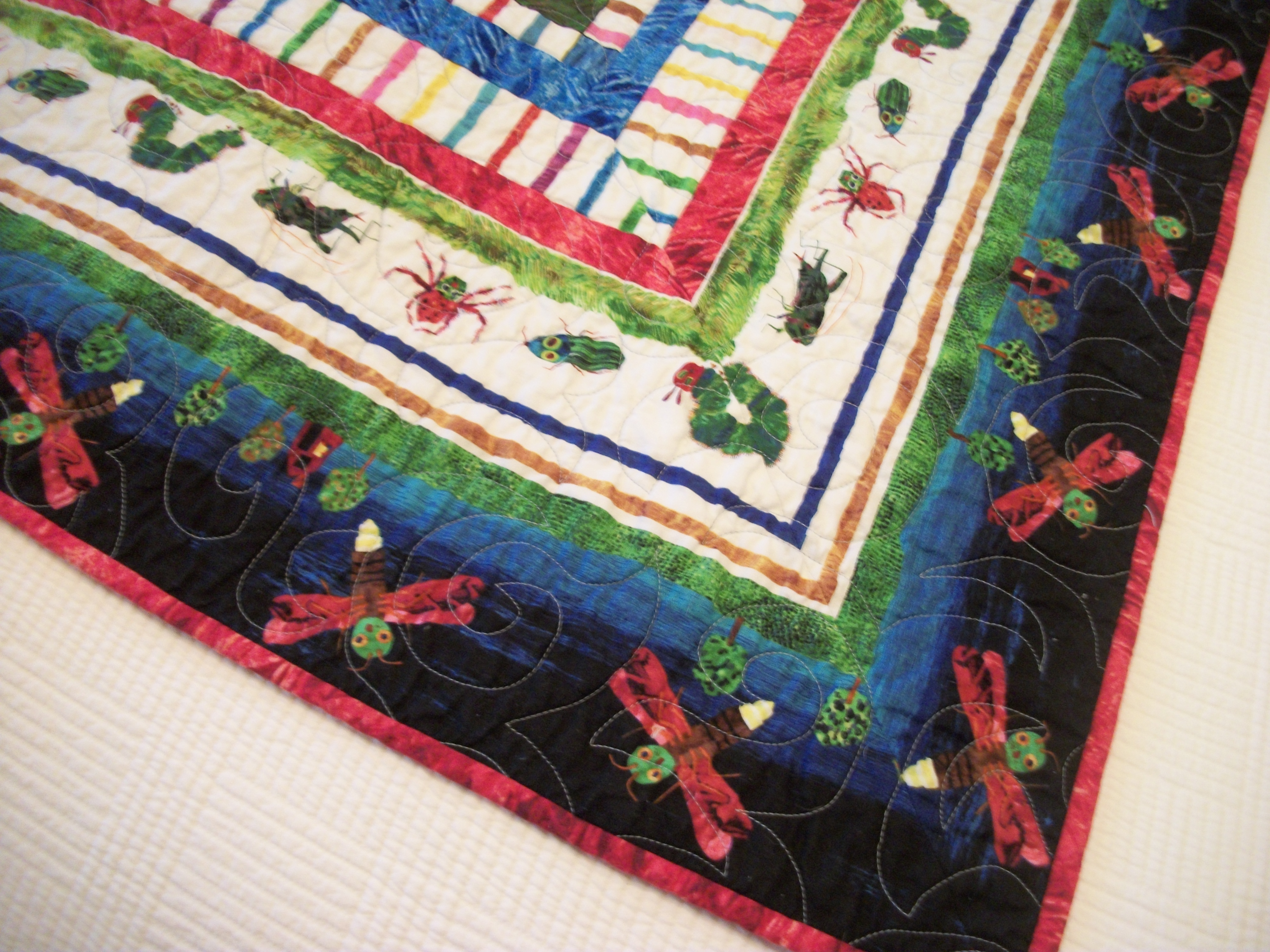
I realized with some horror that this kit HAS MITRED BORDERS!   But I sucked up my dread, and look how pretty they came out.  We should all do more mitered borders as they really are so pretty and are not all that hard once you get the hang of them–especially if you are working with border prints.

One trick is to sew all your borders together and put them on the quilt as a unit.  The other is to be sure to allow for enough length for the miters in the borders themselves–at least 8 or 9 extra inches on each side, depending on how wide the border unit is.  I’m sure there are formulas in some of the books I have…

Here are some closeups of a mitred corner–don’t look at the big stripes, look at the red  and green borders:

Hungry Caterpillar mitered border

And:

Hungry Caterpillar mitered border 2

And of a star block:

Hungry Caterpillar block

And of the BIG sun block:

Hungry Caterpiller sun

And the BIG moon block:

Hungry Caterpiller moon

Here the quilt is ready to be quilted on “Lucy the Longarm”:

Hungry Caterpillar long arm

I quilted with the pantograph “Deb’s Swirls” in the medium size as I just wanted a general overall pattern that would not distract from the quilt.

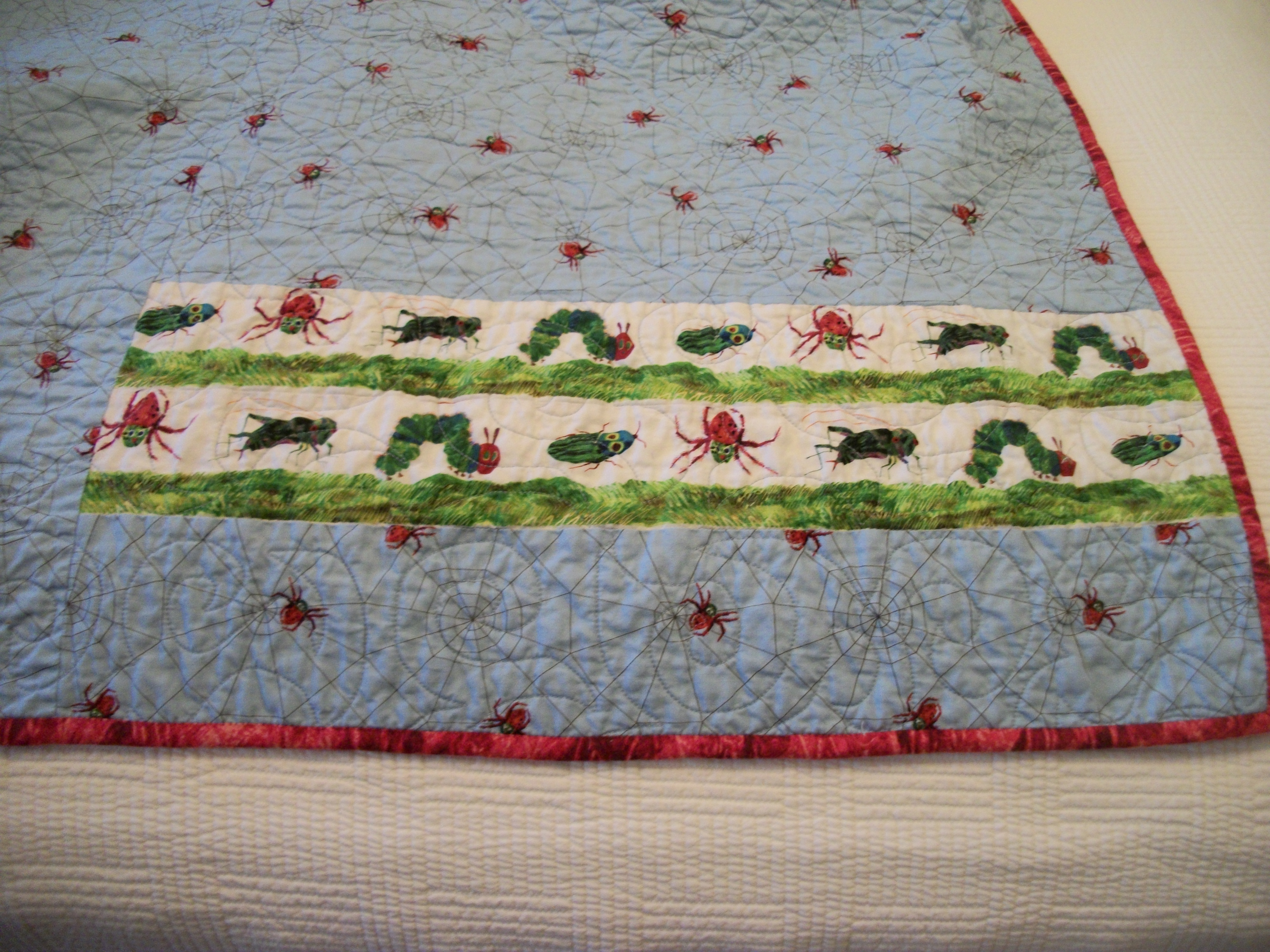
Here’s the backing:

Hungry Caterpiller backing

The kit did not give me enough fabric to do two side-by-side panels of the blue–and the narrow panel would have required a lot of piecing, so I used some of the leftover border print to fill out what was needed.  Bah Humbug!

And I made a label from more of the border fabric–Bonnie Hunter style–an 8-inch piece folded diagonally and basted into the corner before sewing on the binding:

Hungry Caterpiller label and backing

(This is my 90th quilt.)

I know this kit is lovely.  And the ensuing quilt is, too.  BUT, I found myself to be quite agitated while making the quilt.  I didn’t dare wash the given fabrics as I might throw something off–and I hated working with the starchy fabrics.  And I was always afraid I’d cut something wrong and be in a pickle since these fabrics are gone, gone, gone.

Well, now this quilt is done, washed, dried, and gone, gone, gone…

PS:  I’m putting the binding on the winding ways/wheels of mystery quilt–now named “Earth.”  It’s gorgeous!

Interesting Information: No Such Thing as Organic Canola Oil

Interesting Information:  November 20, 2013

No Such Thing as Organic Canola Oil

Bruce Fife, N.D., writes in the July/August 2013 issue of Well Being Journal that there is no such thing as “organic” canola oil (16).

He writes

“All canola oil on the market was developed by seed-splitting, which is really a form of genetic engineering, and essentially all canola oil on the market contains some Roundup Ready genetically engineered canola.  So if it is labeled organic, it really isn’t.”

Seed-splitting “alters genes in plants,” but is “considered a high-tech form of hybridization”–so ensuing plants can be labeled organic.

That’s how the market works, folks.  It plays games with language to hide what has really happened.   And part of what has happened is that all commercial rapeseed (wow, how’s that for descriptive language as to exactly what happened) has led to contamination.  Thus, there is no longer any “pure” rapeseed commercial crop–and organic rapeseed is fast being contaminated.

There are many, many reasons not to eat or use canola oil–but that’s for another post.

Interesting Information: “Is it Really Coconut Water?”

Interesting Information:  November 18, 2013

“Is it Really Coconut Water?”

Bruce Fife, N.D., asks and answers this question in the July/August issue of Well Being Journal (13-16).

First, a definition:  coconut water is the water inside a coconut that pours out of the center when you open the coconut.

Secondly, real coconut water has amazing healing properties and is used in the tropics to fight dehydration and heat stroke.  Fife writes that “recent research suggests that it may also be useful in treating or preventing cancer, high blood pressure, atherosclerosis (hardening of the arteries), heart failure, stroke, glaucoma, kidney stones, osteoporosis, and Chron’s disease.”

Coconut water works at the cellular level to “extend the youth of cells.”  So,  yes, it might have some anti-aging properties.  And it works better to preserve transplant organs than the chemicals industry was using.

Thus, the market has picked up on coconut water and is presenting us with choices.

ONLY–and you know what’s coming now–most of what’s sold is NOT a product that will offer you anything but calories and sugars.

The GOOD NEWS is that there are some really good ones, and I’ll list those in a minute.  First, understand that the problem is that coconut water is harvested in the tropics and needs to come from young coconuts that haven’t aged unduly by long shipping times.  And, as Fife writes, “once the coconut is opened and the water extracted, it beings to ferment and the taste and smell rapidly changes.”  Thus, industry uses high-temperature/short-time pasteurization…which destroys some of the coconut water’s nutrients and much of its flavor.”  Additionally, some companies make a concentrate by boiling the coconut water down.  Of course that kills all the “good.”  And some companies attempt to dry the water into a powder that you reconstitute.

If the coconut water you’re looking at has been bottled or packaged somewhere where coconuts don’t grow, it’s reconstituted from a concentrate and likely has added sugars for flavor.  And the usual suspect preservatives.

Powdered coconut where you add the water is…useless.  Don’t even go there.

****

What you want to look for is coconut water that has been frozen on the spot and remains frozen until you thaw it or it’s put into a store’s refrigerated section.  Fife lists the best brand as HARMLESS HARVEST, sold at Whole Foods.  This product is completely raw and is not heat pasteurized.  (Guess where I’m stopping on my next trip to Portland, Maine.)

Exotic Superfoods (www.exoticsuperfoods.com) also freezes coconut water on the spot and can ship to you frozen.  I have no idea what it costs.

Any and Brian’s coconut water is listed by Fife as being solid.

Noelani Coconut Water and Beverage Company imports whole young coconuts from the Caribbean within two weeks, but they only service Connecticult, New York City, and northern New Jersey at the moment.

I hope this helps you discern how to buy this product and not to waste your money or spoil your health on a high-sugar highly-processed product.

Interesting Information: Can This Really Be True?

Interesting Information:  November 18, 2013

Can This Really Be True?

Health officials recommend giving new-born babies a hepatitis B vaccine, followed by two more shots before 18 months of age.

Why? Since hepatitis B is NOT a childhood disease and not a common threat to newborn babies?

I stumbled on an answer in the July/August 2013 issue of Well Being Journal (page 47).  The story is from a March 26, 2013, posting on the Mercola web site:  “Teens Susceptible to Hepatitis B Infection Despite Vaccination as Infants.

First, hepatitis B is a “primarily blood-transmitted adult disease associated with risky lifestyle choices such as unprotected sex with multiple partners and intravenous drug use involving sharing needles.”

IN FACT, this article states “according to the National Vaccine Information Center (NVIC):

`The primary reason that the CDC recommended hepatitis B vaccination for all newborns in the United States in 1991 is because public health officials and doctors could not persuade adults in high risk groups (primarily IV drug abusers and persons with multiple sexual partners) to get the vaccine.’

“But now,” the article continues, “new research has shown that by the time a child reaches his or her teenage years–the time when acquiring a hepatitis B infection may be more likely–the protection from the childhood vaccine may have long since waned.”

And that’s one of the dirty secrets about vaccines:  they don’t last.  So you’ll need to use more boosters along the way, with more junk injected into a body by its back door (a puncture wound).

So let’s be clear.  Our public health officials are choosing to put heavy metals and adjuvants like formaldehyde into newborn, fragile babies WHEN THEY KNOW THEY DON’T LAST.

No wonder 1 out 6 children today have neurological issues.

This practice is NOT about science or health–it’s about drug companies and self-interested doctors making more money.  And their vehicle is the “standards of care” that ensures that doctors have to suggest such a practice as this one or lose their licenses.

This is how industry works if it is not fettered to morals and ethics.

Vaccines are NOT safe for everyone.  They may not be safe for anyone, given their components.  But who know, since few are doing the science to justify them and the science that is showing they are not safe is being ignored.

A tiny newborn–not fully formed, needing adult protection and nourishment, struggling to get some purchase in this life…

Shame, shame, shame…

Do your research on this issue folks…

Turkey Tracks: Leah Day’s Video: Sewing Hexies

Turkey Tracks:  November 18, 2013

Leah Day’s Video

Hand Piecing Hexies

The post previous to this one discusses sewing hexies at some length–and gives some current texts.

But, Leah Day’s weekly post this week consisted of terrific videos on how to design and piece hexies.

And, you should be aware that the old whip-stitching method has been, thankfully, replaced by a better method.

The Free Motion Quilting Project: 73. English Paper Piecing Part 2: Turning Hexagon Edges.

Enjoy!

PS:  If you are a quilter and have not signed up for Leah Day’s blog, you might seriously want to consider doing so.

Turkey Tracks: I’m Obsessed: Hand Sewing

Turkey Tracks:  November 18, 2013

I’m Obsessed

with

Hand Sewing

It’s official.

I’m obsessed with hand sewing.  I have one project going and two more planned.  And I can’t wait for dark to fall so I can settle in and hand sew while watching something fun on the television.  Though just at the moment I’m hand-quilting the clam shell quilt which is, as yet, nameless, but not homeless.  And, I’m putting the binding on the Winding Ways/Wheels of Mystery quilt which I’m naming “Earth.”

I think my obsession all started with Bonnie Hunter’s numerous posts on her hexie projects.  Hexies are all the rage in quilting these days, which I’m sure most quilters know.  And these projects are NOT your grandmother’s flower garden variety.

Or, maybe it was seeing the gorgeous quilt that Rhea Butler of Alewives quilting, in Damariscotta Mills, Maine, from Kathy Doughty and Sarah Fielke’s MATERIAL OBSESSION 2 book.  (Those gals are from Australia, the home of fantastic quilting.)

I did a hexie project a while back–a challenge to depict a grocery store product–I chose Green Hive Honey, a local raw, unheated honey.  That quilt was called “A Thousand Flowers” since that’s what it takes to make a ridiculously small bit of raw honey.  (You can search for it elsewhere on the blog.)  I found sewing the hexies tedious–especially the whip stitching that joined them.  And the stitches showed in a way I didn’t like.

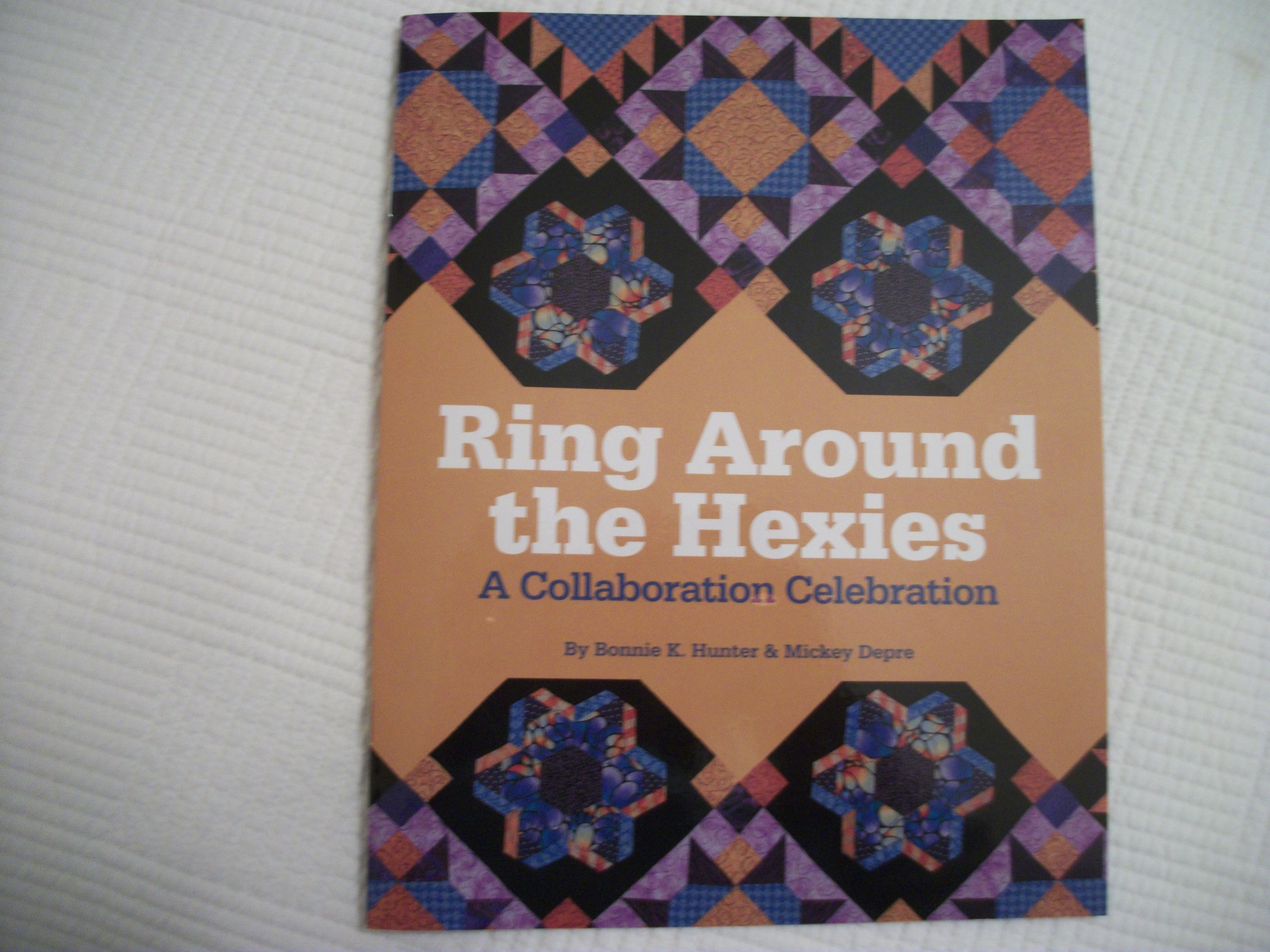
BUT, But, But!  There is a better way to do this whole process.  And I began to discover that only recently with Micky Dupre and Bonnie Hunter’s book, RING AROUND THE HEXIES:  A Collaboration Celebration.

Hexie blocks

You can English Paper Piece the hexies and then the way you join them is NOT with whip stitching.  I’m posting a video from Leah Davis that’s a close-up of her hands piecing hexies in the “new” way in a separate post.  (Ask and you shall receive from the universe.)

So, Bonnie makes a pieced quilt, leaving, in the above case, blank black squares on-point.  Micky pieces a hexie formation–and she manipulates the hexies to get interesting color changes–and appliques her arrangement onto the quilt.  They are beautiful.  The resulting quilt is beautiful.

But, I think my own obsession stemmed from Rhea Butler’s quilt from MATERIAL OBSESSIONS–hanging in Alewives.  And somehow I did not take a picture of the whole quilt.
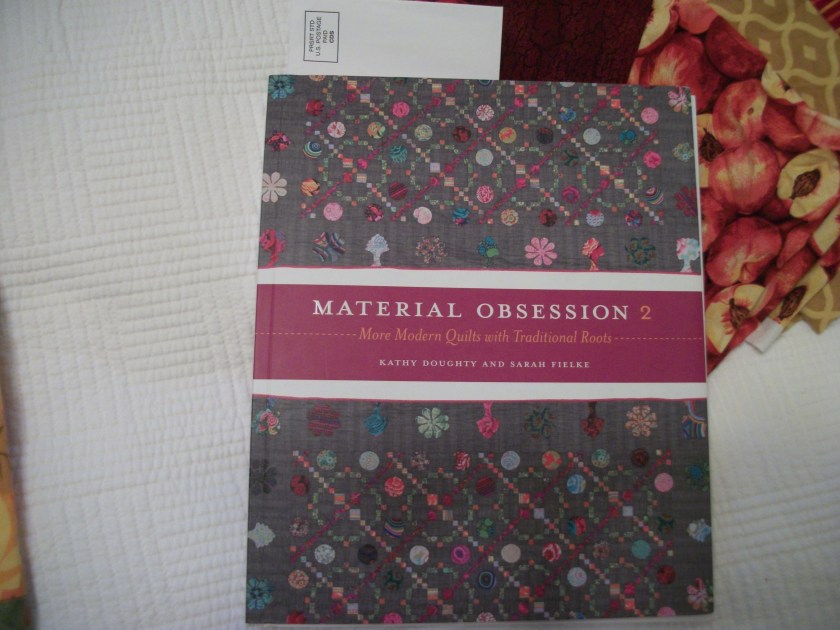
Kite Block book

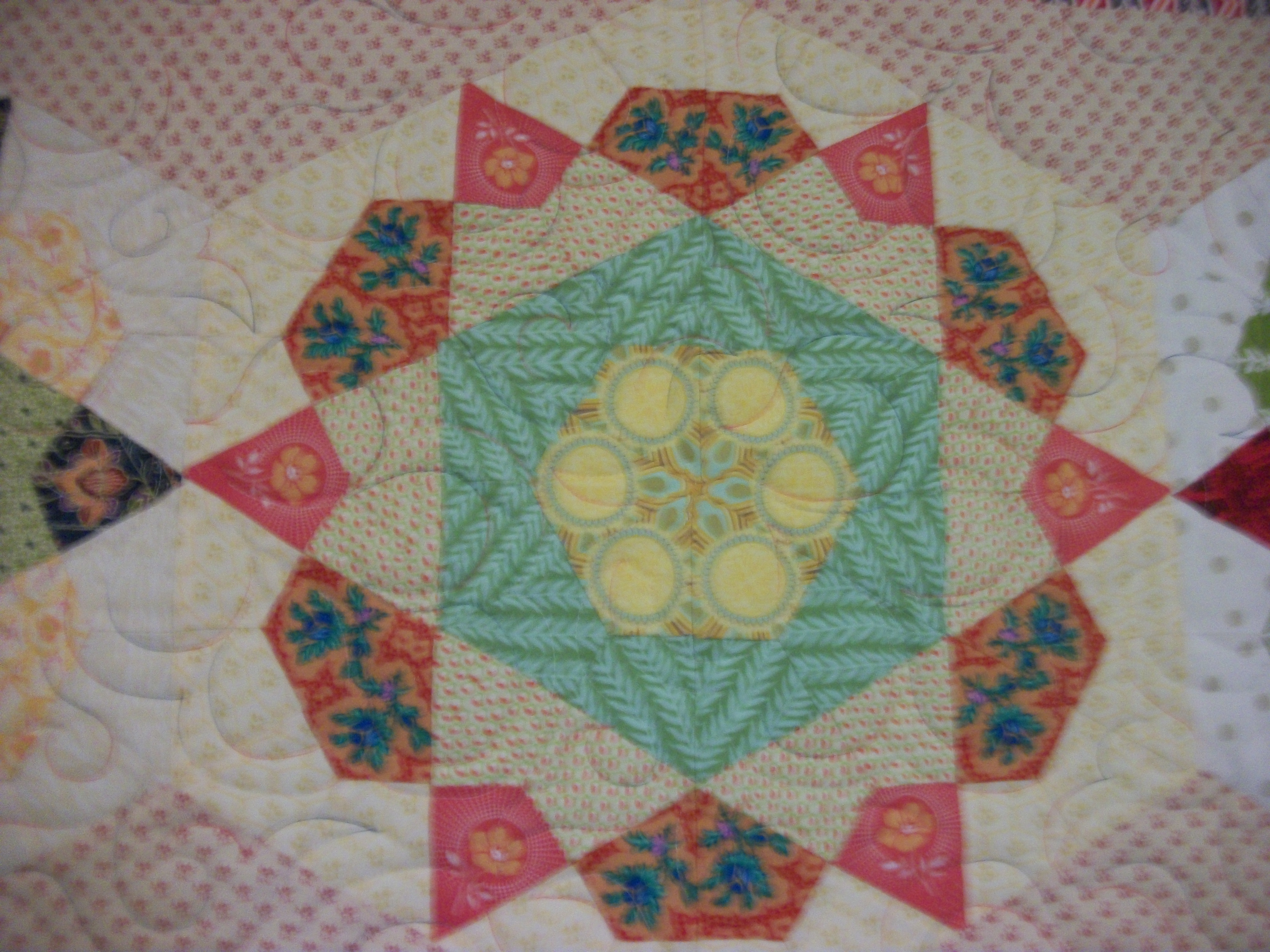
That quilt is made of large hexies–all constructed from a kite-shape (a quadrilateral) that when combined forms a hexie.

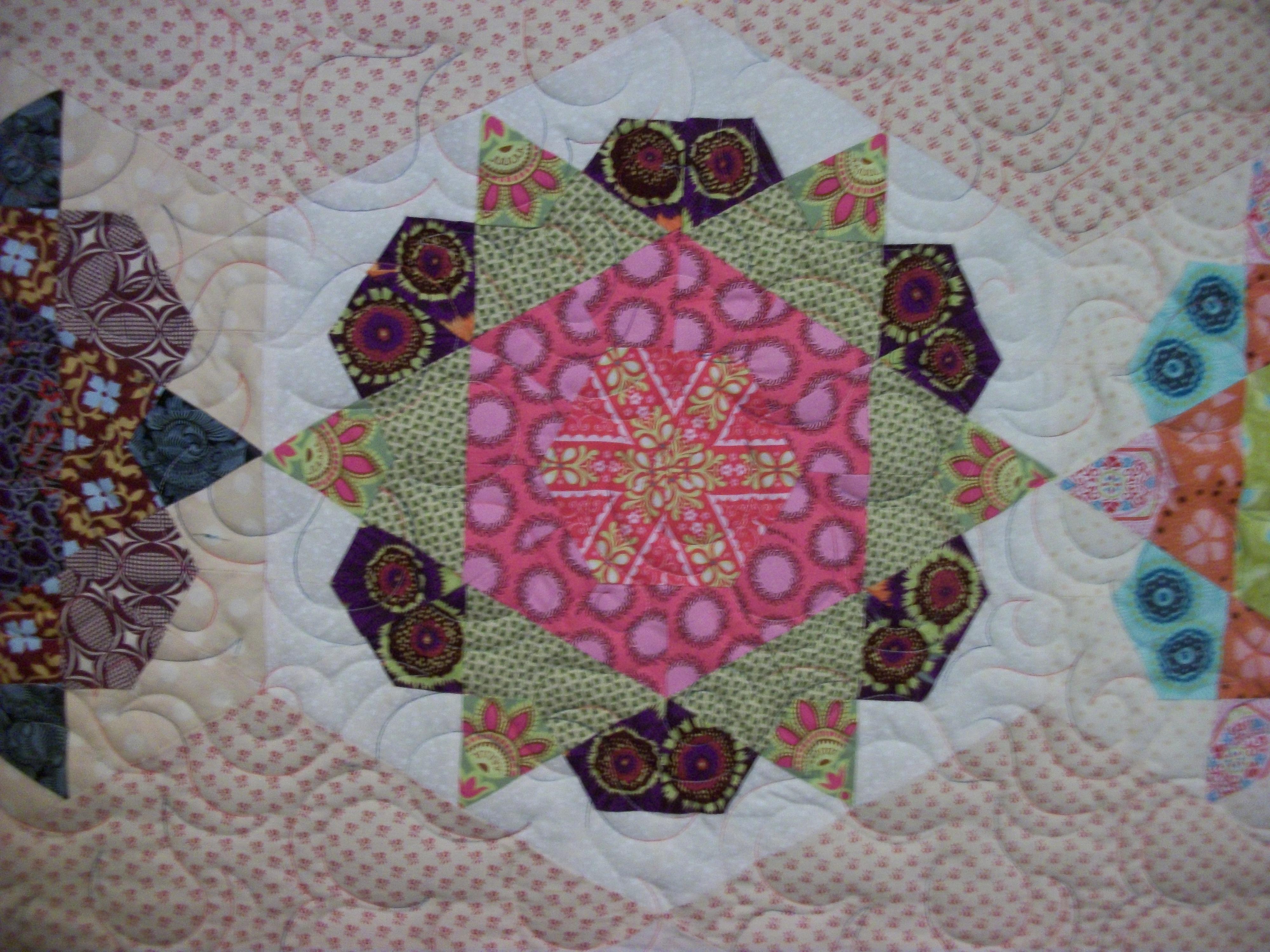
Here are some examples of those bigger blocks.  You can see the “kite” in the dark, outer prints with circles–it takes two “kites” to form that dark patch.  The outer neutral fabric is also made of the “kite” shape.  The red dotted fabric is used to link a line of blocks together–it’s a large diamond shape.

Kite Template block

And, here hyou can see the kite shape a bit better:

Kite block 2

These big hexies are joined with interesting geometric shapes and lavish, BIG borders from contemporary fabrics.

Here’s fabric for my first try at these blocks–and you can see the kite template.  The dark fabric will be used on the outer ring.  I suspect the peach fabric will form the inner ring.

Kite Block fabrics

I was going to do these by hand, but Rhea says they sew well on the machine, too.  So, I’ll play around.

BUT, if I’m not going to hand-sew these, what is going to occupy my fingers?

This project I suspect:

Take a hexie and pull out the sides, and you get a “honeycomb” hexie.  And back in the day in England, a woman named Lucy Boston used that shape to construct the most amazing quilts.  Rhea Butler was already playing with this honeycomb hexie when I saw her last.

Here’s the book, done by Linda Franz, and a packet of honeycomb papers.  One varies the block by varying the fabric color within the block.

Honeycomb blocks

Whatever I do I’ll pull from the stash.

So, on to Leah Day’s excellent video.

Books, Documentaries, Reviews: New Books In The Mail

Books, Documentaries, Reviews:  November 14, 2013

New Books In The Mail

Look what came in yesterday’s mail?

Books

And Stephen Kinzer’s THE BROTHERS, about the Allan and Foster Dulles, rolled in a day later.

I’ve never read Donna Tartt’s work, but listened to a really great review about this author and this novel.  It’s a big sprawling thing.

And, Jill Lepore’s work on Jane Franklin is also all over the media and is being reviewed really well.  I love it when women’s voices from the past get reclaimed and surfaced.

It’s going to be a good winter of reading.

Turkey Tracks: Jo Diggs Visits Coastal Quilters

Turkey Tracks:  November 14, 2013

Jo Diggs Visits Coastal Quilters

Jo Diggs, of Portland, Maine, visited Coastal Quilters for our November 9th meeting.

We are so lucky to have so many nationally recognized quilters here in Maine, and Jo Diggs is a bright star among that number.   To top it off, Jo is funny, clever, gracious–a lovely, lovely lady.

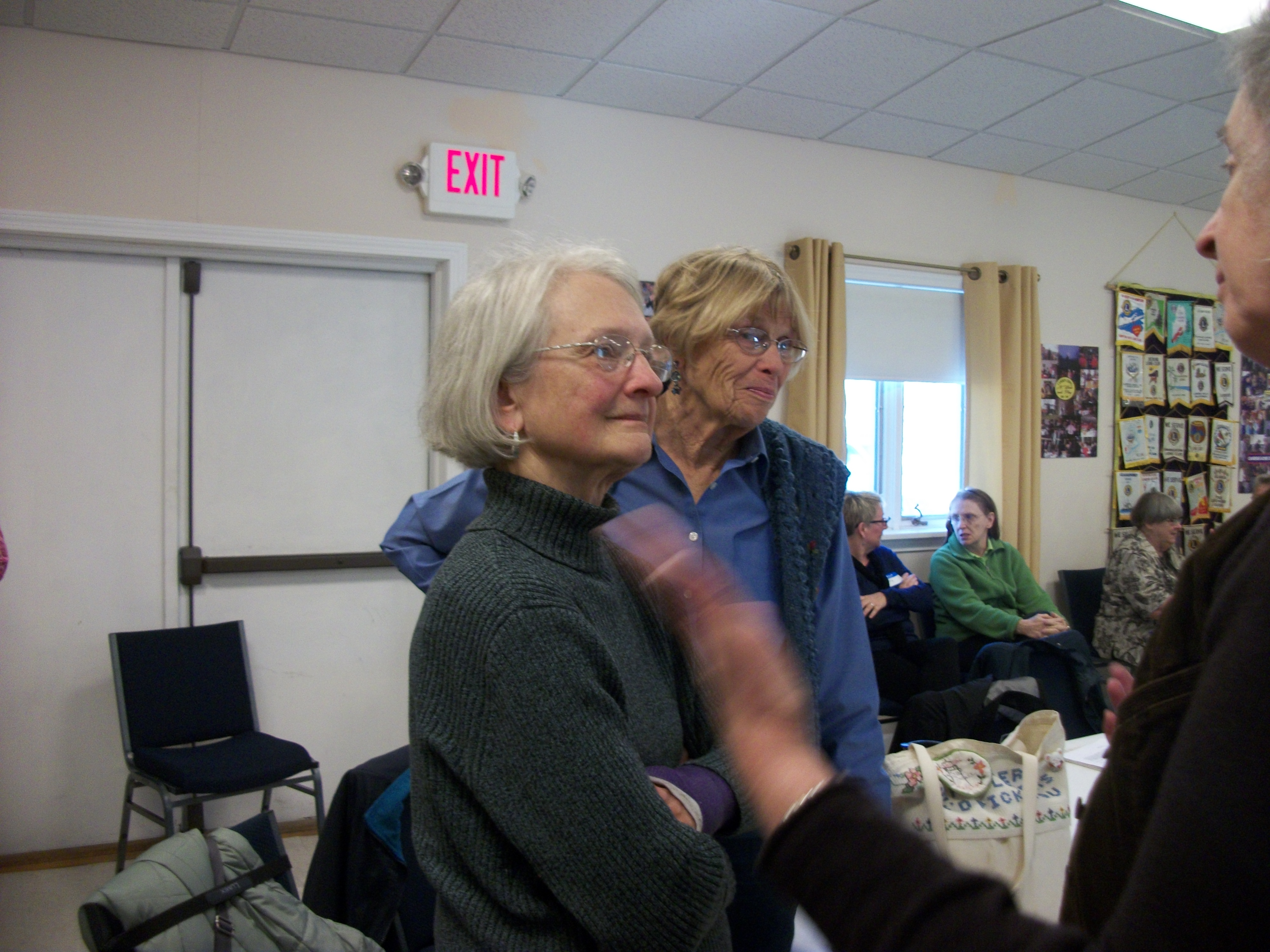
Here she is (grey sweater) talking to our members after her trunk show.

CQ, Jo Diggs, Nov 2013

I took LOTS of pictures.  But my little camera just didn’t do justice to her work.  So, I’ve posted a link to her blog where you can enjoy really good pictures of her work.  So, take a minute and take yourself on a little art outing.  Jo’s work is applique, and she does large and small art pieces–though in the future, she says, she is going to concentrate on large pieces.

Gallery.

ENJOY!

Books, Documentaries, Reviews: Sisterland: A Novel: Curtis Sittenfeld

Books, Documentaries, Reviews:  November 7, 2013

SISTERLAND

Curtis Sittenfeld

I  finished Wish You Were Here, Steward O’Nan, the other day.  And, moved on last night to Curtis Sittenfeld’s Sisterland.

In the opening pages, I discovered that there was a great earthquake in the midwest in the early 1800s.

Sisterland takes place in St. Louis, Missouri.  The opening date is 2009.

Two identical twin sisters:  the narrator twin is married with two children; Vi is single.  They may have psychic powers.

The sisters have lunch together and argue.  That night there is an earthquake tremor.  The frightened parents gather their children and put them into their bed.

Here’s text from the opening chapter:

I felt them falling asleep one by one then, my son, my daughter, and my husband.  Awake alone, I experienced a gratitude for my life and our family, the four of us together, accounted for and okay.  In contrast to the agitation I’d been gripped by before the earthquake, I was filled with calmness, a sense that we’d passed safely through a minor scare–like when you speed up too fast in slow highway traffic and almost hit the car in front of you but then you don’t.  The argument with Vi, inflated prior to the quake, shrank to its true size; it was insignificant.  My sister and I had spent three decades bickering and making up.

But now that several years have passed, it pains me to remember this night because I was wrong.  Although we were safe in that moment, we hadn’t passed through anything.  Nothing was concluding, nothing was finished; everything was just beginning.  And though my powers weren’t what they once had been, though I no longer considered myself truly psychic, I still should have been able to anticipate what would happen next.

Ok, I’m hooked!

I’ve read Sittenfeld’s American Wife, so know her abilities.  This book is going to be gooooood!


Sisterland: A Novel: Curtis Sittenfeld: 9781400068319: Amazon.com: Books.

PS:  Wish You Were Here is a lovely read.  I especially enjoyed the exploration of how a family comes together–or doesn’t–with all their complicated relationships–after the death of the father/grandfather.