Turkey Tracks: Lacto-Fermenting Project

Turkey Tracks:  December 7, 2013

Lacto-Fermenting Project


I got it into my head that I needed to make a good bit of lacto-fermented foods right away.

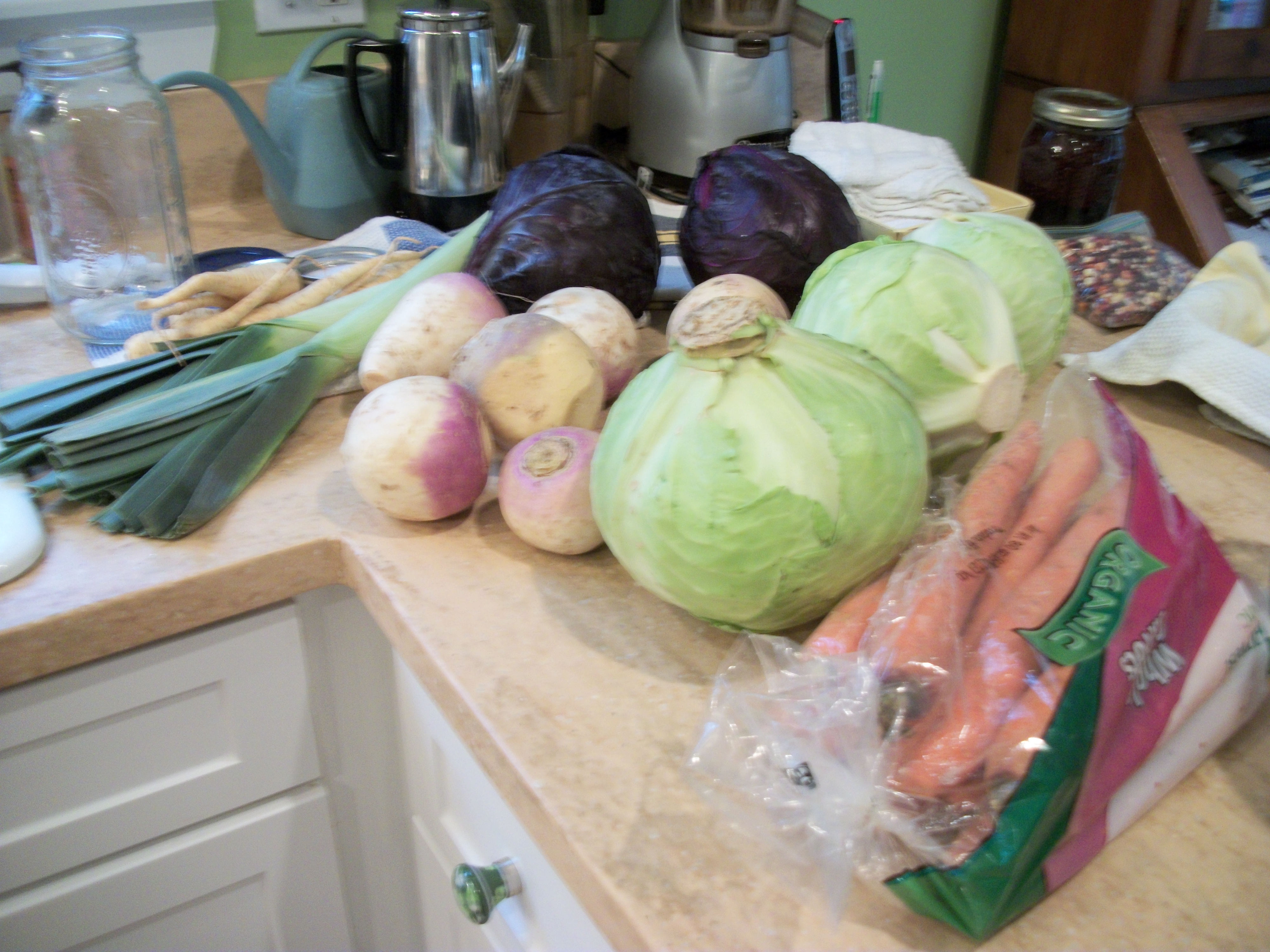
Thursday saw me buying a huge bag full of cabbages (red and white), leeks, turnips, rutabegas, and parsnips.  I already had a big bag carrots.  And the garden is full of kale.

Veggies to Lactoferment

Here’s the spread:

Veggies on counter

And the kale from the garden.  I also brought in handfuls of the last of the sage, which is a bit more winter hardy than the other herbs:

Kale from garde

On Friday, I started food processing.  I had two projects:  to make a new batch of the root veggies I LOVED over the past few months.  The first batch was just turnips, carrots, garlic, and sage.  This batch would have also parsnips (very sweet) and rutabegas and red onion.

I don’t know how to describe the taste of this turnip mixture.  It does not taste like turnip.  It does have a bright, fresh taste that is delightful–much as Sandor Ellis Katz promised in his book WILD FERMENTATION.

The second project was some mixtures of cabbage (red and white), leeks, onions when I ran out of leeks, kale, carrot, one had a turnip, more garlic, and sage.  I decided to do at least two mixtures of just cabbage, carrot, and caraway seeds–the traditional mixture from NOURISHING TRADITIONS (Sally Fallon Morell and Dr. Mary Enig of The Weston A. Price Foundation) with which I started this journey.

The project went rather well:

Lactofermented veggies, 4 gallons

There is a gallon of fermented cabbage in the crock.  I transferred it to jars this morning.  So I have almost 4 gallons of delicious food.

The orange is the root veggie mixture.  The cabbage mixtures will turn bright rosy pink in a few days–from the red cabbage effect.

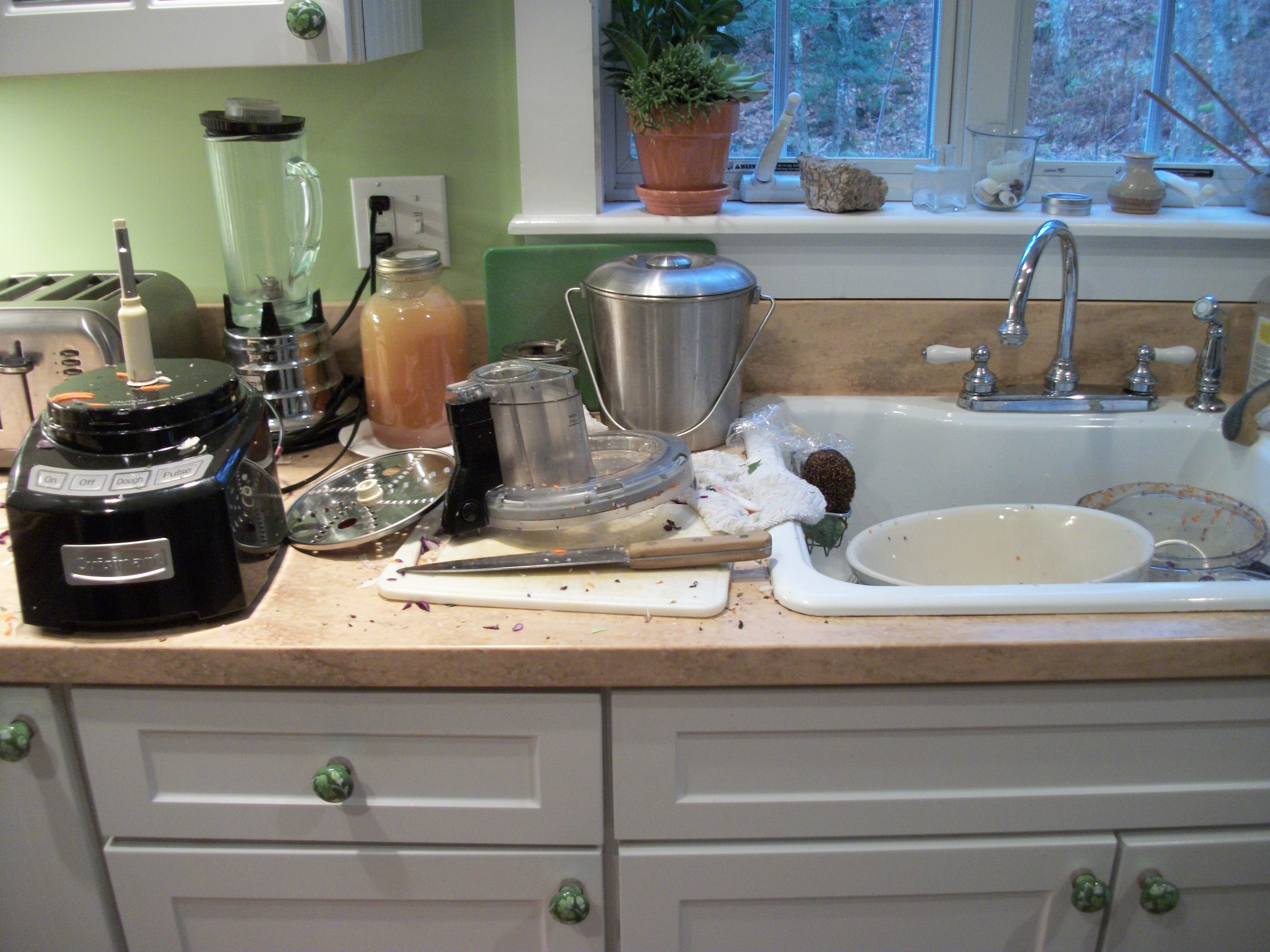
The kitchen was a mess when I was done.  (You should have seen the floor.)

veggies, kitchen wipeout

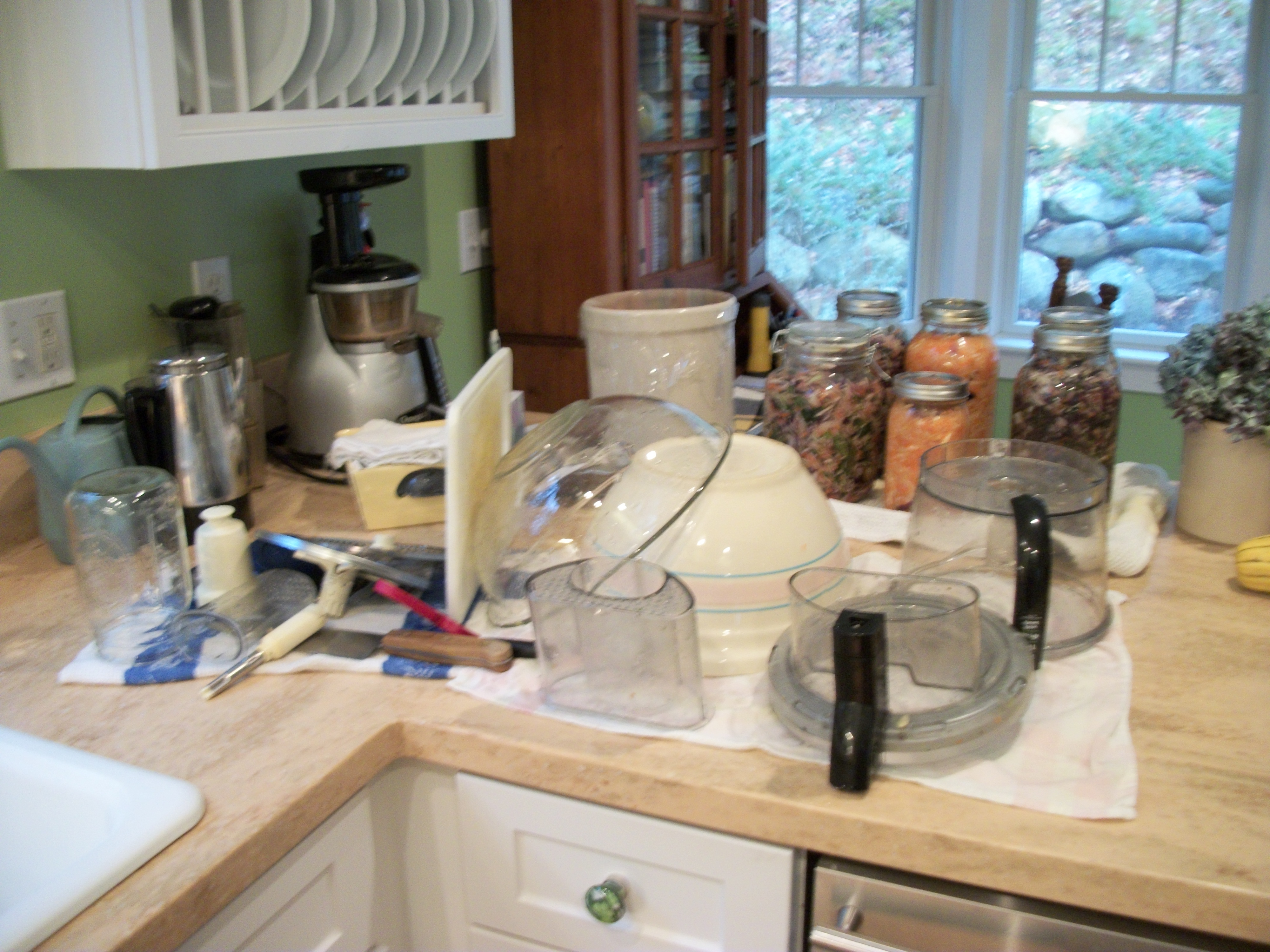
But it cleaned up quickly as no grease was involved:

Kitchen clean-up

Hint:  the jars will be so pretty with a red ribbon and a Christmas Card attached, don’t you think?

Shhhhhh…..

And I’m not giving away the big root veggie jar or the jar with the hinge.  They’re for ME!!

Turkey Tracks: Celtic Solstice Quilt Update

Turkey Tracks:  December 7, 2013

Celtic Solstice Quilt Update

The first “clue” for Bonnie Hunter’s 2013 mystery quilt, Celtic Solstice, came out November 29th, the day after Thanksgiving.  Following “clues” will come out each Friday.

Bonnie Hunter is a scrappy quilter, so if, for instance, one needs “blue” for a task, one gets many shades out of one’s stash.

We were to make 188 (for the 75 x 75-inch quilt–there are many more units for the king-size quilt Bonnie made) block units that will form a star.  About half of the blue stars have a scrappy  orange background and half have a neutral background.  I put four together of each so you can see what will happen eventually.  We will obviously be making the center of the star at some point.

Celtic Solstice, first clue

I finished these 188 units Friday night.

The new clue came out early Friday morning–and the email traffic on the Facebook group dedicated to this project has been humming.  As have sewing machines.

The new block is a chevron of green, yellow, and neutrals.  One hundred of them.  My patches are almost cut out now…  And I’m going straight to the sewing machine after I’m done with the blog.

You should see some of the beautiful blocks, and also different color combos than Bonnie used, people are making.

Inspirational!

If you’re interested in making this quilt, go to quiltville.com, click on the blog button, and in the masthead, click on “Celtic Solstice Mystery.”

Interesting Information: Vaccines In Your Body: How They Really Work (Or Don’t)

Interesting Information:  December 4, 2013

Vaccines In Your Body

How They Really Work (Or Don’t)

I’ve looked for some time for a simple explanation of how vaccines work (or don’t) in your body.

Shane Ellison, also known as The People’s Chemist, explains in his Over-The-Counter Natural Cures that vaccines come through the “back door” of the body–through a puncture wound–which breaches the body’s first line of defense:  the skin.  Vaccines are supposed to “trigger” the immune system, but because they are entering the body through the back door, “they fly below our immunity radar, rendering many of them ineffective” (96).

Ineffective at least in part means a short shelf life.  I’m beginning to read that drug companies and most doctors are realizing that vaccines have a limited range of effectiveness–maybe up to two years.  So now, in my opinion, they have a conundrum:  should they recommend booster shots,  a practice that would mean more money, but which would certainly increase the harm from vaccines, which could result in everyone stopping drinking this particular koolaid mixture, which would mean no money.  I’m betting they will play around the edges of keeping the status quo.

But what goes on inside the body once a vaccine has entered it? 

Why is the vaccine response ineffective?

I finally got my answer in an article by Thomas S. Cowan, MD, in the Spring 2013 edition of The Weston A. Price Foundation’s journal, Wise Traditions.

The link:  Preventing and Treating the Flu – Weston A Price Foundation.

Dr. Cowan explains that we have two immune systems:  the cell-mediated or Th1 (thymus derived) immune system and the Th2 immune system which targets extracellular (outside the cell) infecting agents (like worms) or foreign proteins and which “produces antibodies that call for a killing response before the offending agent gets into our cells and makes us sick” (50).

Dr. Cowan explains that the Th1 system is intracellular (inside the cell):

It primarily works through the production of white blood cells that essentially digest and then excrete cells (for example, in our throat or bronchial tubes) that have been infected with a virus or bacteria.  The consequences of a cell mediated response, that is, the digestion and excretion of dead and infected cells, are what we call sickness.  In other words, fever, rash, cough, mucus and so forth are not caused by the virus but by the body’s response to the virus.

When you get a naturally occurring infection “both immune systems respond, first the cell-mediated to clear the virus, then the antibody or humoral system to make antibodies to remember what happened so our cells don’t get infected with the same pathogen more than once.”

The degree of “severity of any particular illness is a function of how many cells are infected and the strength of our cell-mediated response.”  And, “whether we get repeated sickness is related to whether we can make an effective antibody response.”

So, and this part is important, if we have a strong immune system, we throw off infection quickly and gain immunity to that infection/illness for life.

Dr. Cowan writes that “the cell-mediated exercise is largely responsible for immunity to cancer, auto-immune disease and other chronic conditions.”

So, vaccines “deliberately” try to “bypass the cell-mediated immune system and only provoke a humoral response.   And Dr. Cowan notes with sly humor that “if a vaccine provoked the cell-mediated immune system, it would just make us sick and no one would agree to them.”

And, so, vaccines shift us into “what is called a Th2 dominant mode, an imbalance in which the humoral immune system is too strong and the cell-mediated immunity is suppressed.”

Here’s the kicker:

This leaves us with no avenue to clear the poisons that we have just been injected with from our tissues; it leaves us with chronic inflammation as our bodies struggle to clear these inflammatory toxins, such as mercury, formaldehyde and dead viruses, and an increased susceptibility to chronic disease.  An overactive humoral immune system often leads to auto-immune disease, where the humoral immune system attacks our own tissues.

Dr. Cowan goes on to name sugar and refined carbs as trouble in that they “blunt the immune response and should be avoided as much as possible.”

Dr. Cowan discusses preventative and helping strategies, like cod liver oil and elderberry extract.  For more detailed advice and remedies you many want to keep on hand, you can read the article for yourself.

Some questions to ponder:

If vaccines are hobbling the normal working of our immune system function, could that help account for the horrific rises in cancer?

Heavy metals like mercury and aluminum damage the brain–do vaccines set in place future cases of neurological diseases like Parkinson’s?  Especially if the body can’t clear these toxins properly?  Neurological diseases are also on the rise…

Interesting Information: Chandler Webb: Flu shot killed son, Utah mother claims

Interesting Information:  December 4, 2013

Flu Shot Killed Son, Utah Mother Claims

Chandler Webb

We are bombarded with media pleas to get a flu shot these days–even though there have been many mainstream stories questioning the efficacy of the flu shot.   There are even signs in drug stores and grocery stores that advertise that you can get the shot in those places.

There are few stories of the danger involved in getting ANY vaccine in the media.

But, here’s one.  A very sad one.

Chandler Webb: Flu shot killed son, Utah mother claims.

If you watch the video you will see that a CDC doctor does acknowledge that the flu shot can cause encephalitis (an infection of the brain) and death, but this doctor claims that death is very rare.  And you will see that many tests were done on Chandler Webb to see if anything on earth BUT the flu shot made him so sick.  In the end, the doctors had to admit that the flu shot was the culprit.

The burning question is not only how rare death is, but what kinds of damage are done by vaccines every day.  That information is not being pursued, and you can understand why.  The money involved with vaccines is, simply put, enormous.

So, again, as is raised in the documentary THE GREATER GOOD, how many people are being seriously hurt or killed to promote “the greater good” of having some kind of projected “herd immunity”–an actual scientific concept that is being vastly misused in the vaccine propaganda.

There may be a place for vaccines.  More and more I think not.  But that’s my decision for me.  It is crystal clear, however, that vaccines pose a real danger to many people and that there needs to be some kind of testing for vaccine reactions before they are given.

I will follow this post with one by an MD who explains how vaccines work in your body.  Or, don’t work.

Books, Documentaries, Reviews: GROWING OLDER, Joan Dye Gussow

Books, Documentaries, Reviews:  December 2, 2013

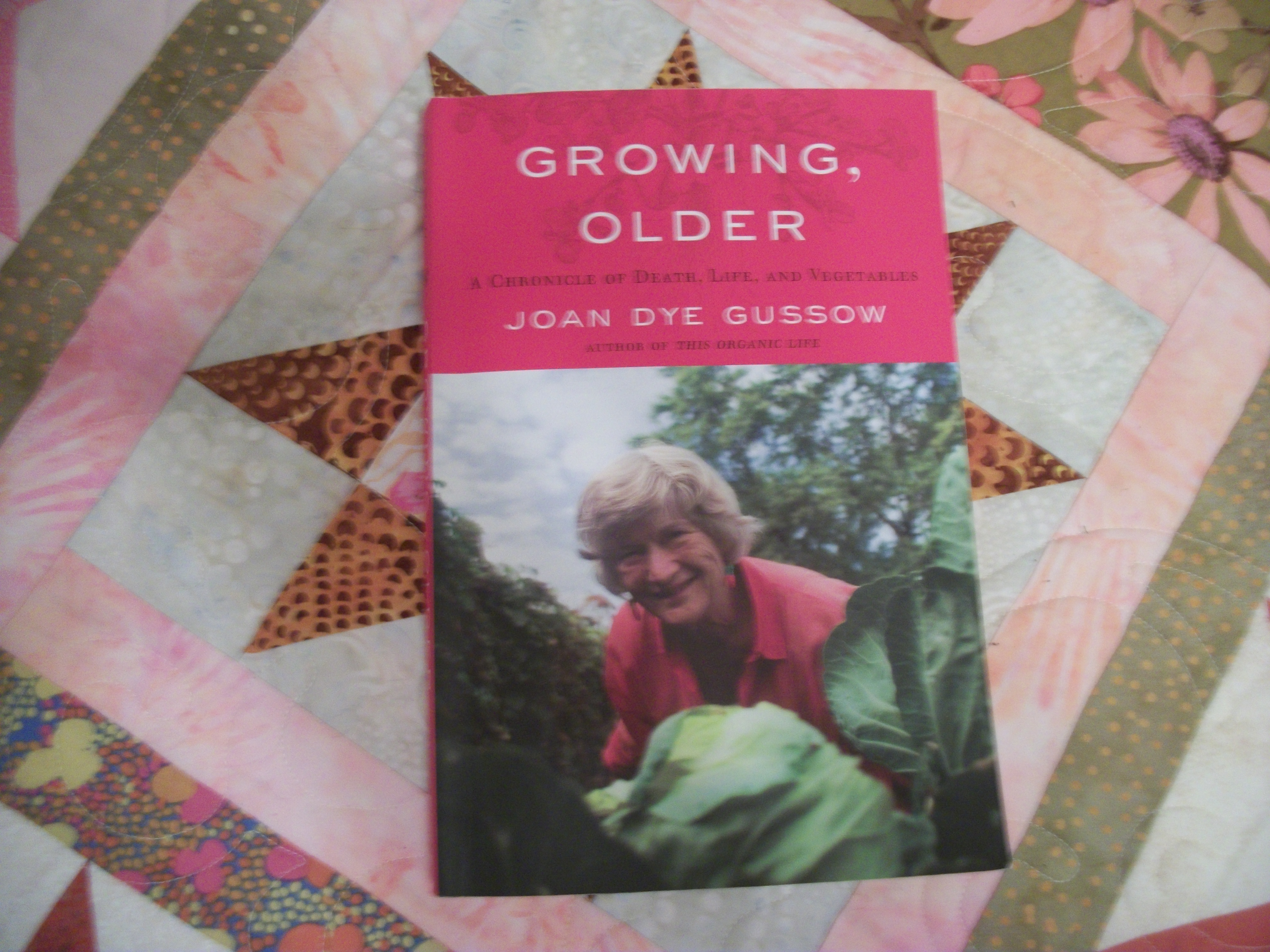
Growing Older

Joan Dye Gussow

Kathleen Nixon recommended Joan Dye Gussow’s This Organic Life shortly after we moved to Maine.

I read and loved it.

Of course I did.  Here was a woman who held and lived my values.
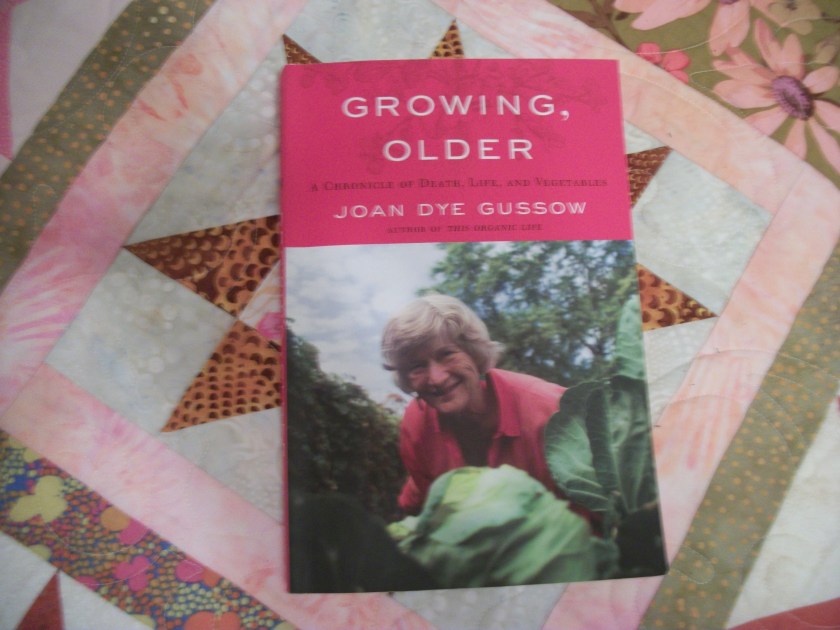
Growing Older

Gussow is a “food hero,” as she has spent much of her life addressing our flawed food system.  In addition, she helped pioneer urban gardening and attempts still to grow most of her food.  She is a Professor of Nutrition Education and was still teaching one course a year at Columbia University while writing Growing Older, which was published in 2010.  As of 2013, she is 85 years old.

For me, Gussow has been a huge inspiration.  She, too, lost her husband of 40 years to cancer when she was 68.  But she continued living her rich and thoughtful life.  Like me, she is passionate about food and health issues–and feels in many ways, as I do, like a Cassandra.  She can see the trouble brewing, but beyond trying to shine a light on the problems with her writing and by the daily choices she makes, is powerless to do much more than that.  She is feisty and will stick up for what she knows–and she does know what she knows after a lifetime of study.  She has, for instance, testified about industry advertising of bad foods targeted to children.

One of the issues Gussow grapples with in this book is her forty-year relationship with her husband.  Alan, an artist, was proud of Gussow’s work, but never really embraced it in a way that allowed intimacy between them.  And just about six weeks after Alan died, Gussow found herself skipping down a side-walk and was horrified that she felt such a lightness of being.  She promptly went to a counselor who helped her put her emotions into a perspective that enlarged her understanding of them.

She had an “aha” moment when the universe spewed up an article by Richard K. Moore called “escaping the Matrix”–which draws on the sci-fi film The Matrix, which posits that we are living in a ” `fabricated collective illusion’ ” about “who and what really runs the world” (31-32).  In the film “Morpheus invites Neo [love those names] to choose between a red and a blue pill.  The blue pill will allow him to continue living in any way he wants.  The red pill will allow him to see the truth.”  Joan’s “aha” moment comes when a friend notes that she has taken the red pill and Alan took the blue pill.

She writes:

Of course.  That explained so much.  I was always scrambling around trying to get to the bottom of things–figuring out what seemed to be “really” going on, and anguishing about the ills of the planet.  Alan, on the other hand, had a profound need to believe (or seem to believe) that the world–human and otherwise–was just as it appeared to be, with everyone liking him, everyone having honorable motives, and so on.  He left all suspicion, all bouts with reality, to me.  Since he managed his public world so smilingly, and so deftly controlled the situations in which he interacted, there were only a few occasions when life brutally asserted that his self-created picture was not the real world.  On those occasions, he was always deeply shaken and depressed.

Except when he wasn’t; except for the occasions when his capacity for denial astounded even me.

And she sums up in this way:

So the red pill/blue pill metaphor helped me understand, at last, what had on the deepest level isolated me from Alan.  To a truly remarkable extent, we were interested in the same global problems, and our areas of expertise overlapped rewardingly as many people noted:  He was trying to keep the natural world intact with art; I was trying to save it with food.  We once took a sociological test to assess our values and came out eerily similar; it’s just that we looked at the world from wholly different emotional perspectives.  I took our planet’s environmental distress really seriously; he couldn’t.  He could verbalize his anxieties about what was happening to the world, but he couldn’t really let them affect his emotions.  He could admire my passions, but he could not share or even really understand them.  My belated recognition of that solved a hundred puzzles that had littered our marriage (33-35).

It takes real guts to share such a story as this one.

But it’s an important sharing because one can expand the metaphor far beyond this husband and wife.  And, Gussow means it to be expanded, clearly.  Alan’s psychic burden of anxiety is not allowed to reach his emotions.  Or, maybe it’s that the anxiety is paralyzing his emotions.  In any case, the result is the production of a kind of non-action in terms of trying to make changes about lifestyle patterns, for instance.

I believe Alan’s “blue pill” stance is what is affecting most people today.  They don’t even know where to begin with changing the structural problems we face.  And those structural issues have become so enormous that maybe they can’t be turned around without, first, a catastrophe of some sort.  So we all just go on fiddling while Rome burns–if we want another metaphor we might understand better than the one in The Matrix.

It was such a relief for me to read Growing Older–on so many levels.  Long-term marriages (47 years for John and me) always contain phases, and the people within them change from time to time.  Some change utterly.  I did when I went back to school.  Like Stephen Douglas, who once said something like “when you’ve learned to read you can’t unlearn it,” I learned…to read.  And that made me different.  More like John in terms of education, which changed our power structure.  And more unlike John because my Cultural Studies degree called into question systems of cultural power of all sorts, like class, race, patriarchy, religion, etc.  John had done well under many of these systems.  And I am a grateful beneficiary of John’s success.  Our differences and my passions did produce the kind of intimate rift Gussow describes.  And, like her, I did feel a lightness of being when the struggle was over.

So, Thanksgiving and this quiet dark season produces reflection.  And last year at this time, John had only five weeks left of his life.  I have found myself over the past fall months, thinking about this count down to the first year anniversary.  And I am humbled by the reality that we never know what life will bring our way from one moment to the next.

Thanks you, Joan Gussow, for all of your wisdom and for all of your efforts to make a difference.

Turkey Tracks: Whole Foods’ Harmless Harvest Raw Coconut Water

Turkey Tracks:  December 2, 2014

Harmless Harvest Raw Coconut Water

You may remember that I did a post recently on the best available coconut waters–and I listed several brands.

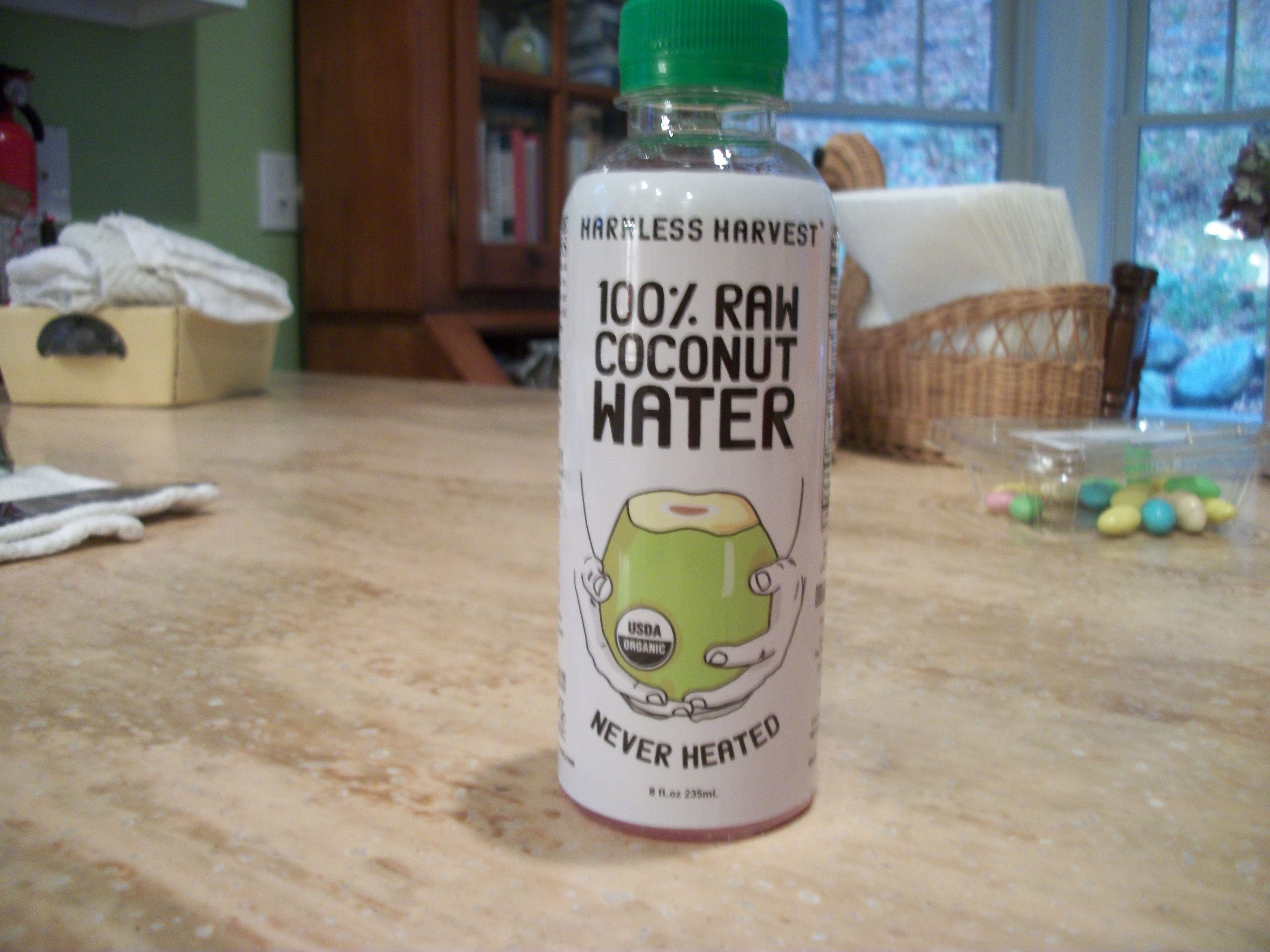
Friend Gina Caceci came for Thanksgiving–she’s a former (for me) Falls Church neighbor.  She had read my post, and after flying  into Portland and renting a car, she stopped by our nearest Whole Foods (2 hours away in Portland) and picked up a case of 8-ounce Harmless Harvest Coconut Water, which is completely raw.  She had preordered the case to be sure they had one on hand.

WOW!

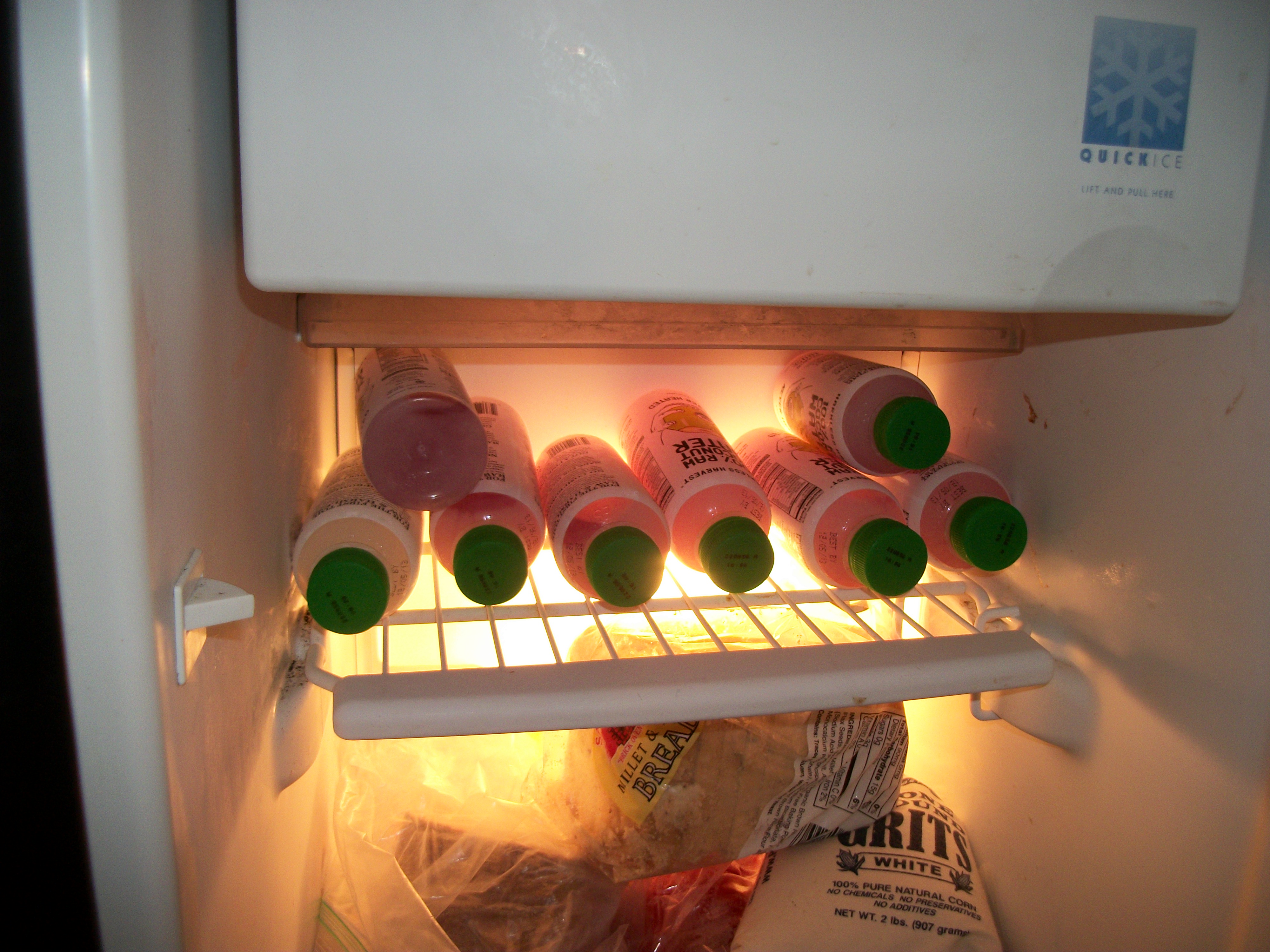
Harmless Harvest

And WOW! for the taste, too.

I find myself contemplating a road trip when this case is gone…

There is a short shelf life–and of course they have to be refrigerated.  So, I froze what we would not drink in the next few days.

Harmless Harvest in freezer

The pink ones are extra special because they have extra antioxidants.  Or that’s the claim…

There are a lot of pink ones in this case.

I have the most interesting sense of well-being after drinking the contents of one of these bottles.

THANKS! Gina


Turkey Tracks: First Snow

Turkey Tracks:  November 26, 2013

First Snow

I woke this morning to our first snow.

I love the stillness that comes with the first flakes–and the white sky.

We didn’t get much–but I didn’t start off on my errands until the roads were plowed.  Linda McKinney was here early, and she said the roads were very slippery.

Together we got the house ready for Gina Caceci (Falls Church, VA, beloved neighbor) and Maryann Enright (beloved SIL), both of whom will arrive tomorrow–God willing and the creek don’t rise.  (We are expecting weather tomorrow, but also warmer temps.)

I bought a handmade Christmas wreath at Good Tern Coop in Rockland this morning.  The fresh-cut greenery made the car smell so lovely all the way home.

That’s a bow made from birch bark.

Christmas Wreath

But what drew me in addition was the Pretty Bush (purple) berries.  We had a Pretty Bush back in Virginia, and I have not seen one here in Maine.  But, they must grow here as these wreaths are made from local plants.

Christmas Wresth detail

I will tuck some Christmas Balls into the wreath when I get around to it.

I am a staunch defender of keeping Christmas confined to December.  But Thanksgiving is very late this year, so it’s gobbling up Thanksgiving in all kinds of ways–not to mention that Black Friday has now become Black Thursday and Friday.  But that’s what the market will do if you don’t beat it back into a place that’s good for all people–including the ones that have to work for stores to be open.

I finished the big Wheels of Mystery Block quilt–now named “Earth.”  It’s gorgeous.  I’ll put up pictures after it lands at its new home–which will be after our December Coastal Quilters’ meeting on the 14th.  But here’s a picture of part of the top–I made many of these blocks by hand and then discovered they sew quite well on the machine.  I love all the geometric shapes the block forms.

Earth block

I’ve gone quite mad in the quilt room and have five projects going–six if you count the little clam shell quilt I am hand quilting. Seven if you count the time I spent the other day making more of the fabric strips from small pieces of fabric in my discard bin.  Bonnie Hunter calls them “crumbs.”  I’m making 2 1/2 by 8 1/2 strips–and I showed some in an earlier post.  They will be a border to a quilt one of these days.

I’ve cut out the first kite-shaped fabrics for the first medallion–see earlier post on hand quilting projects.  It’s the quilt from Material Obsessions 2.  And, I’ve marked all the seam joins.  That took quite some time actually.

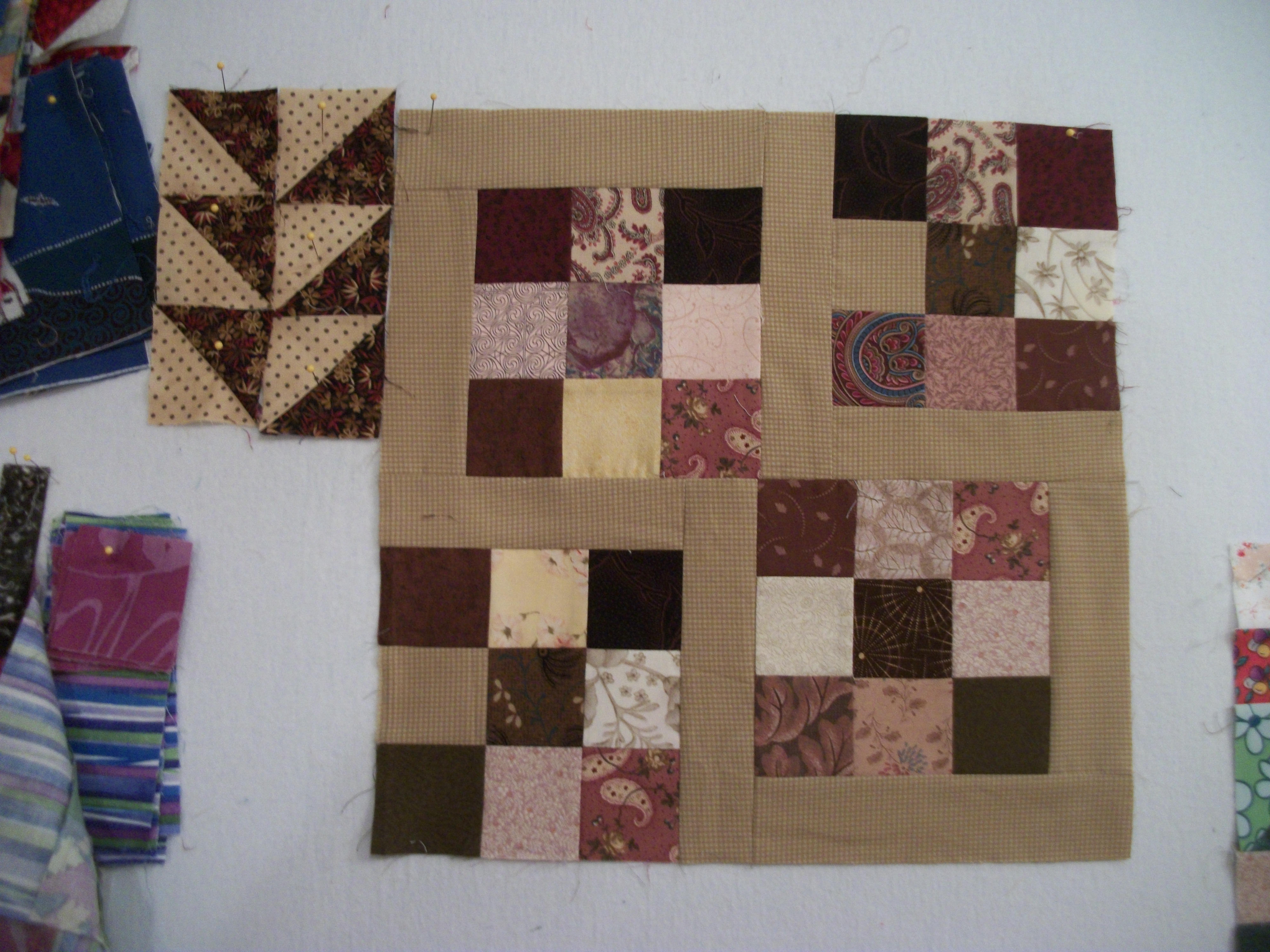
I am making myself sew together the quilt top of another Dancing Nine’s quilt top–as I’ve got a lot of really beautiful fabric left over from the Wheels of Mystery quilt.  Here’s one set of blocks:

Brown Dancing Nine

I nixed doing a border with half-square triangles–also from this batch of fabric.  It’s too busy and too narrow.  I’ll do the piano keys border again, with a narrow inner border to separate it from the quilt body.  (Bonnie Hunter has the best design eye it seems, and this is her pattern.  These blocks are a bit bigger than hers as I’d already cut 2 1/2 inch strips.)

Bonnie Hunter’s current leader/ender project is with 2 1/2-inch half-square triangles–so I seem to be doing that with these browns.  You can combine the light/dark blocks in at least 50 ways.  I’ve just put these four block together this way until I get more of them.  So stay tuned on this one as I have no idea what will happen with it.

Bonnie Hunter's LeaderEnder Project

I started a leader/ender project with leftover 3 1/2-inch light and dark green strips some time ago.  I now have at least 300 of those blocks.  So, here’s what’s happening–I chose a classic Contrary Wife traditional block with which to experiment–only I made the bigger block a four patch and am paying attention to the light/dark orientation of it so that the quilt will have long runs of light or dark little blocks–something I learned from Bonnie Hunter.

Red and Green 1

Here it is with two more blocks added yesterday:

Red and Green 2

It’s going to be gorgeous!  Everyone comes in says “wow!  I really like that red and green one.”

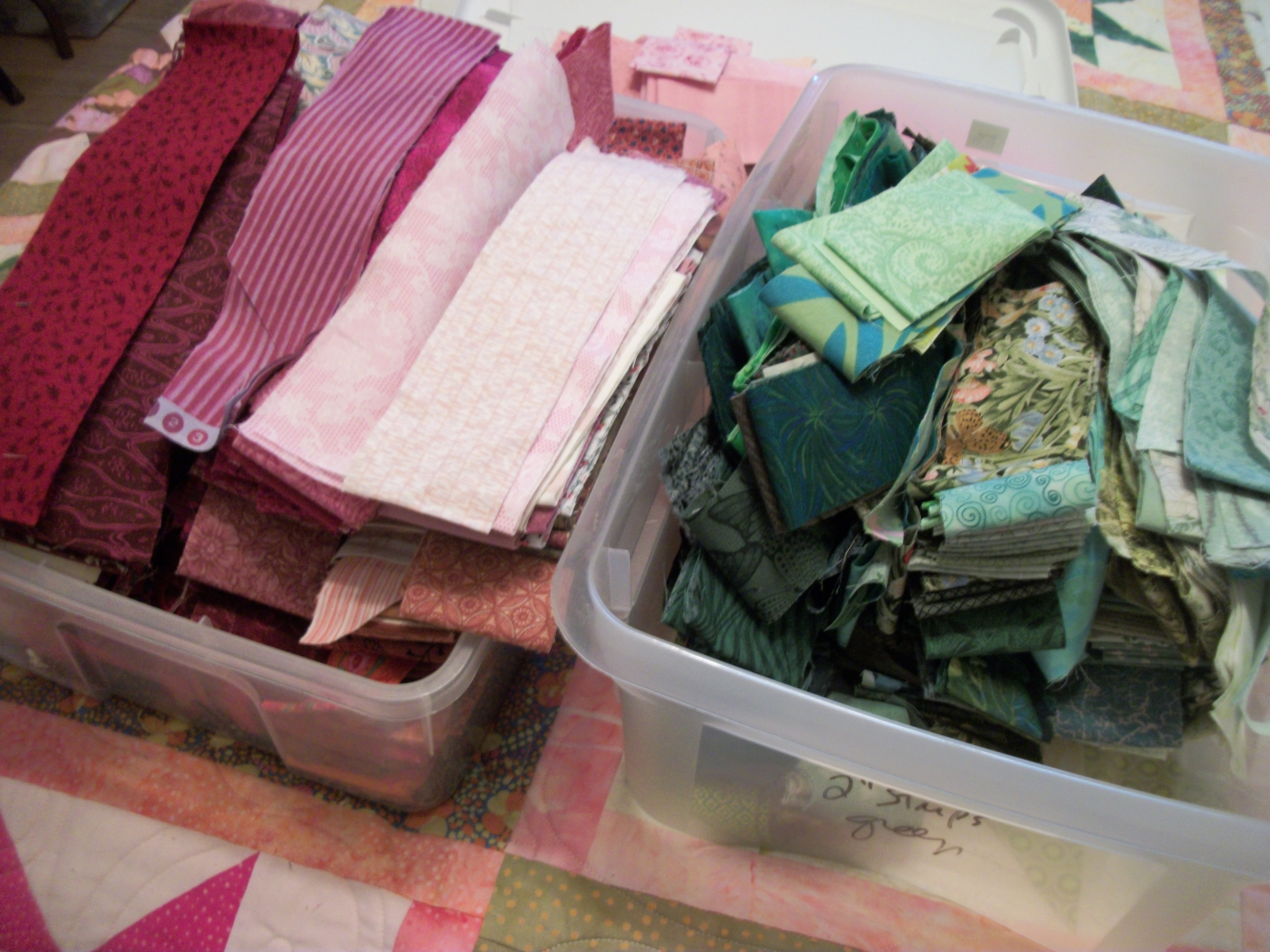
And I’m pulling from the 2-inch red and green strip bins from the cutting frenzy this summer.  It’s so EASY just to pull pre-cut strips from the bins and not have to wade through a ton of fabrics in the stash:

Red and Green bins

That purple stripe fabric is in the bin by mistake–from my pulling of fabrics for this “fish” project that seems also to be happening:

Fish

I bought a new coat from LLBean a few weeks ago–and none of my scarves go with it really.  I have a hat that’s the right blue, and it’s trimmed with a burnt orange yarn.  So I stopped by Over the Rainbow yarn shop in Rockland yesterday.  Here’s what I came home with–the coat color is the dark, smoky blue in the yarn:

Cowl Project 2

I’m going to make a cowl kind of scarf–and make it twice as long as this one, which has this very interesting textured pattern.  One uses a circular needle to make it, and it knits up REALLY fast–or so I was promised.

Cowl project

How fun is that???

So, now it’s time for me to leave for the monthly meeting of my Book Club.  We are discussing Steward O’Nan’s Wish You Were Here, which I enjoyed rather a lot as it is about a family where the father/grandfather/husband has died and where those left behind have to figure out how to move forward with their relationships–which have altered in the wake of the patriarch’s death.  Nothing will ever be the same again for those left behind, and they struggle in the short space of a week, to come to grips with the immensity of all that has changed.   The novel does not hit you over the head with this truth, though.  Rather, O’Nan patiently and calmly walks through each day and shows you with exquisite subtlety just how much everything has changed.

Turkey Tracks: Whoo Hoo!!!

Turkey Tracks: November 23, 2014

Whoo Hoo!

The Houston International Quilt Festival–October 20 to Noember 2, 2014.

It’s the biggest, baddest, best, most amazing…quilt show in the world.

It’s on my very short bucket list as I thought I was pretty much done traveling all over the place.

AND I’M GOING!!

I’m really doing it.

And I’m staying all THREE days.  Maybe I’ll take a class or two.

I made reservations today at the FOUR SEASONS hotel–which has the most amazing rent charge for the festival–about half of its usual charge or what’s listed on line.  And it’s walking distance (across a park) to the quilt show.  WALKING DISTANCE.  Located among some nice shops and restaurants.

They’ve got rooms if you want to join me…

But call the hotel direct and tell them you are coming for the quilt festival.

Spa, pool, local food, did I mention walking distance, it’s the FOUR SEASONS.

FUN, FUN, FUN–it’s time for some fun in my life…

I’m going, going, going!

I’m also clearly delirious…

Whoo Hoo!

Interesting Information: Sugar and Inflammation

Interesting Information:  November 22, 2013

Sugar and Inflammation

Ellen Davis promotes ketogenic diets, which is a diet where fats provide most of the calories.  She has an article in the July/August 2012 issue of Well Being Journal entitled “Ketogenic Diets:  A Key to Excellent Health” (20-23).  Davis supports the ketogenic diet because she used it to reverse her own metabolic syndrome and to regain her health.  In the process, she lost over 80 pounds.  Her web site is www.healthy-eating-politics.com.  (I’ve written about metabolic syndrome in the essays on this blog.)

I am drawn to more of a balanced diet approach–as long as there are not digestive issues.  If there are digestive issues, then one needs to eat in a healing way for some time.  This ketogenic diet is very like Dr. Natasha Campbell-McBride’s GAPS protocol–which has a lot of good science and clinical practice results behind it.  (GAPS stands for Gut and Psychology Syndrome, and there are essays on this blog about GAPS.)

I do think that most Americans are eating way, way too many carbs–that their eating so many carbs is out-of-balance and is causing chronic disease.  (This statement does not address, also, the toll that toxic poisons in and on American foods, takes.)

And I do think that eating a lot of carbs is causing inflammation in the body–which is one root cause of disease.  For instance, Davis points out that a bagel “breaks down into about sixteen teaspoons of sugar in the bloodstream” (21).  So if you are going to eat one, be sure to put a lot of cream cheese or butter on it to help cut the sugar load–just as you would with a baked potato.  And remember that the cream cheese or the butter is not going to make you fat, but that the bagel will because it turns to sugar in your system.

Davis writes that “oxidative stress is what causes metal to rust, and cooking oils to go rancid when exposed to the air.”  This oxidative stress “can create molecules called reactive oxygen species, or ROS.  These molecules, commonly called free radicals, are chemically reactive and can damage internal cellular structures” (21)

She writes that “if inflammation is present, excessive amounts of ROS are created and overwhelm the cell’s defenses, causing accelerated damage and eventually cell death.  This is why inflammation is linked with so many types of disease processes.”

So, food choices are very important, says Davis:  “…high-carbohydrate foods provide much more glucose than the human body can handle efficiently.  Blood glucose is basically liquid sugar, and if you have ever spilled fruit juice or syrup on your hands, you know how sticky it can be.  In the body, this stickiness’ is called glycation.”  The process of glycation starts a chain of events that increases inflammation and creates “substances called advanced glycation-end-products (AGEs)”–which “interfere with cellular function, and are linked to the progression of many disease processes, including Alzheimer’s, cardiovascular disease, stroke, and autism.”  The “higher the blood sugar, the more serious the damage” (21).  And I wonder if there is a connection between inflammation in the body and the start of cancer–which may get a toehold when the immune system is overloaded.

Davis quotes Ron Rosedale, MD, from his book Burn Fat, Not Sugar to Lose Weight:

“Health and lifespan are determined by the proportion of fat versus sugar people burn throughout their lifetime.  The more fat that one burns as fuel, the healthier the person will be, and the more likely they will live a long time.  The more sugar a person burns, the more disease ridden and the shorter a lifespan a person is likely to have.”

While I am always leery of MDs who are writing about nutrition–since most have had no nutritional training whatsoever–what Rosedale is saying about fat being healthy is a fit with Dr. Mary Enig’s stance on fat in Eat Fat, Lose Fat, written with Sally Fallon Morell, both of The Weston A. Price Foundation.  Dr. Enig is an internationally recognized expert on dietary fats, and I have written about her work in many places on this blog.

And Rosedale’s statement is a fit with Gary Taube’s work on the hormonal conditions caused by eating too many carbs, in Why We Get Fat.

So, there you have it…

Some interesting information…

Turkey Tracks: J&E Riggin Cruise

Turkey Tracks:  November 22, 2013

J&E Riggin Cruise

The J&E Riggin is a windjammer that sails out of Rockland, Maine.

She’s big and fast and is owned by two of my favorite people, Captains Jon Finger and Annie Mahle.

John and I went on her many times, and I have truly missed sailing on her in the summer.  Maine’s “water world” out in the bay is so gorgeous, fun, and interesting.  And Annie’s cooking is…sublime.  She uses local foods of all sorts.

So guess what arrived in my email box this morning?  A Thanksgiving special.  A 15% discount.  And only $100 down now.

I clicked on the 2014 sailing date and discovered a 6-day cruise with knitter Margaret Radcliffe (Blacksburg, Virginia, and author of three books with a new one coming out soon) running September 1-6.  September is beautiful sailing weather in Maine, and the bay has had all summer to warm up–so there may be swimming for me from the boat.

I called Elizabeth in the Riggin office to discuss possibilities immediately.  As a Riggin Relic (one who has made many cruises on the Riggin), I could go ahead and book.  So there you have it.

Are you up for a safe adventure?  Take a look.

Maine Sailing Schedule | Maine Windjammer J&E Riggin | Maine Windjammer J&E Riggin.