Interesting Information: Best Known Peer-Reviewed Medical Journal–THE LANCET–Officially Classifies Fluoride As A Neurotoxin

Interesting Information:  March 25, 2014

Best Known Peer-Reviewed Medical–THE LANCET

Officially Classifies Fluoride As A Neurotoxin


Well, this story floated into my email this morning from Health Freedom Alliance.

Thank heavens, I thought.  Hope has emerged again.

Here’s the url:

Health Freedom Alliance » Success! Best Known Peer-Reviewed Medical Journal Officially Classifies Fluoride As A Neurotoxin.

And here’s the url from The Lancet itself:  http://www.thelancet.com/journals/laneur/article/PIIS1474-4422(13)70278-3/abstract


Fluoride harms developing brains–among many other damages that it does.  There is plenty of science now showing that one to one cause and effect.

Here’s a quote from The Lancet abstract, which Health Freedom Alliance reproduced–and for heaven’s sake, don’t miss the reference to the  neurotoxicity of methyl mercury, which is “common in vaccines”:

“Neurodevelopmental disabilities, including autism, attention-deficit hyperactivity disorder, dyslexia and other cognitive impairments, affect millions of children worldwide, and some diagnoses seem to be increasing in frequency. Industrial chemicals that injure the developing brain are among the known causes for this rise in prevalence. In 2006, we did a systematic review and identified five industrial chemicals as developmental neurotoxicants: lead, methyl mercury (common in vaccines), polychlorinated biphenyls, arsenic and toluene. Since 2006, epidemiological studies have documented six additional developmental neurotoxicants – manganese, fluoride, chlorpyrifos, dichlorodiphenyltrichloroethane, tetrachloroethylene, and the polybrominated dihenyl ethers. We postulate that even more neurotoxicants remain undiscovered. To control the pandemic of developmental neurotoxicity, we propose a global prevention strategy. Untested chemicals should not be presumed to be safe to brain development, and chemicals in existing use and all new chemicals must therefore be tested for developmental neurotoxicity. To coordinate these efforts and to accelerate translation of science into prevention, we propose the urgent formation of a new international clearinghouse”(1)

Here’s another quote from the Health Freedom Alliance posting:

“In point of fact, fluoride causes more human cancer deaths than any other chemical. When you have power you don’t have to tell the truth. That’s a rule that’s been working in this world for generations. There are a great many people who don’t tell the truth when they are in power in administrative positions. Fluoride amounts to public murder on a grand scale. It is some of the most conclusive scientific and biological evidence that I have come across in my 50 years in the field of cancer research.” (2)  – Dr. Dean Burk, Biochemist, Founder of Biotin, and Former Chief Chemist at the National Cancer Institute of Health.


I put three essays about the danger of putting fluoride into our water system on the blog a few years back–Mainely Tipping Points Essays, 34 to 36–using the text THE CASE AGAINST FLUORIDE:  HOW HAZARDOUS WASTE ENDED UP IN OUR DRINKING WATER AND THE BAD SCIENCE AND POWERFUL POLITICS THAT KEEP IT THERE (2010), Paul Connett, PhD, James Beck, MD, PhD, and H.S. Micklem, DPhil,   In the essays, I cite the formidable credentials of these three authors–all of whom are now senior scientists.

Here’s an excerpt from what I wrote regarding who is tasked with responsibility for the safety of fluoride in our water:


Astonishingly, Connett et al report that no federal agency accepts responsibility for the safety of fluoridation.

The Food and Drug Administration (FDA) has never approved fluoride for ingestion and rates fluoride as an “unapproved drug”—which is why it can mandate the toothpaste warning.  Nor has the FDA subjected fluoride to rigorous randomized clinical trials for either its effectiveness or its long-term safety (270).

At the Center for Disease Control (CDC), only the Oral Health Division (OHD) is involved with fluoridation, and the OHD is staffed largely by dental personnel.  In 2008, Connett et al note, not one of the 29 staff members had scientific degrees qualifying them to assess the toxicity of fluoride, yet this division aggressively promotes fluoridation throughout the United States (23-24).

The Environmental Protection Agency (EPA) has an indirect role in that it regulates safe standards for all “contaminants” in drinking water.  In 2002, as it is legally required to do every 10 years, the EPA asked the National Research Council (NRC) to review the current 4 ppm (parts per million) Maximum Contaminant Level (MCL) standard.  The NRC appointed a 12-member panel that, the authors state, was “the most balanced ever appointed in the United States to do any kind of review on fluoride” 137).  This panel issued its 507-page report in March 2006, in which it declared that the seemingly low-level 4 ppm maximum standard was not protective of health (25).

The ADA [American Dental Association] declared the NRC report irrelevant to water fluoridation on the day it was released—claiming erroneously that the panel only reviewed water fluoridation of 4 ppm.  The panel, in fact, “examined several studies that found adverse effects at levels less than 2 ppm” (138).

The CDC followed six days later with the same conclusion.  To date, write the authors, the CDC has produced “no comprehensive analysis to support its claim.”  And “it’s hard to believe that in six days Oral Health Division personnel could have read and digested the report, let alone its over 1,100 references” (140).

Ironically, in 1999, the CDC “finally conceded what many dental researchers had been reporting over the previous two decades:  Fluoride’s predominant mechanism of action was topical, not systemic.  In other words, if fluoride works at all, it does so via direct exposure to the outside of the tooth and not from inside the body” (13).  So, write Connett et al, to continue “the practice of forcing people to ingest fluoride has become even more absurd (269-270).

BUT, even the ADA, in fine print on its web site, warns against feeding baby with formula mixed with tap water because the fluoride levels are too high for infants.

YOU CANNOT CONTROL THE DOSE OF THIS TOXIC MATERIAL WHEN YOU PUT IT IN THE WATER–and that affects infants, the elderly, the infirm, and anyone who drinks a lot of water.

What is particularly GALLING to me is that putting fluoride into our water has always been a POLITICAL DECISION–not a scientific one–which is totally demonstrated by Connett et al in their book.

What is doubly particularly GALLING is that the most recent scientific review, as stated above, commissioned by the EPA and carried out by the National Research Council, raised at least a dozen red flags about the efficacy of fluoride at all and the use of fluoride in the water.  Yet our public health officials, who get their information from the big health organizations–most of whom have gotten themselves way out on a shaky legal limb with regard to fluoride–have clearly NOT READ for themselves recent information on fluoride, to include the recent NRC study.

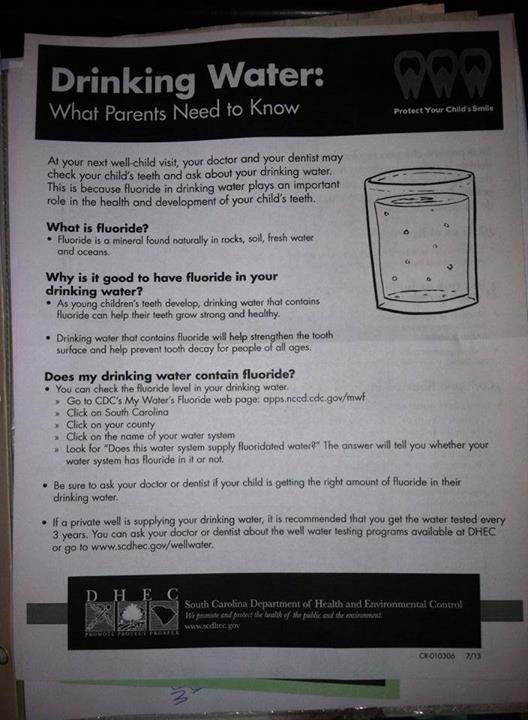
So there’s a “kool aid” loop in place here that is not taking into account any current science.  So, here’s what gets sent home to parents via the school system:

IMG_0197

(Thanks niece Nancy Howser, herself the mother of two young boys, one of whom has already suffered a broken leg bone.)

AND, when a local jurisdiction gets a referendum on fluoride, the local public health officials, including MDs and dentists, come out of the woodwork supporting fluoride and throwing around their “health” credentials.  This behavior happened in Damariscotta a few years back–and it was clear that not one of these folks had read the most recent EPS/NRC report.  And we all must remember that doctors and dentists are PRACTITIONERS, not scientists, and public health officials know only what they have been taught and that if they deviate from what they have been taught, they can lose their jobs.

So, cheers to The Lancet!

Interesting Information: The Worth of Bananas

Interesting Information:  March 24, 2014

The Worth of Bananas


A friend was here recently, and she was SHOCKED that I rarely eat a banana.

“What about potassium?” she said.

“Well,” I said, “bananas being a good source for potassium is mostly food industry hype and does not take into account the down side of eating bananas.”

“What???”

One medium banana of the type in our stores has 450/mg of potassium–and a whole lot of starchy carbohydrates that aren’t much good for anything.  (Highly colored bananas in other parts of the world carry a better nutrient load than the yellow banana to which we have standardized–an incredible loss of diversity through monocrop cultures run by industry.)  I don’t know about you, but I’d like to lose another 20 pounds, and I can’t do that by eating useless, starchy carbs.

And there are better food sources for potassium:

Flounder (6 ounces) has 996.

Winter squash (1 cup cooked) has 946.

One medium white potato has 844.

Salmon (6 ounces fresh) has 756.

Cod (6 ounces) has 690.

Parsnips (1 cup cooked) has between 573 to 758.

Avocado (1/2 medium) has 602.

Asparagus (1 cup lightly cooked( has 558.

Orange juice freshly squeezed (1 cup) 496 and collard greens (1 cup cooked) 468

Broccoli (1 cup) comes just below banana at 440.

Other sources are chicken, sweet potato, celery, and tuna.

(I left out the dried fruits as they aren’t especially good for you even if they have good doses of potassium.)

Potassium is a mineral that works as an electrolyte that carries “tiny electrical charges throughout the body, and especially ensures the proper functioning of the heart,” according to Rachel Albert, B.A., in “Charging Up With Potassium” in Well Being Journal, Jan/Feb 2013 (35-37).  (I love Rachel Albert’s The Garden of Eating–it has wonderful recipes and a plan for how to manage to always have really good food available in your home by cooking multiple dishes at once and adding to them as you go along in the week.)

Potassium deficiency “may include fatigue, weakness, irritability, loss of muscle strength, muscle cramps or spasms (charley horses), swollen ankles, general edema, and recurring headaches that come at the same tie each day” (35).

Albert writes that “potassium and sodium play a tug of war across the cell walls in your body, with the delicate balance of your body chemistry at stake.  So, when the sodium concentration is high, potassium is literally stolen from your body.  It is leached from your tissues, poured into your blood stream, then dumped into your urine and excreted.  Conversely, when the potassium content outweighs sodium, your body is able to release and let go of excess sodium and water.  Potassium in its natural state acts as a mild diuretic and can counteract hypertension, which is more common among individuals and ethnic groups who consume few potassium-rich goods (37).  In hot weather, Albert notes, we need more potassium as we sweat potassium levels out of our bodies.

The more I read about our bodies, the more I am realizing how delicate the chemical balances can be.  I often have muscle cramps–especially after I eat some chocolate, I’ve noticed.  Or, when I hike.  And I know that my potassium can get too low–from a blood test the last time (March 2013) I had a bad food allergy attack.  The minute I take a potassium tablet, the cramps stop.

BUT, this article is the first time I’ve made an association between potassium and salt.  I eat and LOVE a LOT of salt–sea salt.  So maybe I’ll cut back a bit.  Salt is not the demon it has been made out to be for years–I’ve written about that on this blog–but I often put even more salt on foods before tasting them.  So…time for a bit of a change.  Perhaps I’ve been throwing off this potassium/salt balance in my body.


Interesting Information: ZZZ Wraps

Interesting Information:  March 23, 2014

ZZZ Wraps

Here’s what I hope will be a very fun product–given to me by DIL Tami Enright, who is Director of The Bee Cause in South Carolina–a project of The Savannah Bee Company.

This bees’ wax soaked fabric can seal a bowl or wrap a sandwich.

I can’t wait to try it.

IMG_0211

Here’s what it looks like unfolded.

IMG_0212

It came from Mama Bee Hive,  http://www.mamabeehive.com/index.php.  But the present web site does not list this product.  Perhaps a phone call to them if you are interested?

So I have no idea what it costs.  Apparently one just washes off the cloth and lets it dry and reuses.

I’ll report back after use…

Interesting Information: Misunderstandings About “Good” and “Bad” Cholesteral

Interesting Information:  March 21, 2014

Misunderstandings About “Good” and “Bad” Cholesterol

Within the past week, two family members have had questions about “good” and “bad” cholesterol and WHAT causes heart disease.  One has been on a statin for three years now–much to my horror as you will see why if you keep reading–to lower LDL cholesterol.  The other thought saturated fats led to the plaques that can block arteries and that the plaque was formed from the “bad” LDL cholesterol which must be lowered for health.  The latter understanding is both incomplete and flawed in that saturated fats are not the culprit and undamaged LDL cholesterol is not even…cholesterol…so lowering what is called LDL cholesterol is not going to work and is going to make you sick as you will not be getting the nutrients you need.  In addition, Seneff explains in detail how statins destroy your muscles, including your heart muscle.

I’ve written about Stephanie Seneff’s article “Cholesterol:  The Essential Molecule–And the Adverse Effects and Overuse of Statins” in Mainely Tipping Points 37, available on this blog.  This comprehensive article appeared in Well Being Journal, Nov/Dec, and is not free.   Seneff, based at MIT, is doing some amazing bench science research at the cellular level, and I like her work a lot.  Her web site lists her credentials, papers, talks, etc., if you want to take a look:  http://people.csail.mit.edu/seneff/.  Or just google her name.  Much of her work is free to you, so you can find parts of the information in the above article scattered across her papers or in shortened forms.  In addition, the Joseph Mercola web site has a nice video of an interview with Seneff about statins:  http://articles.mercola.com/sites/articles/archive/2012/02/11/dr-stephanie-seneff-interview-on-statins.aspx.  (There are other interviews on Mercola with Seneff as well as her main concern is the lack of cholesterol sulfate in our bodies today. Or, sulfur, which used to come from the soil, but which, thanks to commercial farming, is no longer available in the soil in the quantities we need.)

ANYWAY, Seneff’s explanation of HDL (called the “good” cholesterol) and LDL (the “bad” cholesterol) calls into question these simplistic and erroneous labels.  These terms were coined to sell you–and your doctors–the notion that you need to take a statin to lower your LDL cholesterol.  I’ve read Seneff’s explanation from other researchers, but her explanations in this article are very comprehensive and are easy to understand.  

Seneff’s conclusion about statins is also easy to understand:

I have been driven by the need to understand how a drug that interferes with the synthesis of cholesterol, a nutrient that is essential to human life, could possibly have a positive impact on health.  I have finally been rewarded with an explanation for an apparent positive benefit of statins that I can believe, but one that soundly refutes the idea that statins are protective.  I will, in fact, make the bold claim that nobody qualifies for statin therapy, and that statin drugs can best be described as toxins (13).

So, here’s Seneff’s discussion of LDL, HDL, and Fructose:

We have been trained by our physicians to worry about elevated serum levels of low density lipoprotein (LDL), with respect to heart disease.  LDL is not a type of cholesterol, but rather can be viewed as a container that transports fats, cholesterol, vitamin D, and fat-soluble anti-oxidants to all the tissues of the body.  Because they are not water-soluble, these nutrients must be packaged up and transported inside LDL particles in the blood stream.  If you interfere with the production of LDL, you will reduce the bioavailability of all these nutrients to your body’s cells.

The outer shell of an LDL particle is made up mainly of lipoproteins and cholesterol.  The lipoproteins contain proteins on the outside of the shell and lipids (fats) in the interior layer.  If the outer shell is deficient in cholesterol, the fats in the lipoproteins become more vulnerable to attack by oxygen, every present in the blood stream.  LDL particles also contain a special protein called “apoB” that enables LDL to deliver its goods to cells in need.  ApoB is vulnerable to attack by glucose and other blood sugars, especially fructose.  Diabetes results in an increased concentration of sugar in the blood, which further compromises the LDL particles by gumming up apoB.  Oxidized and glycated LDL particles [glycation is when a sugar molecule combines with a protein or fat molecule, degrading it] become less efficient in delivering their contents to the cells.  Thus they stick around longer in the blood stream, and the measured serum LDL level goes up.

Worse than that, once LDL particles have finally delivered their contents, they become small dense LDL particles, remnants that would ordinarily be returned to the liver to be broken down and recycled.  But the attached sugars [through glycation] interfere with this process as well, so the task of breaking them down is assumed instead by macrophages in the artery wall and else where in the body, through a unique scavenger operation.  The macrophages are especially skilled to extract cholesterol from damaged LDL particles and insert it into HDL particles.  Small dense LDL particles become trapped in the artery wall so that the macrophages can salvage and recycle their contents, and this is the basic source of atherosclerosis.  HDL particles are the so-called good cholesterol, and the amount of cholesterol in HDL particles is the lipid metric with the strongest correlation with heart disease, where less cholesterol is associated with increased risk.  So the macrophages in the plaque are actually performing a very useful role in increasing the amount of HDL cholesterol and reducing the amount of small dense LDL.

The LDL particles are produced by the liver, which synthesizes cholesterol to insert into their shells, as well as into their contents.  The liver is also responsible for breaking down fructose and converting it into fat (Collison et al., 2009).  Fructose is ten times more active than glucose at glycating proteins, and is therefore very dangerous in the blood serum (Seneff et al., 2011).  When you eat a lot of fructose (such as the high fructose corn syrup present in lost of processed foods and carbonated beverages), the liver is burdened with getting the fructose out of the blood and converting it to fat, and it therefore can not keep up with cholesterol supply.  As I said before, the fats can not be safely transported if there is not enough cholesterol.  The liver has to ship out all that fat produced from the fructose, so it produces low quality LDL particles, containing insufficient protective cholesterol .  So you end up with a really bad situation where the LDL particles are especially vulnerable to attack, and attacking sugars are readily available to do their damage (15-16).

SO THE REAL CULPRIT IN HEART DISEASE IS TOO MUCH SUGAR, ESPECIALLY FRUCTOSE SUGARS.

What to eat:

Cut way back on fructose–found in processed foods and in FRUITS.  Grains also turn into sugars in the body.  Really, if it’s in a box, a can, or a package in the grocery store–or in the middle aisles–don’t eat it.

Spend time outdoors and let the sun shine on your skin as that produces useable cholesterol sulfate.  Strenuous exercise helps clear your body of excess sugars.

Eat foods that are good sources of lactate:  sour cream and cultured products like yogurt and kefir, preferably made from raw milk.

Eat foods rich in cholesterol sulfate:  GOOD eggs (NOT the ones from vegetarian chickens), liver, oysters, onions, garlic, cabbage family, GOOD meats–in other words, clean, nutrient-dense whole foods.

Interesting Information: AARP BULLETIN: 10 Medical Tests to Avoid–Choosing Wisely Campaign

Interesting Information:  March 17, 2014

AARP BULLETIN:  10 Medical Tests to Avoid

Choosing Wisely

I remember a time when one went to the doctor only when one was sick.

Imagine that…

Then came the days when doctors went on the hunt for disease–under the paradigm of finding illness before it got cranking.  In the process, a whole host of yearly tests became part of the annual physical.

Imagine my surprise when the AARP BULLETIN came floating in this weekend with a front-page feature on “10 Tests to Avoid” by Elizabeth Agnvall.

Here’s how the first paragraph reads:

Doctors are warning that some of the common medical tests routinely taken by Americans do more harm than good, waste billions of health care dollars annually [$225 billion] and could endanger your health or even your life.  Among the tests targeted as overused by prestigious panels of doctors were annual Pap smears, regular PSA tests, regular EKGs and even routine yearly physicals.  Overuse of such tests leads to dangerous side effects, pain, radiation exposure, unnecessary surgery–even death, the doctors said.

This campaign is called Choosing Wisely and is joined by a diverse number of partners exploring the overuse of these yearly tests.  Among them are The American Board of Internal Medicine Foundation, many individual doctors from diverse medical specialties, AARP, and the medical director at Consumer Reports (John Santa, MD).

Here’s the list:

1.    Nuclear stress tests, and other imaging tests, after heart procedures.

2.    Yearly electrocardiogram or exercise stress test

3.    PSA to screen for prostate cancer

4.    PET scan to diagnose Alzheimer’s disease.

5.    X-ray, CT scan or MRI for lower back pain

6.    Yearly Pap tests

7.    Bone density scan for women before age 65 and men before age 70

8.    Follow-up ultrasounds for small ovarian cysts

9.    Colonoscopy after age 75

10.  Yearly physical

To read more information about each test, here’s the url to the article:

http://www.aarp.org/health/conditions-treatments/info-2014/choosing-wisely-medical-tests-to-avoid.html?intcmp=BUBB1

WARNING:  the article also recommends eating “plenty of fruits, vegetables and whole grains for fiber,” cutting down on fatty foods, red meat, and processed meats.  My reading warns against eating too many fruits as our modern fruits carry heavy sugar loads and fructose is increasingly being seen as a problem.  Sugar causes inflammation in your body and is likely the root cause of chronic disease.  The vegetables and meat in your diet supply plenty of fiber–grains add too much and can cause constipation and are a source of too much sugar.  Fatty animal fats from animals raised properly are GOOD FOR YOU.  Red meat (grass-fed, organic) is the only place you get vitamin b12 in a form your body can easily use–there’s no science behind the anti-red meat campaign.  Commercial processed meats are often carriers of pathogens.  Fermented, traditionally made “processed” meats (like salami, proscuitto, for instance) are good for you.

Interesting Information: Why Not To Buy Cut Flowers

Interesting Information:  February 13, 2014

Why Not To Buy Cut Flowers


I had no more put up a picture of a vase of cut flowers to which I had treated myself–a practice I do from time to time in the winter–when a post came in from Dr. Joseph Mercola saying NOT TO BUY cut flowers for a loved one for Valentine’s Day.

Why?

They are chock full of pesticides!

And, of course, HOW they are grown is also an issue–lots of fertilizers that spoil the soil, etc.

Here, again, are my pretty flowers:

IMG_0170

Enjoy the sight, as I’m not buying any more.

It makes sense, of course.  Mercola writes that if at a border/port inspection, the inspectors detect one tiny little bug, the whole shipment is rejected.  So, growers and shippers drench the flowers with pesticides.   I hope you are remembering the recent post I put up about statistics that worry me.  If so, you’ll know that we have got to back ourselves out of the system that is poisoning us in countless ways.  And, know that even tiny amounts of these harmful chemicals are…really harmful.

There is a new documentary out that I am planning to see as it is going to be shown locally.  Take a look at the trailer for Unacceptable Levels:  https://www.youtube.com/watch?v=PVB6XSyBTVE.  Their web is http://www.unacceptablelevels.com/.

Secondly, the pesticide issue is one thing–a BIG thing, but, again, I was ALSO not practicing what I preach–which is to live within the seasons, to live sustainably.  Cut flowers (like out-of-season fruit) are shipped in here from across the world–which is a terrible use of energy that we are depleating way too fast.  What was I thinking?  NOT…

So, I’ll be living without flowers in the winter from now on.

Here’s Mercola’s post:   http://articles.mercola.com/sites/articles/archive/2014/02/11/cut-flower-pesticides.aspx

Interesting Information: Some Supplement Dangers

Interesting Information:  February 10, 2014

Some Supplement Dangers

Calcium, Vitamin D, Folic Acid


Shane Ellison is The People’s Chemist and has a blog with that name.

Shane Ellison is brash and angry, but he’s also very smart.  And he’s had a bird’s eye view of Big Pharma products as he worked in a big industry lab until he saw that the dangers he was finding were going to be ignored and those products were still to be sold regardless of their danger.  That’s where his anger comes from, I think, and since I have a lot of it myself–it is simply incredulous to me that poison is allowed to be sold, put on plants, put on our food, put on our soil, put into our water, put into our air, put into our veins, and so forth–I can overlook how he sometimes chooses to express himself.

In the post below, Shane takes on the wide-spread supplements that are themselves harmful or are harmful as being given.  I’ve read this information elsewhere, many times, so I don’t doubt it.  But Shane’s synopsis of what’s wrong is instructive and ALL IN ONE PLACE.   One takaway is DO NOT TAKE A COMMERCIAL MULTI-VITAMIN.

Shane sells supplements, so you can skip the ads and the video if you like.  That he sells things does not negate what he’s saying about crappy supplements and their impact on the body.  He has a weight-loss system that is built on regulating hormones, and hormone imbalances are what cause obesity.  The trick is to STOP eating what’s causing your body to gain weight, and in most cases, that’s too many starchy carbs.  Maybe Shane’s system also helps.  I do not know.

Anyway, here’s the url with the above-mentioned good information:

Daily Dose – Store » | ThePeoplesChemist.com.

Interesting Information: Statistics that Scare Me

Interesting Information:  February 6, 2014

Statistics That Scare Me


1 out of 2 people are now getting cancer–so don’t for a moment think we are “winning” the “war” on cancer.  Or, curing it once you’ve gotten it.  The “standards of care” cures are horrific and carry their own horrors.

Interesting documentaries to watch:  both the Burzynski documentaries as they show that the cancer industry is not interested in a bona-fide cure that means they don’t make money and will do anything to stop such a marvelous thing from happening.

1 out of 50 children now have autism according to the May 2013 statistics from the CDC.  And, no, these figures are not because there are better diagnostic tools.

1 out of 6 children now have a neurological issue.

See the documentary, The Greater Good

The United States has an abysmal infant mortality rate–the worst among the other industrialized nations.  Take a look at this graph from The Washington Post:

http://www.washingtonpost.com/blogs/wonkblog/wp/2013/01/09/graph-of-the-day-the-united-states-has-a-really-high-infant-mortality-rate/

And, for some reasons why, see the documentary The Business of Being Born

* * *

We didn’t get here by accident.

There has been a long, slow change in the structures of how we organize our society.  If you want to understand those changes, those structures, take 90 minutes and watch Robert Reich’s Inequality for All, which quickly dispenses with the Democrat/GOP divide and gets to the historical heart of what has happened.  Understanding a problem is the first step toward solving it.

Best of all is that Reich leaves us with tremendous hope that something can be done, that change can occur, that we can all get out of the now-hot water that is scalding us.

When he is asked what other country we should emulate to get out of our mess, Reich says “America.”

That would be the America of my youth.

Bravo!


Interesting Information: Mercola Post: Widely Used Antacids Can Cause Vitamin B12 Deficiency

Interesting Information:  February 5, 2014

Mercola Post:

Widely Used Antacids Can Cause Vitamin B12 Deficiency


Two observations:

1.  I think that the information Joseph Mercola puts out and his free web site is a real gift.  I do NOT agree with everything Mercola says, but DO think that he has amassed a really useful archive that should always be considered.  And the points where I disagree are small.  I think REAL fermented cod liver oil is far better than any fish oil, and I am not at all sure that a lot of raw food can be fully assimilated by our bodies.  And it’s clear that too much raw food, especially fruit, causes nutrient deficiencies and a lot of cavities.  These differences are where I would favor information and analysis on The Weston A. Price Foundation over Mercola, and the WAPF folks argue that cooked food often has nutrients that are more available to our bodies.  Having said that, I love a good salad and am not suggesting that ALL food should be cooked.

 If you want to read the Mercola/Weston A. Price Foundation debate on cod-liver/fish oil, the WAPF web site has it.

2.  I am fascinated by how often an issue arises in my life and in a few days, the universe throws up useful information about the issue.  Not even a week ago, I was in a discussion about the role of stomach acid in digestion.  And in came this Mercola post.

Mercola’s post here has some new information on why antacids are NOT a good idea.  Specifically, they set into place the depletion of vitamin B12.  Can I just say that if you are not processing or cannot process and use B12, you get dementia.  And I can tell you that that is exactly what happened to my father.

There is now a host of information about how wrong mainstream medicine is with regard to the treatment of GERD, or Acid Reflux.  It’s not caused by too much stomach acid, but by too little.  (I know that I have written about this issue more than once.)  And it does not matter WHY you have GERD or indigestion, the solution is still MORE stomach acid–except in some truly rare cases.  I keep Betaine HCL with Pepsin on hand for the rare occasions when something runs amuk in my body, and I feel I have indigestion.  You can buy it at any supplement store.


So, if you have indigestion of any kind, before you reach for an antacid, do your body a favor and read this Mercola post.  Then go to The Weston A. Price Foundation archive and google Acid Reflux.  Then try to figure out WHAT you ate that is causing you trouble–and err on the side of bone broths and clean foods that do not come in a box or can.

Widely Used Antacids Can Cause Vitamin B12 Deficiency.

And also bear in mind that doctors ONLY KNOW what they have been taught and most don’t have time or skills to research this issue.  The drug companies are the “teachers” here, and they are making a HUGE profit on these antacid drugs.

Interesting Information: New Breakthrough: Roundup DOES Harm Humans

Interesting Information:  January 21, 2013

New Breakthrough:  Roundup® DOES Harm Humans


Roundup®, which is mostly the chemical glyphosate, is “the most popular herbicide used on the planet,” according to Stephanie Seneff, PhD, in “Roundup®:  The `Nontoxic’ Chemical that May Be Destroying our Health,” Wise Traditions, Fall 2013, 30-38.

Roundup® is produced by Monsanto (it went off patent in 2000), and Monsanto has claimed that Roundup® is nontoxic for humans–even though glyphosate is “an established endocrine disruptor.”

Yet, there are many real-world examples of people sickened in all kinds of ways by exposure to Roundup.   But up to now, that I know of, there’s not be an explanation for HOW glyphosate affects humans that can stand up to industry’s insistence on using it.

****

The “nontoxic for humans” argument is that glyphosate kills weeds by “interfering with what is called the shikimate pathway–which is “essential in plants for the synthesis of a class of amino acids called the `aromatics.’ ”

The shikimate pathway is “nonexistent in any mammalian cell.”

BUT, BUT, BUT…AND HERE’S THE BREAKTHROUGH–“all of the microbes that take up residence in our digestive tract do have this shikimate pathway, and exposure to glyphosate…will cause them serious stress as a consequence.”

And, hopefully, each of you has become aware of the rapidly increasing knowledge of how important these gut “flora and fauna” are to human health.  And, how, if the opportunistic microbes get out of balance in our systems (sugar), they can be a real wrecking crew to your health.  This knowledge is the basis of Natasha Campbell-McBride’s work with the GAPS (Gut and Psychology Syndrome).

Studies have shown that glyphosate disrupts the gut bacteria in chickens, cows, and pigs, causing inflammation in the gut along with an overgrowth of pathogenic forms and concurrent loss of beneficial bacteria.  It is now becoming apparent that our gut bacteria, which outnumber our own cells by a factor of ten to one, play many important roles in supplying nutrients and protecting us from toxins.  There’s also an intricate connection between the gut and the brain, such that an unhealthy digestive system translates into pathologies in the brain.

AND we are NOT healthy in America–likely at least in part because we–unlike western Europe–are awash with chemicals like glyphosate.

Despite spending nearly two and a half times as much on health care as our peer nations, the U.S. lags behind many of these other nations in basic metrics like infant mortality and life expectancy.  The most recent figures for infant mortality place the U.S. at number forty-six, behind Cuba and Guam.  Clearly we are doing something wrong, and our wholesale embrace of GMOs is an obvious candidate.

Autism used to be rare, affecting one in ten thousand children.  The latest numbers put out by the CDC in March 2013, show one in fifty.  This is an alarming number, and, what is even more alarming is how quickly the number has been rising in recent years.

Ninety percent of the GMO crops (GMO corn, soy, cotton, sugar beets, and canola) are engineered to be “Roundup Ready,” which means that they can be sprayed with Roundup and they will happily soak it up into their tissues.  The practice of “desiccating”crops like wheat and sugar cane just before the harvest by spraying them with Roundup is also becoming more and more popular as a way to reduce the amount of vegetation that needs to be cleared in preparation for planting next year’s crop.  These two changes in agricultural practices almost certainly mean that Roundup is entering our food supply in record amounts.

Here’s more on the mechanics of why the shikimate pathway in our gut microbes affect us, but it’s not the whole description Seneff discusses as it is complex and too long to synthesize here:

Plants and microbes use the shikimate pathway to produce the aromatic amino acids, tryptophan, tyrosine and phenylalanine.  Because they don’t have this pathway, mammals can’t produce these essential nutrients, and therefore we depend on plants and microbes to provide them for us.  So it is logical that glyphosate, by interfering with this pathway, would lead to a deficiency in these nutrients.  Tryptophan is the sole precursor to serotonin, and serotonin deficiency is implicated in a litany of diseases and conditions that are prevalent today, including autism, obesity, Alzheimer’s disease, depression, suicide, and homicidal behavior.  Serotonin is an appetite suppressant so it’s hard not to overeat when it is in short supply.

Autism is associated with two comorbidities that may yield hints as to its underlying etiology:  disrupted gut bacteria and impaired sulfur metabolism.  A characteristic feature of children with autism is an overgrowth of pathogenic bacteria in the gut, which can lead to neurological defects arising from exposure of the brain to toxins produced by these bacteria.

Two pathogens exist in our gut, and they can play a beneficial role if kept under control by other microbes:  Clostridia difficile and Pseudomonas aeruginosa.  (Both are “causing a major crisis in hospitals in the U.S. and elsewhere due to their increased prevalence and multiple antibiotic resistance.)  Pseudomonas aeruginosa can metabolize glyphosate.  BUT, formaldehyde, “a known carcinogen and neurotoxin,” is the by-product.  Clostridia diff. is a yeast pathogen that thrives on sugar.  It can punch holes in your gut that let food particles escape into the bloodstream which, in turn, cause all sorts of food allergies and autoimmune problems.  BUT, in terms of autism, Seneff has a long, involved explanation of how this pathogen is connected to sulfate transport and autism.

So, what can you do?

Eat organic foods.  Refuse to buy industrially grown, poisoned, monocrop, and/or GMO foods.  Insist on labeling of GMO foods.  And tell people who question WHY, what’s at stake.

And you can also tell them that chronic illnesses are incredibly, incredibly expensive.

Dr. Seneff works at the intersection of technology and biology.  She is a Senior Research Scientist at MITs Computer Science and Artificial Intelligence Laboratory.  She has a Bachelor’s degree from MIT in biology with a minor in food and nutrition, and her PhD from MIT is in computer science.  She has done groundbreaking work with the importance of sulfur in foods humans eat–and sulfur has seriously diminished with industrially grown produce.

Here’s her heavily researched article in total–where you can see all her citations:

Roundup: The “Nontoxic” Chemical that May Be Destroying our Health – Weston A Price Foundation.