Books, Documentaries, Reviews: Reading THE GOLDFINCH, Donna Tartt

Books, Documentaries, Reviews:  December 21, 2013

Reading THE GOLDFINCH

Donna Tartt

I read fiction mostly at night when I go to bed.

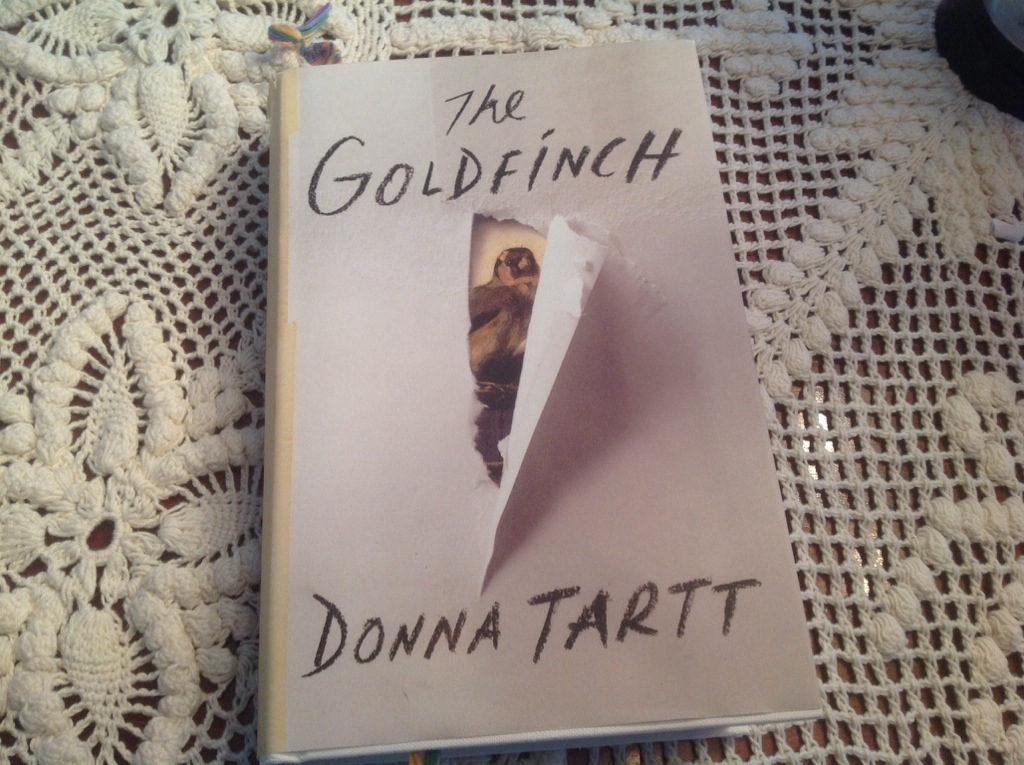
Last night I started THE GOLDFINCH.

20131221-110000.jpg

Theo Decker is the opening narrator.  At 13, he loses his mother in a sudden accident, which he survives.

Here’s a titillating paragraph near the opening of the novel:

“Oh, drat!”  cried my mother.  She fumbled in her bag for her umbrella–which was scarcely big enough for one person, let alone two.

And then it came down, cold sweeps of rain blowing in sideways, broad gusts tumbling in the treetops and flapping in the awnings across the street.  My mother was struggling to get the cranky little umbrella up, without much success.  People on the street and in the park were holding newspapers and briefcases over their heads, scurrying up the stairs to the portico of the museum, which was the only place on the street to get out of the rain.  And there was something festive and happy about the two of us, hurrying up the steps beneath the flimsy candy-striped umbrella, quick quick quick, for all the world as if we were escaping something terrible instead of running right into it.

This novel comes highly recommended and is included in those holiday reading lists for gift-giving or for your own pleasurable reading.  Besides, old friend June Derr says its good.

Turkey Tracks: “Earth” Quilt

Turkey Tracks:  December 20, 2013

“Earth” Quilt

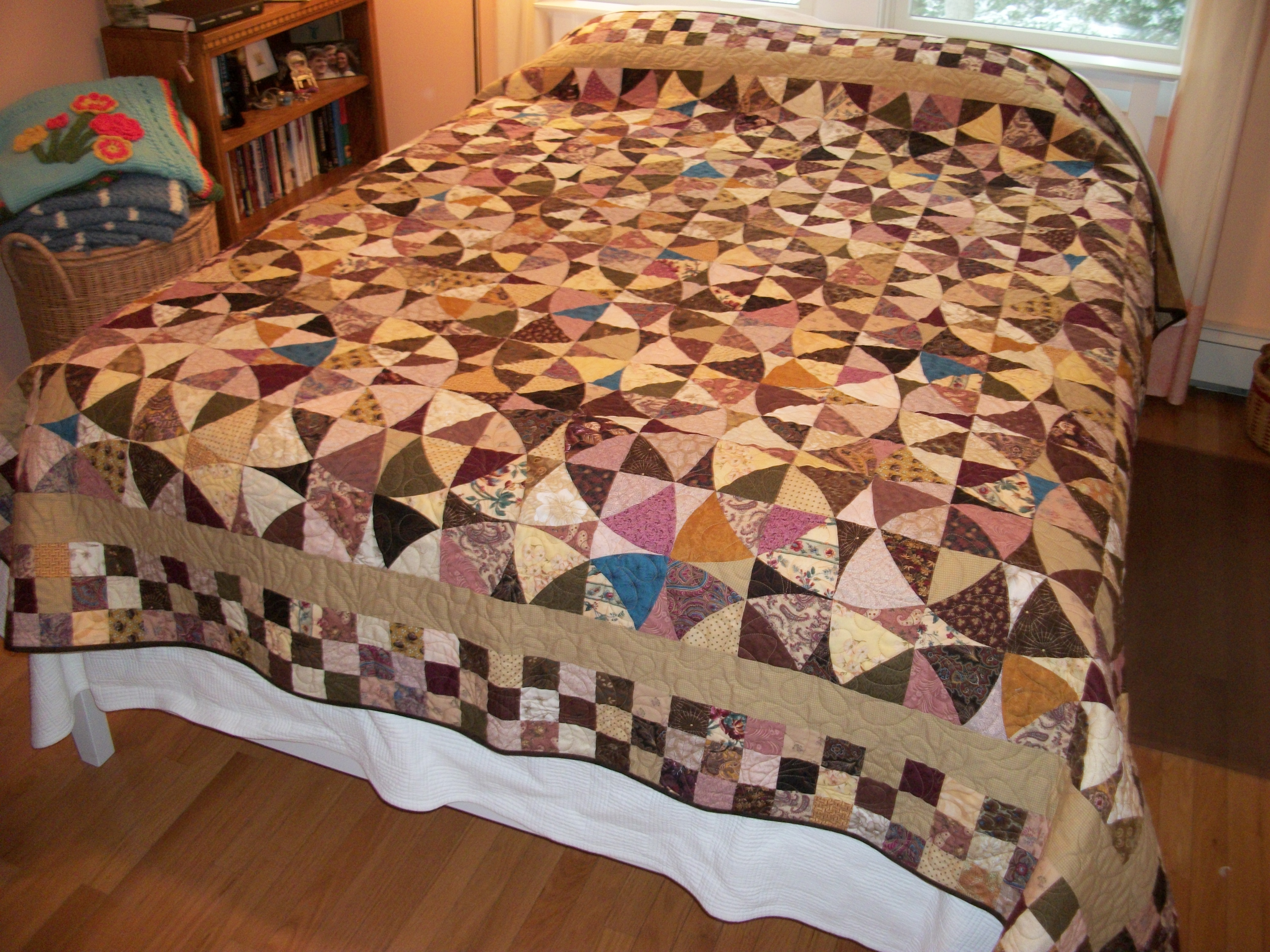
This picture is not the greatest picture I could have taken of this big, bold-hearted quilt.

It’s hard to get a good overall picture without two people to hold a big one like this aloft somewhere.

Earth 2

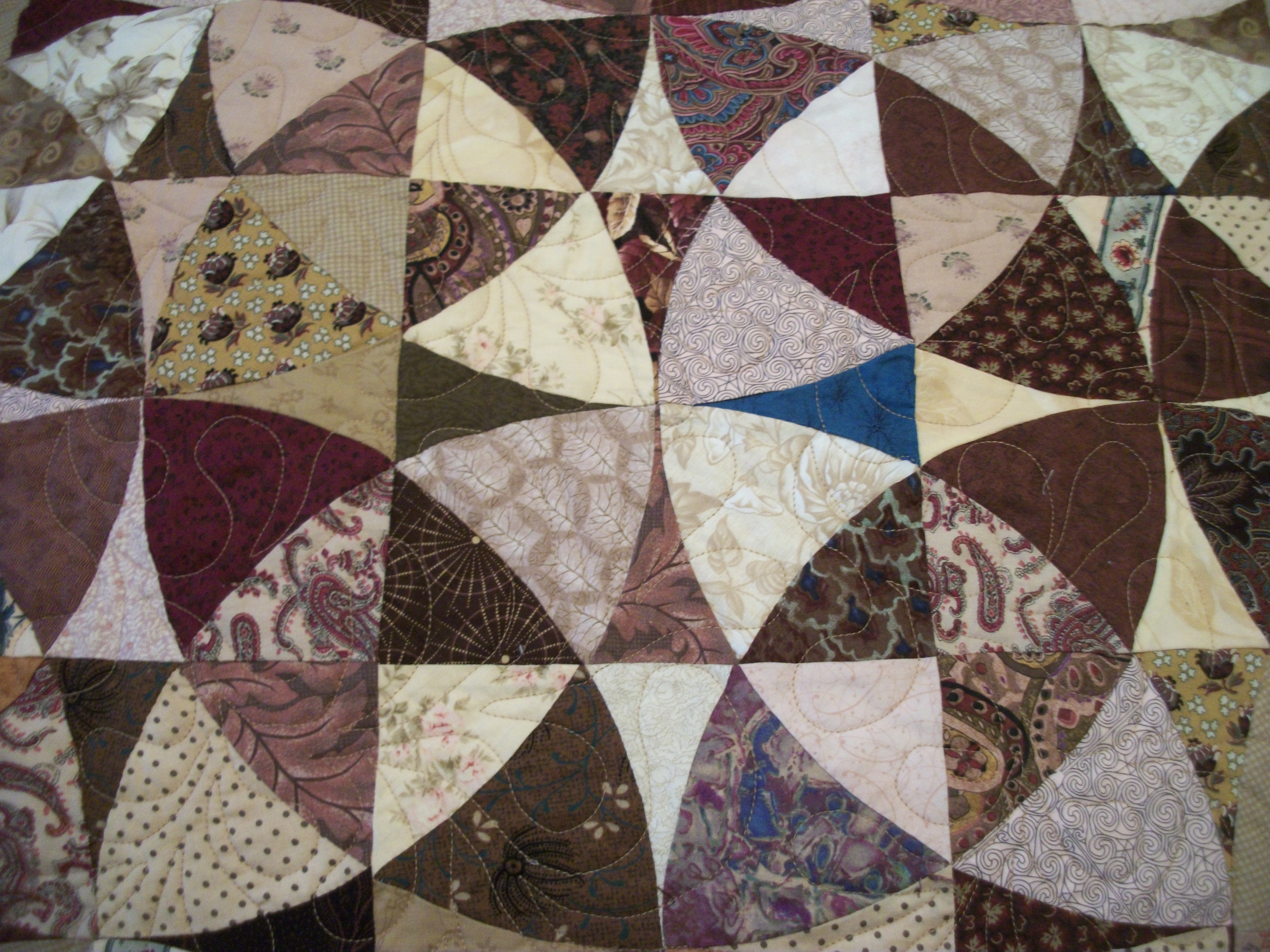
I hand-sewed about 2/3s of these blocks this past summer–which are known as Winding Ways or Wheel of Mystery blocks.  Then I discovered that they sew really well on the machine as well as the curves are not extreme.  It’s easy to cut four layers of fabric with the templates I have (you can order the set online–John Flynn makes one) and with a SMALLER rotary cutter–like the 45mm.

The dark/light blocks form big circles on the quilt–which I really love.  And I really love all the geometric shapes that show up as well.

Earth block

I put in bits of the blue you see–and those bits show up like little polka dots.  Or, pools of water scattered across the earth.  They sparkle across the quilt top’s surface.

It takes a “deep” stash–many fabrics collected for many years–to make a scrappy quilt like this one.

I pieced the backing–and like the way it came out:

Earth backing

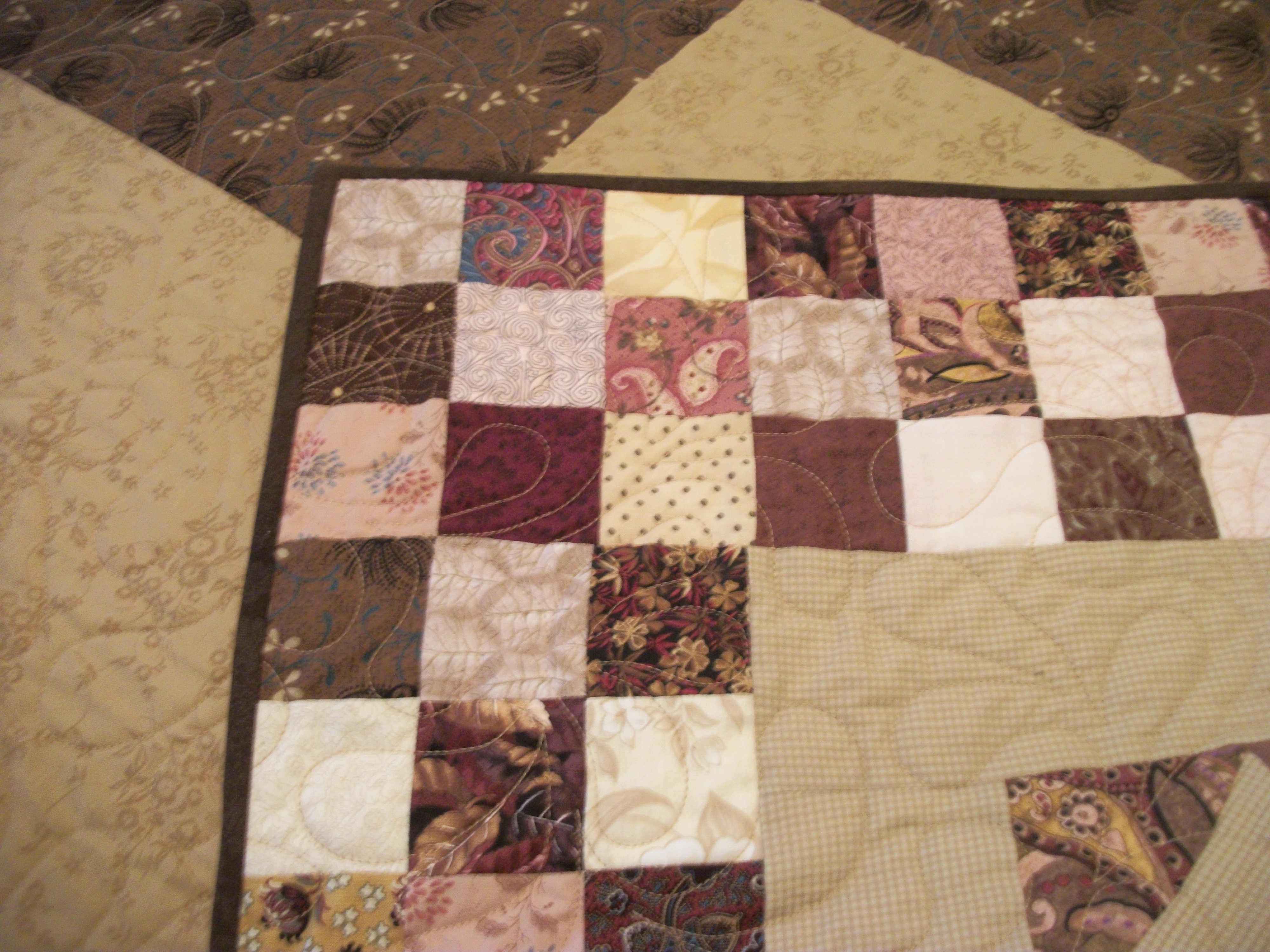
I had the dark brown/teal print in the pile of fabric I used in this quilt.  And I cut 10 1/2-inch blocks from other pieces to make rows on the back–an idea which came from Bonnie Hunter’s books.  I also put in some random blocks left over from the front of the quilt.

I really like the border–which is vintage Bonnie Hunter:

Earth border with back

Here’s another view:

Earth border and binding

And I quilted overall with a feathery pantograph pattern I’ve used many times now:  “Simple Feathers” by Anne Bright.  (I love her patterns.)

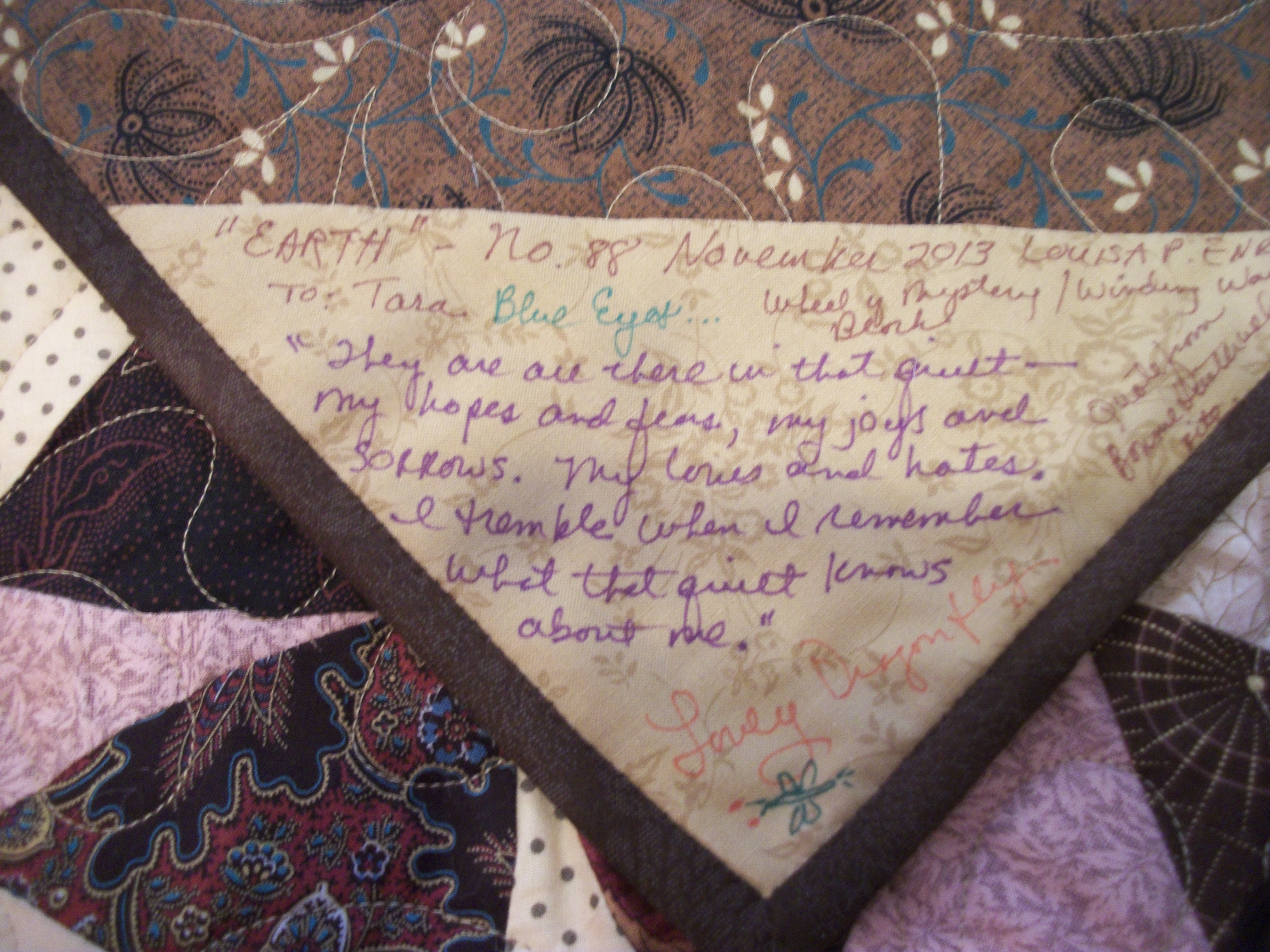
There is a lot of work, love, healing, and emotion in this quilt–more than most I do.   Here’s the label.  (The saying came from Bonnie Hunter’s web site quiltville.com.)

Earth label

This quilt was delivered TODAY to Tara Derr Webb, whose age fits between my two sons.  I have known her and loved her and worried with her and rejoiced with her since she was eight or nine years old.  Today is the day that Tara is cooking out of “the Farmbar” for the first time in Charleston, SC, where she and her husband Leighton own and operate a developing farm.  Tara is also a photographer, and you can see her work and pictures of Deux Peuces Farm (two fleas) and the Spartan trailer that is “the farmbar” on her web site:  www.thefarmbar26.com.

Turkey Tracks: Celtic Solstice Mystery Quilt: Clue Three Finished

Turkey Tracks:  December 20, 2014

Celtic Solstice Mystery Quilt

Clue Three Finished

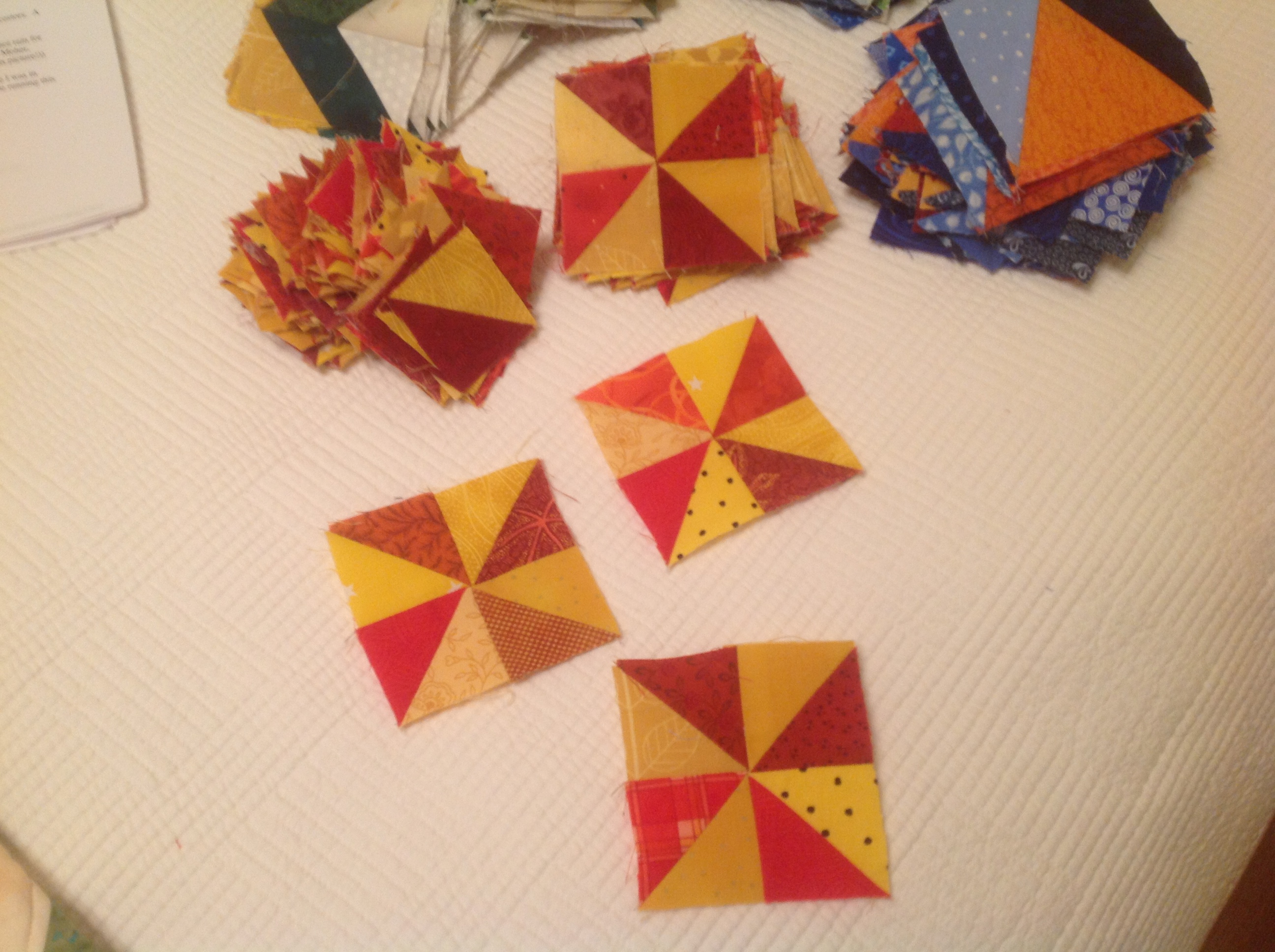
Clue Three was to create these orange and yellow pinwheels and half-square triangles.

Aren’t the pinwheels cute?

I am still chuckling because each measures perfectly, but I did a lot of unsewing.  The seam ripper is still hot.

Based on wisdom from the Facebook web site for this quilt, I changed my needle, used the single hold needle plate, and tried to be more consistent with feeding the units through the needle.

IMG_0037

So, now, these three sets of units are completed, and I am up-to-date and having fun.  AND, learning a lot.  Bonnie’s directions for each step are amazingly complete, and I am learning new rulers and basic things like “swirling” seams on the underside to mitigate bulk–a step I had forgotten completely lately.

IMG_0038

Clue FOUR came out this morning.  Four-patches with orange and green.

That should be simple.  But I thought the other units would be simple, too!

Books, Documentaries, Reviews: THE TIGER’S WIFE, Tea Obreht

Books, Documentaries, Reviews:  December 19, 2013

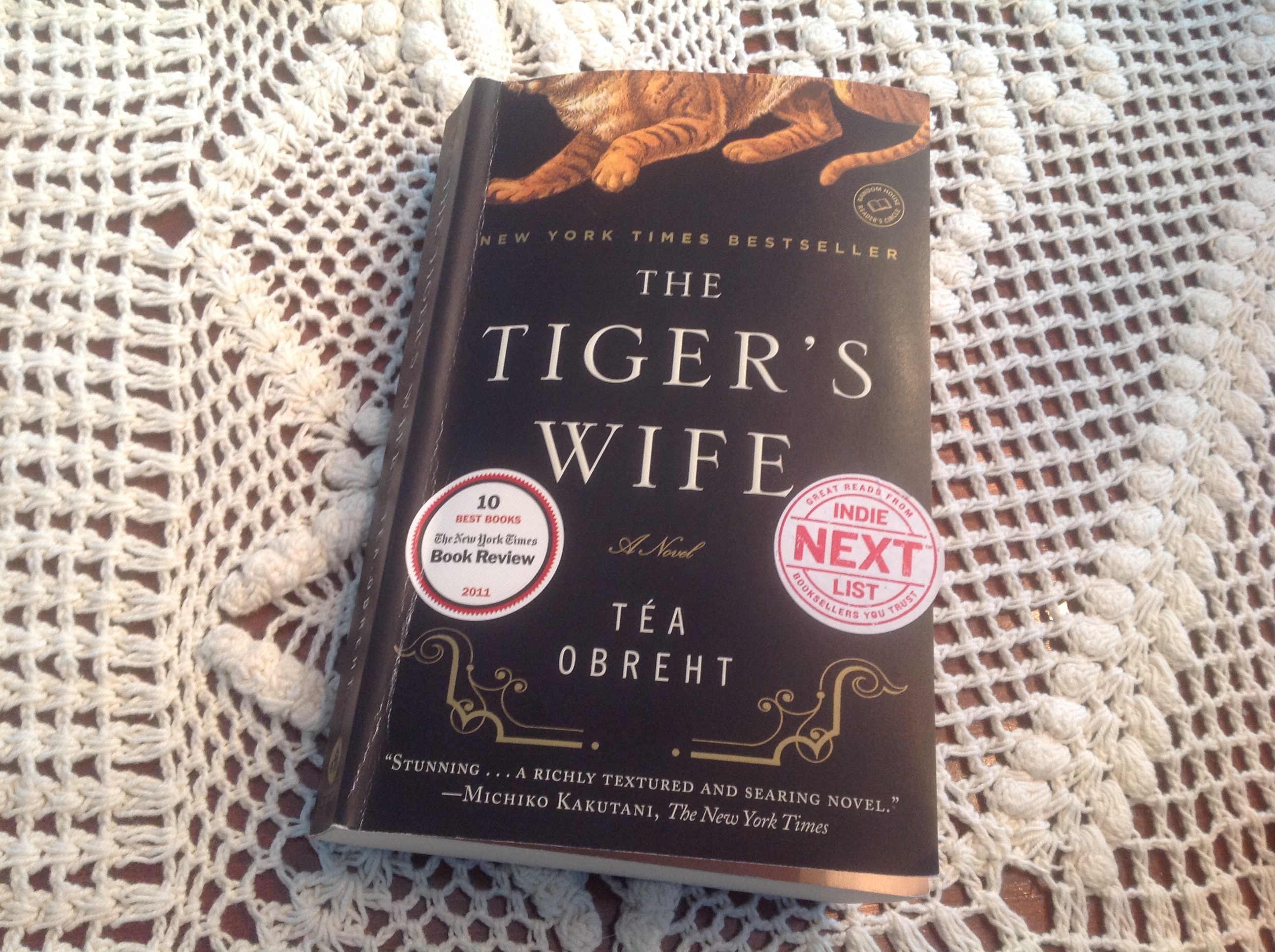
The Tiger’s Wife

Tea Obreht

I’ve read it twice now.

And loved it both times.

I read it first last year, after which I recommended it for our Book Club.

And I just finished it for the second time and found this second reading was even more enjoyable as I picked up on details and connections I had not seen as sharply as I did with the first reading.

IMG_0035

The novel begins in unnamed Balkan countries after one of a long series of wars has ended–think Christians vs. Muslims and Turks vs. Ottomans.  But the novel takes readers back to the war years–not with graphic descriptions of war, but with descriptions of how war affects populations in general.

The protagonist, Natalia, is a young woman, a doctor, who has grown up during the war.   And the story begins as she and a doctor friend, Zora, go into conquered territory (that used to be part of a whole) on a peaceful mission to inoculate school children in a remote village.  She hears on the way that her grandfather, who raised her, has followed her to, according to her grandmother, help her, has died in yet another remote and strange village–which turns out to be not so very far from the village where Natalia is presently.  But Natalia’s grandfather is very sick with cancer, which Natalia and he have hidden from his wife.  So, WHY has he left home?  And so it begins, the unraveling of the history of her grandfather’s life in all its complexity and its mysteries AND of Natalia’s life, which is still fairly new.  The journey Natalia makes is a coming of age journey for her.

The grandfather and the granddaughter are both doctors, the grandfather a famous, once-respected one in the old regime.  Natalia and her grandfather are wedded to science and rationality; yet their lives are both filled with stories, of narratives that defy a grounding in actual reality.  And the reader begins to understand that “stories” are how we explain what we don’t understand.   The “tiger” of the title functions in the intersection between the real and the explanatory narrative–much as the white whale did in Moby Dick, as more than one reviewer notes.  And the zoo that holds tigers and the elephant functions a metaphor as well, but I’m still thinking about what is involved.

Here’s a quote from the text:

He learned, too, that when confounded by the extremes of life–whether good or bad–people would turn first to superstition to find meaning, to stitch together unconnected events in order to understand what was happening.  He learned that, no matter how grave the secret, how imperative absolute silence, someone would always feel the urge to confess, and an unleashed secret was a terrible force.

Part of what resonates with me in this novel is how people behave when what they know and the cultural power they have is perceived to be threatened or is threatened.  Is that not what is at the bottom of much of our politics these days?  We now live in a multi-cultural society, and there is a lot of fear of “loss” on the part of those who have had cultural power and who are now having to share it.

All through the war, my grandfather had been living in hope.  The year before the bombing, Zora had managed to threaten and plead him into addressing the National Council of Doctors about recasting past relationships, resuming hospital collaboration across the new borders.  But now, in the country’s last hour, it was clear to him, as it was to me, that the cease-fire had provided the delusion of normalcy, but never peace.  When your fight is about unraveling–when it is about your name, the places to which your blood is anchored, the attachment of your name to some landmark or event–there is nothing but hate, and the long, slow progression of people who feed on it or are fed it, meticulously, by the ones who come before them.  Then the fight is endless, and comes in waves and waves, but always retains its capacity to surprise those who hope against it.

Natalia’s grandfather is well aware of the power of stories.  He creates a memory story with Natalia during the night he shares an experience with her that revolves around a rescued elephant coming to their local zoo.  It’s a magical scene that is powerfully written.  And he shared his own story of his experiences with “the deathless man.”  But she ferrets out his story of “The Tiger’s Wife” after he has died–a story that took place in the remote mountain village from which he came.

There are many other stories wound up in this tale.  Yet they are interconnected in many ways so that they form at least parts of a whole history–the parts Natalia needs to know to form her own whole story of understanding of her grandfather and, though that understanding, of why people often act the way they do.

I will keep my copy as a treasure.  And maybe in a few years will reread it again.

PS.  Obreht was born in Bosnia, but left there at age 7.


Interesting Information AND Turkey Tracks: Making Bone Broths AND What’s In Them

Interesting Information AND Turkey Tracks:  December 18, 2013

Making Bone Broths AND What’s In Them


I love it when something is being discussed or a piece of information is sought and “the universe” pops it up for you.  That phenomenon is called synchronicity.  And it happens in my life all the time.

My post yesterday on dysfunctional gallbladders talked about bone broths for healing–and about that time, the Mercola web site did a posting on bone broths–why they are good for you and how to make them.


Here’s that link:

Bone Broth: One of Your Most Healing Diet Staples.

Then my oldest friend (in length of time, not years) got very sick and landed up in the hospital–pneumonia–and I said “bone broths” to her.  She asked next how to make them.  So, here is synchronicity working for her.

Mercola discusses chicken bone broth.  If you use a whole chicken–take the chicken out after about 30 minutes and strip the meat from the bones and put the bones back into the pot to make the “bone broth.”  Use the meat in another recipe.  You don’t want to cook the meat to death.

If you want to use beef or lamb bones–and you do–and you can also mix them with poultry–brown them in a hot oven in a shallow pan first.  Put all the fat that gets rendered into the soup pot with the browned bones.  You can add some savouries–onions, carrots, celery, garlic, etc.–but you can also go plain and add the savouries to your stock when you make soup, etc.  Fry them up a bit in fat first.  You can pull fat off the top of your chilled stock and use that to sauté.

Remember, you want to cook the bones at least 12 hours.  You can leave the pot UNCOVERED on the stove over night and resume cooking the next morning.  As long as you heat it for at least 10 minutes, it’s fine.


Interesting Information: What Causes Gallbladder Dysfunction?

Interesting Information:  December 17, 2013

What Causes Gallbladder Dysfunction?

My father’s gallbladder blew up one day, nearly killing him.

Emergency surgery followed.

My dad had no choice, and he was lucky.

But removing the gallbladder is also a serious thing to do.  And this removal may have contributed to my father’s growing inability to absorb the nutrients from his food, particularly vitamin B12.

In my 40’s, I started having symptoms that I felt were signs that maybe my gallbladder was not so healthy either.  I was at that time “female, fat, and forty.”  (I’m still female, but not fat or forty.)

This episode may have been the start of my interest in healthy food for healthy bodies.  I tried to be a vegetarian, and while the gall bladder issues cleared up (probably because I ate a lot of cheese and olive oil), I set in motion a new set of more severe symptoms–hair loss, nail splitting, more weight gain, and a bunch of new cavities.  And, I think I caused the start of my leaky gut problems, which led, in turn, to the food allergies with which I live today.

So, what does cause the gallbladder to run amok?

Laurel Blair, N.T.P., takes on this issue in “A Nutritional Perspective on Gallbladder Health,” in Well Being Journal, July/August 2012.

The gallbladder is a “small storage organ that sits just below the liver.”  The liver produces bile, and the gallbladder stores the bile.  “Bile released from the gallbladder is an emulsifier that enables us to absorb dietary fats, as well as the fat-soluble vitamins A, D, E, and K, and essential fatty acids such as omega 3’s.  Without bile, these nutrients pass through our bodies without being absorbed.”

And, I know from other research, that if the delicate balance of our bodies gets “off,” it begins to rob stored nutrients to try to make the whole system work or to, at least, make a particular part of it work.  Is that what happened to my dad?

So, modern medicine removes diseased gallbladders.  And in my dad’s case, he was lucky that his gallbladder blow out didn’t cause other tissues/organs, etc., to become diseased.

But, taking out a diseased gallbladder never deals with the cause of the gallbladder disease.  So now a person has no gallbladder AND still has the original problem that caused the disease in the first place.

What is the cause of gallbladder disease?  Here’s Blair’s answer:

What causes gallbladder dysfunction in the first place?  There are a number of factors that can play a role, including food allergies and obesity, but the two that seem to be the most important are low-fat diets and excessive consumption of refined carbohydrates.

The gallbladder is designed to empty several times per day in response to dietary fat and acidity, but it can continue to concentrate and store bile temporarily when food is scarce.  When you eat a meal that contains little or no fat, the gallbladder will not get the message to empty itself.  The liver, however, will continue to make more bile whether the gallbladder empties or not.  The gallbladder has the ability to concentrate the bile and save it for the next meal.  But if the next meal (and the next, and the next) is low in fat as well, the bile begins to become thick, sludgy,and congealed, a condition called biliary stasis.  Over long periods of time the thickened bile can crystallize into actual gallstones.  This is particularly true if the bile is supersaturated with cholesterol.  Refined carbohydrates have been shown to increase the cholesterol saturation of the bile.  Refined carbohydrates also deplete magnesium rapidly from the body, and magnesium deficiency is another factor that has been linked to gallstone formation.

Blair lists some ways to prevent gallbladder disease:

1.  Avoid refined carbohydrates like white flour and sugar.  (An overload of these can cause the body to pull nutrients from body storage, one of which is, AHA, the B vitamin complex.)

2.  Eat plenty of healthy fats which include saturated fats from pasture-fed animals (butter, ghee, cream, tallow, lard, fatty meats, egg yolks, organ meats, etc.), tropical oils (palm and coconut), monounsaturated fats from extra virgin olive oil and avocados, and small amounts of polyunsaturated fat from nuts, seeds, and fish.  AVOID corn, soy, canola, sunflower, safflower, cottonseed, other seed oils, and hydrogenated oils.

3.  Make sure your diet contains plenty of minerals–eat homemade bone broth, dairy products, organ meats, seafoods, and organic vegetables (especially leafy greens)

4.  Include taurine-rich foods as taurine is a major constituent of bile.  Taurine is an amino acid found in animal proteins, including meats, seafood, eggs, dairy products, and brewer’s yeast.

5.  Eat beets.  Beet root and stem are “natural bile thinners.”  Beet greens are high in magnesium–but, I’d add, also high in oxalates, which can cause kidney stones.

6.  Avoid rapid weight loss and very low-calorie diets–as this behavior can increase the risk of gallstones.  Lose only about two pounds a week.

Hang on to your gallbladders!

Feed them with good fats!
Turkey Tracks: December Update

Turkey Tracks:  December 14, 2014

December Update

Well I have neglected the blog.

I’ve been busy with the Christmas party for the Coastal Quilters and with buying and starting to learn a new MAC computer (!).

I’ve been told for years and years that MACs are great for artists, and I have completely fallen in love with my Apple IPad and IPod Touch.  So, when my PC recently threw up the blue screen of death and started screaming at me–necessitating putting it into the car and rushing it down to Archangel Computers, which, fortunately for me, was open–I started rethinking getting a MAC.  I personally believe I am due a nice treat for this first Christmas I will be spending alone.  And I learned you can turn off a computer by holding down the start button for ten seconds.  Another piece of the learning curve…

And then there was the issue of trying to juggle email on four different devices that were not talking to each other.  Our local Time Warner carrier has roadrunner, and they have instituted changes that have made it pretty much totally unworkable, clunky, time-consuming, and a general pain in the you know what.  So…I’ve also gone to a gmail account.

The PC was, by the way, playing an audio book on CDs.  And it was sitting on my ironing board while I was sewing.  Who knows what happened…???  Anyway…I had to take the CDs back to the library as I do not have any way to play CDs except for an old CD player in the living room–and I don’t quilt in the living room.  I’m not sure I want to pay to download books, but I might.  I’m still rethinking this particular problem.  The CD players on the market now are either really cheap and have terrible reviews or are really expensive–and I’m not going to spend money on dead technology.

Anyway, I do have an update for you.

I finished the knitted cowl and am more than a little mildly disappointed with it.  Oh, it’s big and warm, but I thought the blues and greens would be dominant.

Here is a reminder of what the yarn looked like:

Cowl Project 2

Knitted, the yarn is kind of muddy looking–though it’s growing on me with my brown coat.  The pattern is nice and there is a lot of texture:

100_3615

Here I am in it:

100_3619

I can now take a picture like this one on the MAC!

And I’m going to need to make a hat that goes with the cowl…

The sauerkraut is ready to give away or store:

100_3633

Isn’t it gorgeous!

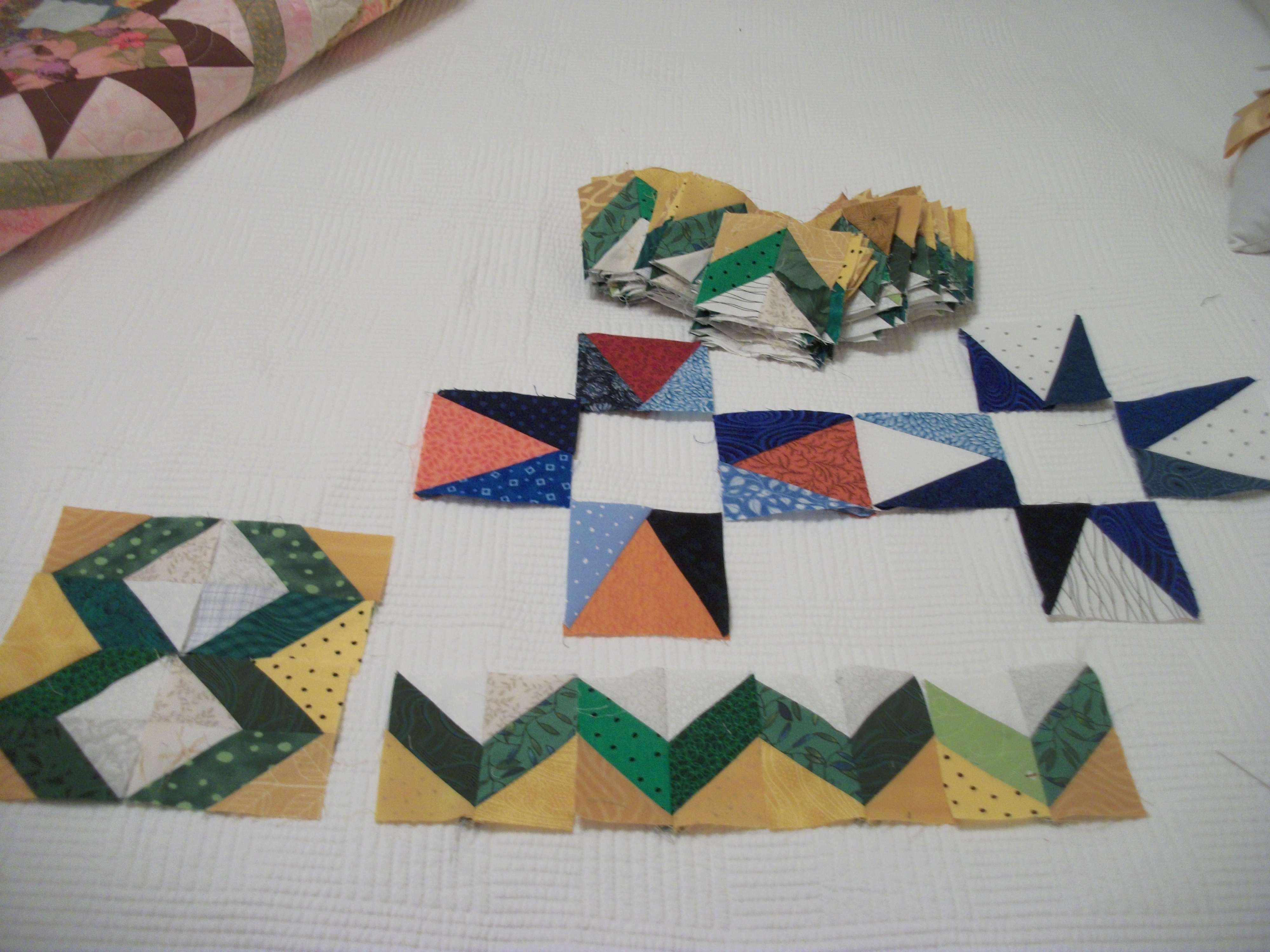
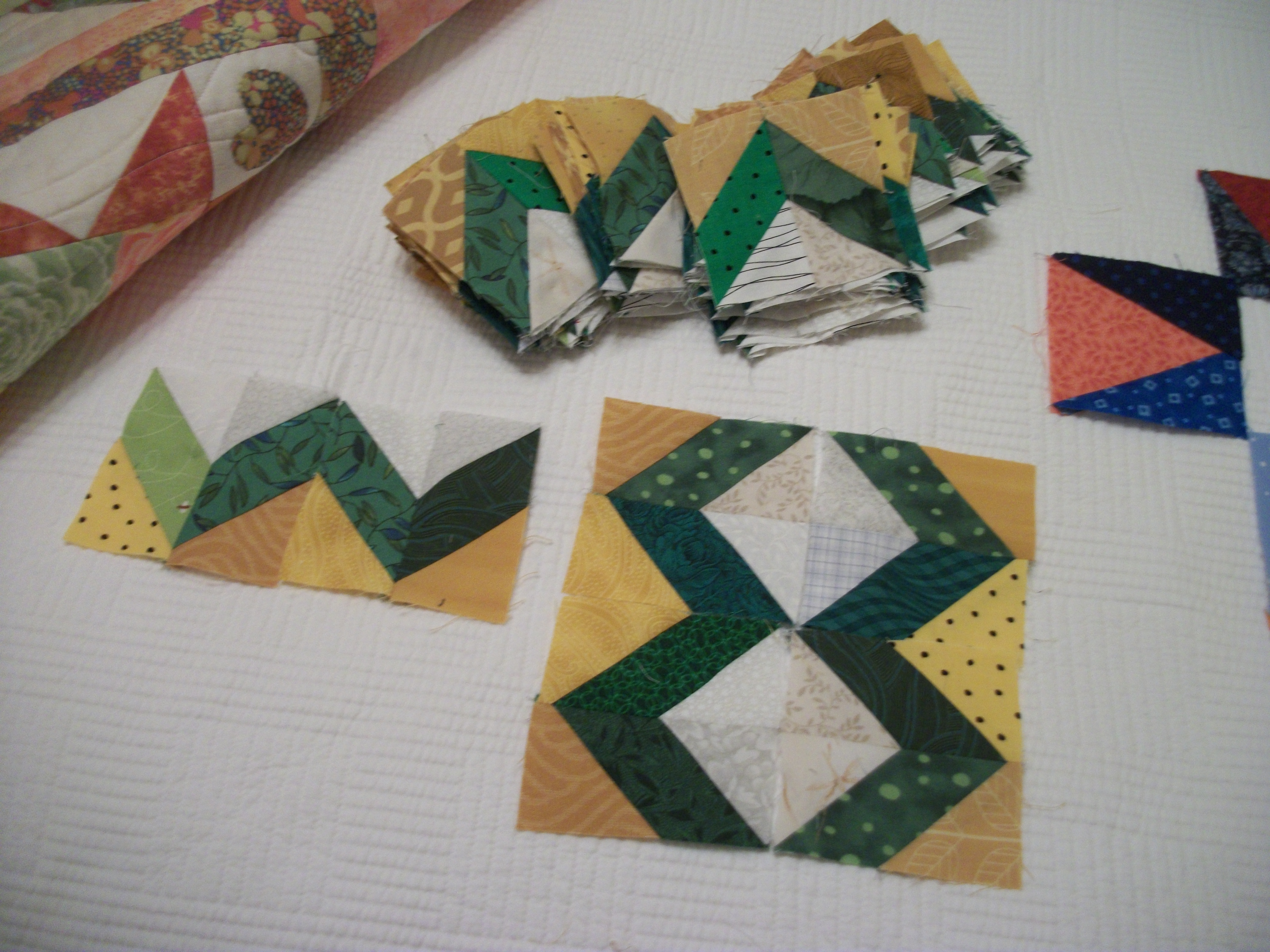
I finished “Clue Two” of Bonnie Hunter’s 2013 Thanksgiving Mystery Quilt:  Celtic Solstice.  They were chevrons and quite pesky to sew.  “Clue Three” came out on Friday, and I finished these units sometime on Thursday.  Here they are with “Clue One”–the units that will make stars when assembled.

100_3631

Here’s another view–a close up:

100_3628

The Facebook group members are all wondering how these chevrons will be used in the quilt.  Here are some patterns, though not all I’ve seen:

100_3630

Bonnie shows a picture of an intricate tiled floor she took on her trip to Ireland this past summer.  Hmmmm.

The new clue came out Friday.  They are 2-inch half-square triangles in the yellow and orange.  Some are sewn into pinwheels; some are left alone.

I have a pile of “interesting information” to write about–and I promise to get going on that information in these quiet days.

We are expecting a BIG SNOW tonight, and it’s bitter, bitter cold here in Maine.

Interesting Information: 7.83 Hz, and Sleep in the Quiet Dark

Interesting Information:  December 8, 2013

7.83 Hz, and

Sleep in the Quiet Dark

I used to fuss at my younger son and his wife all the time about the sleep monitors they have in their babies rooms.  The older child, especially, is a very light sleeper.  To give her comfort, they also keep a night light on.

But I’ve given up.  And they do have to live their lives in their own way.

Nevertheless, like many of my generation who grew up without much technology, I’m worried about the overload of radiation in our world today–from cell phones, baby monitors, microwaves, wireless transmitters of all sorts (computers, Smart Meters, radios, etc.), the machines at the airports.  It’s a growing list.

I myself cannot sleep with lights on around me.  The fire alert contraption on the ceiling near my bedroom door–meant to show me where the door is in the case of fire–seems at night like a strobe light.  I covered it with several coverings of masking tape.  But I can still see it once my eyes get accustomed to the dark, and one of these days, I’m getting on a ladder and putting MORE tape over it.  The light from the clock or from the plug strip in my room or from the phone–I block or cover them up.  Then I get, blissfully, dark.  Then I have only the monthly full moon and the countless bright winter stars to thwart my sleep.

Am I nuts?

You can watch Resonance:  Beings of Frequency for free at https://vimeo.com/54189727 (James Russell and John K. Webster Directors, Patient Zero Productions).

And below you’ll find the review of this DVD from Tim Boyd in the Spring 2013 issue of Wise Traditions, the journal of The Weston A. Price Foundation.

Seems that 7.83 Hz is the resonant frequency of the earth–and as such is the frequency at which the alpha waves of our brains resonate.  If that frequency gets interfered with, ill health follows.  Reviewer Tim Boyd notes that if you put a cordless phone in a bee hive, the bees leave.

Be sure to read the paragraph on dark and wireless devices and melatonin production.

Resonance: Beings of Frequency PDF Print E-mail
Written by Tim Boyd
Tuesday, 23 April 2013 20:05
book-thumbupResonance: Beings of Frequency Directed by James Russell and John K. Webster Patient Zero Productions Available for free viewing at http://topdocumentaryfilms.com/resonance-beings-frequency/When you have a sphere within a sphere and an electromagnetic field, that arrangement creates a frequency. For at least a few centuries most of us have known that Earth is a sphere and it is surrounded by a larger sphere we call the ionosphere. Using that information, Winfried Otto Schumann calculated the resonant frequency of the earth as 7.83 Hz. I know what you’re thinking. Why would anyone care? It turns out that alpha waves generated by the human brain resonate at about that same frequency. It also turns out that when researchers constructed an underground bunker completely shielded from those waves and put test subjects in that bunker, they discovered that was bad for human health.

Other experiments with DNA in water showed that DNA strands communicate with each other at about the same frequency. Life in general seems to be tuned to 7.83 Hz. In our current era we are now adding an unprecedented amount of other electronic frequencies and noise to the environment. Between radio transmissions, cell phones and other wireless transmissions, it is becoming almost impossible to detect the Schumann resonance around big cities.

There is reason to believe this is having adverse effects on human and animal life. When cordless phones are put in a beehive, the bees don’t return. When natural electromagnetic fields are disrupted by things like cell phones or cell towers, birds and bees are no longer able to navigate. There may be other factors involved but this appears to be a significant factor in the decline of many species of birds and insects. In human populations, cancer clusters have been noted around cell phone towers.

Melatonin is a powerful antioxidant that regulates the immune system. It is produced by the pineal gland when it is dark. That is why you need to sleep in complete darkness to get the benefits of any melatonin. There is now evidence that melatonin production is disrupted by other forms of radiation besides visible light, particularly from wireless devices.

There have been a number of studies showing problems with cell phone radiation. There have also been many studies claiming that there is no problem. When you look at who carried out (or paid for) the studies showing no problem, it is obvious that the sponsor of the study had a vested interest in finding nothing. This video also points out that there is no effective government oversight or regulation of all the new phone technology. It is almost amusing when people are shocked by this fact. Large corporations control the governments of the western world. How much genuine regulation do you expect? All of this is more bad news for cell phone lovers. This one gets a thumbs UP.

This article appeared in Wise Traditions in Food, Farming and the Healing Arts, the quarterly magazine of the Weston A. Price Foundation, Spring 2013.

Interesting Information: Vitamin B12 Deficiency

Interesting Information:  December 8, 2013

Vitamin B12 Deficiency


My father’s body stopped being able to use the B12 vitamin in his later years–which is a malabsorption issue.

He got B12 shots, but he slipped into dementia (not Alzheimers) anyway a few years later.

The Spring 2013 issue of The Weston A. Price Foundation’s journal Wise Traditions, Nutrition and Behavior, discusses at length the connections between human violence and other behavioral issues and the lack of nutrients–vitamins, minerals, enzymes, and so forth.

Sylvia Onusic, PhD. CNS, LDN, in “Violent Behavior:  A Solution in Plain Sight” (Wise Traditions, Spring 2013) discusses the lack of B12.

Here’s the link:  http://www.westonaprice.org/environmental-toxins/violent-behavior-a-solution-in-plain-sight

Here’s what Onusic said about the lack of B12:

Vitamin B12 deficiency has a well-known correlation with mental disorders, including irrational anger.  A higher incidence of low B12 is found in mental patients than in the general population.  Deficiencies cause mental symptoms ranging from poor concentration, depression and severe agitation to hallucinations [citation here].  Deficiencies are caused by pernicious anemia, an autoimmune condition; they are also found in vegetarians and vegans, those with low animal protein intake, and individuals with leaky gut.  Drugs including anesthetics can deplete B12 [citation here].

My dad, as I said above, had some sort of malabsorption going on.  He was thin as a rail though my mother, a great cook, fed him very well.  He took a boat load of drugs for allergies and asthma.  (We know now that most food allergies and asthma can be associated with foods and an impaired immune system–not to mention all the chemicals washing over our world these days.  My dad lived across the road from an agricultural field that held skull-and-crossbones signs at its four corners.)  He probably had leaky gut…

Anyway, this article is interesting…

And gives us a lot of information to contemplate.


Interesting Information: Stell Shevis’s Enameled Music Boxes

Interesting Information:  December 8, 2013

Stell Shevis’s

Enameled Music Boxes


When I graduated from high school, my grandmother gave me a china box that I treasure to this day–though it is worn and tired and old now.  

It lives on my dresser and holds some pearls John gave me long ago.

I wanted to give my grandchildren some small treasures that they would have always.  Each has their name spelled out in brightly colored wooden letters–led by a train and followed by a caboose.

And to each–up to the birth of the youngest last April–I gave an enameled music box made by Stell Shevis–who is far more than a local artist here in Maine.  Stell and her husband have national reputations, and we are only just lucky that they decided to live in Maine.  (Shevis died a few years ago.)

link:  Stell Shevis | About Stell and Shevis- Maine’s local artists.

I discovered Stell’s music boxes when we first moved to Maine ten years ago now.

But, Stell, who is in 2013, 97 years young (and she is young in mind and heart and sharp as a tack), stopped making the boxes some time ago.

When Ailey was born, I called Stell and asked if she had any left in her studio.  She did, and I chose one for Ailey.

Last week, I worked up my hope and called Stell again.  Perhaps she had a few left, I asked when she answered the phone.

I went right over, and there were four boxes left.

I bought two.  One for Cyanna.  One, just in case…

And Stell and I had a wonderful visit to boot.

Here are the boxes:

Stell Shevis  music boxes

The white is silver, and the yellow, gold.

One plays “White Christmas” and one plays “Wind Beneath Your Sails.”

Hmmmmm…..