Roasting everything in your meal together is such an easy and quick way to produce dinner.
The chicken breasts and potato take longer (total about 45 minutes), but the veggies don’t want to be roasted that long—so I add them when there is about 35 minutes remaining—and drizzle them with olive oil and herbs after they go in the pan.
And LOOK! There is pretty much no mess to clean up. The pan usually just needs a quick swish with a soapy rag and a rinse.
Here’s my dinner.
There is another meal and more left over. I cut the breasts in half so I have meat for other meals (gently reheated probably) and roasted meat for my lunch salads.
Here’s another meal made in this fashion about a week later:
It was delicious too. The extra drumsticks were reheated and topped a lunch salad.
I don’t usually eat a lot of baked white potato. This just happened…
I could use a sweet potato, pieces of winter squash in the fall/winter, cauliflower, or medley of veggies including carrot, or add a separately-cooked grain (rice, quinoa for me). I use what I have on hand. Since I often have a HUGE lunch salad with lots of raw veggies, I don’t bother with a dinner salad. I do add some cut-up raw fruit for a dessert.
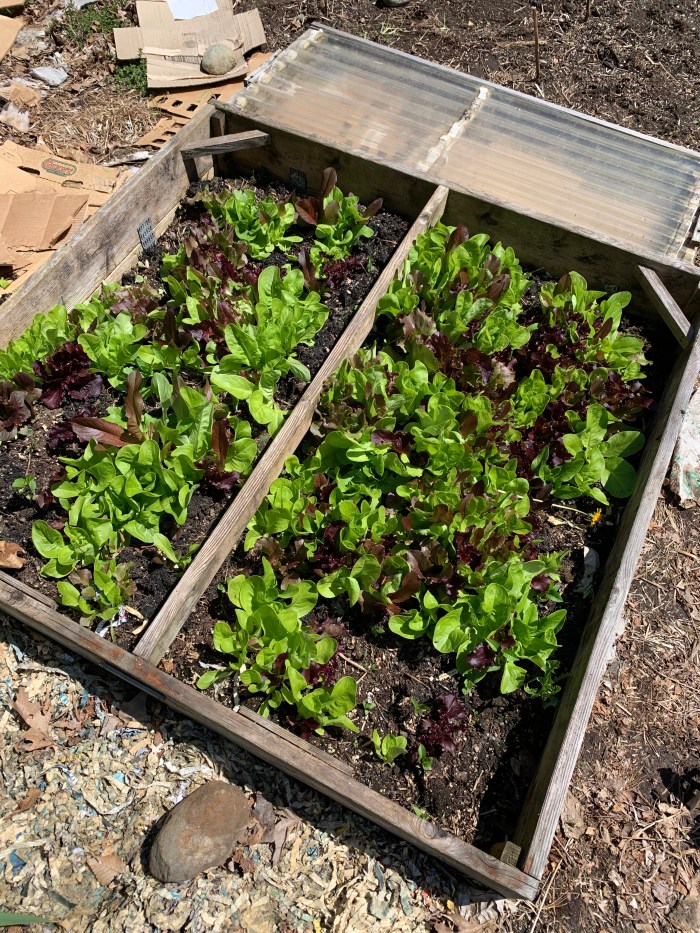
Look at my beautiful cold frame lettuce. It’s still growing—as it has been so cool here in Maine this spring. But I gathered some lettuce—thinning the clumps to give some plants more room to grow—for my first cold-frame lettuce salad.
To remind, I set up this cold frame in the fall with new compost and seed and cover it for the winter. Left alone, it does its own thing when the longer daylight hours return. I’m still covering it most nights—remember that it SNOWED all day last Saturday, with no accumulation, but…
Here’s my first lettuce, rinsed and headed for the lettuce spinner.
I’m making a lunch salad, of course. And the protein will be one of the cube steaks I keep on hand. These steaks have a lot of flavor, defrost quickly, and cook in a very few minutes—just about two minutes a side, or less, in a hot cast iron frying pan.
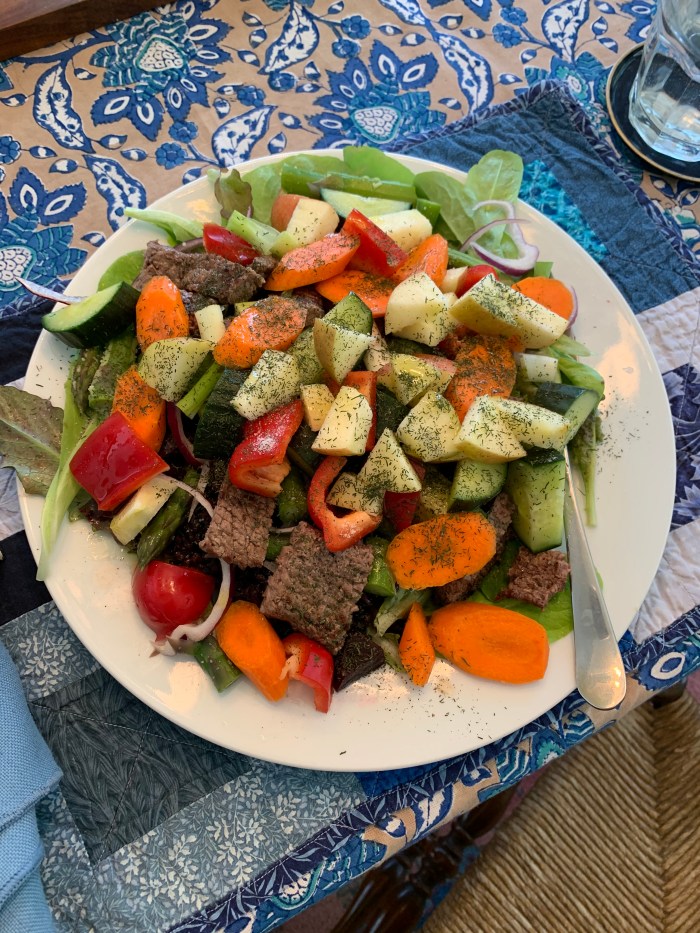
Here’s my beautiful salad:
Lettuce from cold frame, sweet red pepper, roasted beets, cucumber, leftover asparagus, carrot, spring onion, red onion, apple, leftover forbidden black rice, cubed steak, olive oil, salt, and dried dill.
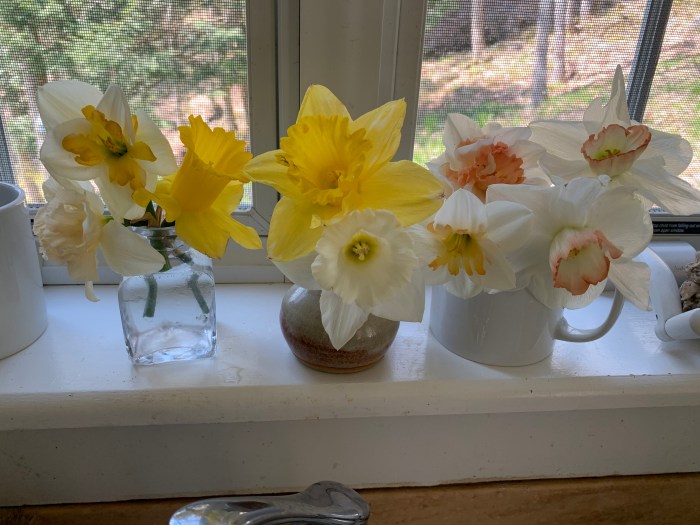
The daffodils this year have been glorious. I’ve planted so many now, each year choosing more and different varieties. Some of them are so frilly—they look almost like peonies.
I bring some inside to the kitchen window and so enjoy them there. Here’s the most recent selection.
Tom Jackson’s crew came and cut up the GIANT ash tree that fell over the stone wall property line last fall. It is a monster. I tried through the winter to donate the wood to anyone who would cut it and take it, but had no takers. It is just in a very difficult spot where getting the wood out would be way too hard.
There is a wetland below the stone wall and the tree, which would not allow for any equipment to come in that way.
I really need to get a picture of the daffodils in the little meadow this year. They are so beautiful and continue to naturalize over this area. They brighten the heart and soul, and I look forward to seeing them each year.
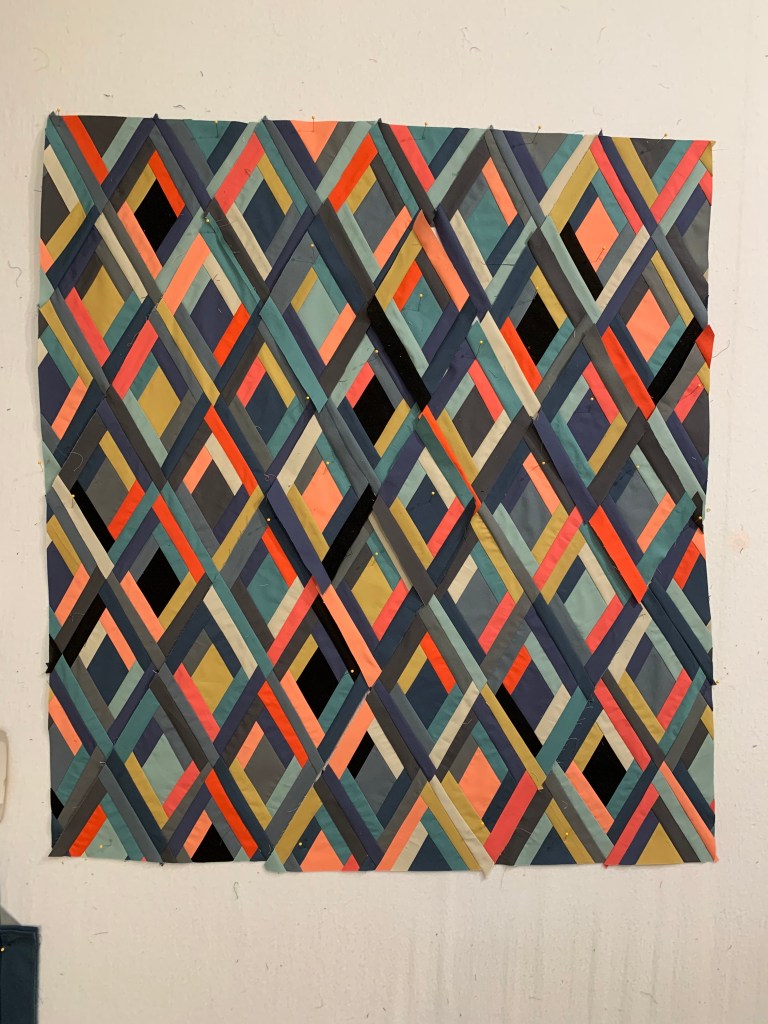
I finished hand quilting the big block Galactic wallhanging last night. I’ll trim and put on the binding/hanging sleeve/label today. And yesterday I finished the smaller block version—just two rounds. I love this block and could quite easily go down a rabbit hole with making the big block in a different palate. But I need to move on to the remaining three projects in The Color Collective, season 2, each of which look exciting to make.
And, today, which is THURSDAY already, is going to be much warmer. It is a bright, sunny day with little wind. I’m eager to get out into it.
The main reason I have to go to the grocery store about twice a week is that I need to buy white fish and sardines for AC Slater’s diet.
I can’t buy more on each trip because our local fish has been frozen at sea and then defrosted locally. It needs to be cooked and not refrozen.
Packages of frozen white fish, like cod, come individually wrapped, which is a pain to unpackage and an environmental nightmare with all that plastic. Plus each packaged fish piece is full of water or some solution, which makes the resulting mixture really watery.
So, why does AC Slater need white fish. Since last summer, AC has been struggling with MASSIVE food allergies that resulted in him chewing and clawing holes in himself as he was itching so badly. It has been a nightmare for me as I cannot bear to see him suffer. EVERYTHING I fed him caused him to react.
To make a long story shorter, I finally took him to a terrific holistic vet who tested him for the foods that were the worst offenders—five foods, some of which are in pretty much in all the commercial dog foods—and started him on a holistic remedy protocol that has stopped the reactions for the most part. He is not out of the woods yet—and we are taking things a day at a time—but his sores are healing and he is not going at himself tooth and claw. When he starts to react again, I give him the remedy.
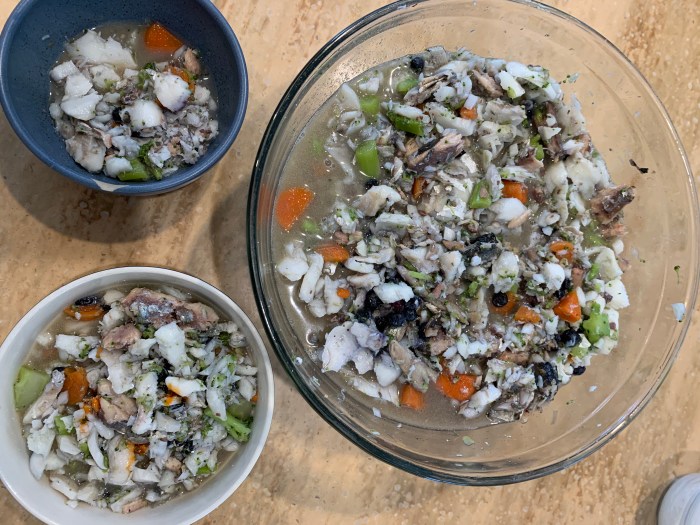
Here’s his food, which I make fresh about twice a week. I put broccoli and carrots (chopped pretty fine) in a big pot, add about an inch of water, and lay the fish over the veggies. I cover the pot and cook the fish and veggies, and then break the fish all apart. I add to this mixture, a cup of blueberries or some peeled and chopped apple and 4 tins of sardines. Sometimes I add a few tablespoons of good coconut oil. Each bowl is topped with a vet product that helps heal the gut (Antronex) and two squirts of Dr. Mercola’s krill oil for pets.
AC is lean and full of energy and is quite happy. He loves his fish meals. BUT, I worry about the heavy toxins in big fish and that, long term, he is not getting the right nutrients.
Now…
What went wrong here?
I will go to my grave believing his 1-year rabies booster started this cascade of issues. And poking around the internet revealed that allergies like what AC has can and do follow a rabies vaccination.
I also learned that there is no scientific basis for the current, legally mandated, vaccine schedule. I know rabies is a problem. It is a serious problem here in Maine. I also know that it would be wiser to check for antibodies with a blood titer rather than mindlessly giving animals more and more boosters that can and do harm them—just so vets get a steady traffic into their businesses. And, that factor is the rational for the legal rabies schedule, not animal health. It was a deal cooked up between vet business people and public health officials.
I did try to work with our local vet at first, who is very nice and caring. But her toolbox didn’t work. That protocol was to use a drug that suppresses the immune system reactions in combination with a prescription dog food. I have since read that the drug used comes with serious side effects.
Also, the prescription dog food is one of the worst industrial products, in my opinion, I’ve every seen. Protein is broken up (hydrolyzed) into tiny bits that are meant to fool the immune system. The protein source is…wait for it…CHICKEN FEATHERS. And the first ingredient is corn starch. The product smelled terrible; it reeked of a heavy chemical odor. AC loved it, until he went off the drug and reacted to it. He thought it was candy, with its sweet, sticky nature.
That left AC with getting more of the drug and switching to the only other formulation of hydrolyzed protein, soy beans. As it turns out he is wildly allergic to peas, so that clearly was not going to work. And this whole fake, chemical food solution would cause other problems down the road.
The other problem is, as I said above, that other kibble concoctions all contain one of the 5 foods that AC is allergic to. So, fortunately, I’ve always fed my dogs real food anyway, and I don’t mind cooking for him.
And one of my unanswered questions is whether or not his immune system reacted to certain foods willy nilly or whether it was because they were in his diet as I tried to find food that didn’t make him sick.
I suppose time will tell.
For right now, he is healthy and happy.
The fish diet is EXPENSIVE, however. And in this pandemic, sometimes I have trouble getting the cheaper versions of available fish.
It’s time for a change in how we treat our beloved pets, from their food to their medical treatment. It’s time for science to prevail, not business models.
Turkey Tracks: Roast Chicken: The Backbone of Many Meals
What’s your favorite part of the chicken?
Mine, hands down, is the roasted skin, followed by the drumsticks, wings, and thighs. Most of the time, the breast in today’s quick-growing chicken tastes like sawdust to me—dry and tasteless. But, I persist. And from time to time can buy locally grown pastured heritage chickens. They are delicious.
It’s so sad to me to see all those skinned chickened pieces in the grocery store because they are tasteless and dry out so fast when you cook them. And the best nutrients and fat in chicken is right under the skin. I can tell you that my grandparents ate the skin, ate meat fat, and they lived to ripe old ages and were not fat.
Anyway, you can see this chicken is accompanied by a sweet potato and a handful of small red and golden beets. You don’t have to peel them when they are small. Just wash them good, quarter or halve them and drizzle them with some fat and whatever herbs or spices you want.
Enjoy this first meal—I hope you add something green to it. I added fresh asparagus cooked in boiling water for only a few minutes. I like my veggies crisp/tender. Asparagus is in season now—it is an early spring crop. The raw apple is for dessert.
So, now you have leftover meat. That meat can go into a salad, sandwiches, stir frys, etc. But the biggest asset you have is the chicken carcass. Put it in a pot that will hold it and add water to more than cover it. You can add some savories as well: onion, garlic, celery, carrot. Cook at least one hour. Longer is even better as you start to get a genuine bone broth, which is so, so, so healthy. By long, I mean 12 hours or more—and if you use a crock pot, there are no worries about leaving a cooking pot on the stove unattended.
Drain the stock through a strainer, throw out the spent veggies and bones, and DO NOT SKIM AND THROW OUT THE FAT from the broth! You would be throwing away a nutrient dense ingredient.
At this point, you can refrigerate the broth or make a soup or stew right away. Don’t let the broth hang around for longer than one day. Freeze it or make something.
Here’s the chicken rice soup I made. I froze half of it and had three or four hearty servings over the next few days. That’s a heated corn tortilla with raw butter slowly melting—it’s the closest thing I can get to that is like bread. Sprinkle it with salt. The apple is for dessert.
I eat one fruit serving a day most days. Apple works best for me as it has natural antihistamine properties. My favorite is a Honey Crisp apple, but they don’t keep well, so I have to eat as many as I can in the fall. Fruit sugar, like all sugars, can cause inflammation, so cut back to reasonable amounts?
Hey! For added nutrients, try dropping a spoonful of raw milk yogurt or raw heavy cream on your soup. And any soup can be made into a cream soup by just adding…cream. Or some whole milk. It’s a good way to change a soup that you’ve already made for a new taste.
Here’s the start of a roasted veggie dish. I used Red Palm oil, which I melted right in the pan here. Red Palm oil is a powerhouse, medicinal fat. I’ve written other posts on this oil, which comes solid, like coconut oil. You can search on the right side bar for more information. And I have not used toxic aluminum foil in two decades. What you see here is parchment paper, which works just fine. It can take up into the 500s with no problem.
So here’s my meal with leftover, reheated gently, chicken. The roasted veggies only take about 30 to 35 minutes to roast. To heat the chicken, put it in the roasting pan for about 10 minutes or less. Drizzle some water over it to keep it from drying out.
No, I do not have a microwave and haven’t had one for decades now. Microwaves heat food, but they also distort the food and the taste of the food. I can taste microwaved food from a restaurant (or could, when I could still eat in restaurants). It does not taste right. It has a whang to it. And this microwave thing is one thing that has destroyed human abilities to taste real food.
Another Week, Another Chicken
It’s another week, and I’ve roasted another chicken. This soup is lighter as it is going over rice noodles as I can’t eat pasta. Noodles are a real treat for me! They are highly processed though, and all I have to do is look at them to put on weight. (All grains turn into sugars in the body.) But when I have a yen for some noodles, and I have not had them recently, they are such a joy.
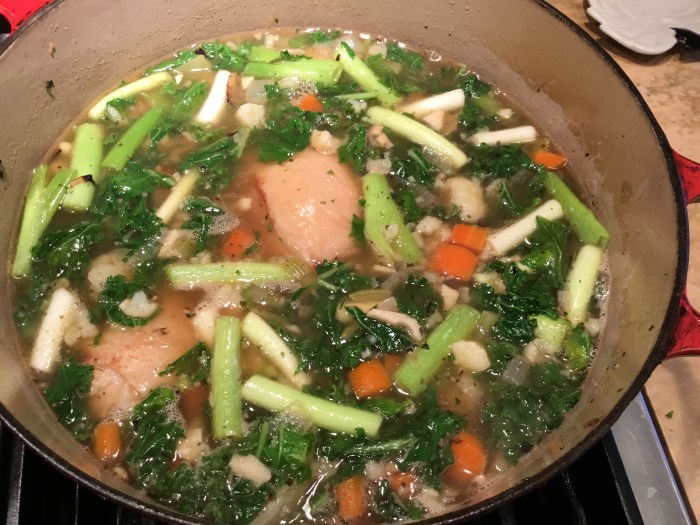
I also added chicken parts to enrich this broth. This time drumsticks, as that is what I had on hand. When they are done, I’ll take the meat off the bone. I add the spring onions and kale last and basically let them cook only about 10 minutes.
Here’s the finished soup.
And here’s my noodle soup dinner—look at those fresh berries just coming into our markets now’!
The next day, I added a two chopped up boneless chicken thighs, a handful of quinoa shells, and some corn to the soup.
The day after that, I added some cream and put some shredded mozzarella on top.
Whoa! That bowl was way too full. This overflowing bowl is a case of neatness: cleaning out the pot. I only ate half at lunch; the other half I ate at dinner, alongside plate of sauteed zucchini and a pan-fried little cube steak.
Have you been counting how many meals I get off of one roasted chicken? Add in at least two or three days of meat for salads at lunch. The point is, good food can be expensive, but if you take full advantage you knock back the per item initial cost AND you have healthy, fun meals.
I’m sure you’re happy by now that I did not buy a whole chicken this week. OK, I did, but I put it in the freezer. Tonight: braised lamb shanks with onions and carrots, a baked potato (Russet), fresh asparagus, and more of the DELICIOUS blueberries and raspberries that are on sale in my local market.
I will never go hungry because I have not cooked for myself.
Back in the day when I was young and during the first 20 years of my marriage, one only went to restaurants for special celebrations as they were scarce and expensive. I cooked. We all cooked. And as my mother grew up in a farm community, gathering food, cooking, and eating were important and fun parts of each day. Frequently, during one meal, the adults would discuss and plan the next one! Food and eating tasks were shared and enjoyed by all members of the family as the men often were the prime food gatherers and instigators of special meals. The men were definitely in charge if outdoor cooking was involved.
OK, I’ll confess. These days I HAVE to cook with my Histamine Intolerance issues. Restaurant food has too many unknown ingredients that could trigger a reaction. Ditto any food someone else cooks for me. And the smells in restaurants don’t work for me either—food particles in the air are a problem. And the smells that reside on other people (personal body products, laundry products, etc.) are serious triggers for me. But I come to this issue well prepared.
And I don’t let this situation hold me back. I just take my own “safe” food with me. And in good weather, I especially like to take a picnic somewhere scenic—or to my own back deck with a good book.
Here are some recent meals I’ve enjoyed. I try to cook for more than one meal at a time, but not too many as “old” food acquires too much histamine and sets me to itching. If I make a big soup or stew, I freeze about half of it. Then, yeah!!, I have a “free” meal to enjoy.
There is nothing for breakfast that I can eat without tempting fate. My breakfast is a big cup of coffee loaded with our local raw heavy cream and a bit of our local honey. By lunch, I am hungry.
Lunch is, most often, a BIG salad with lots of raw veggies and a meat protein. I use herbs, salt, and a drizzle of EVOO olive oil since I cannot do vinegar. The taste of the veggies comes through loud and crunchy and, often, very sweet. I don’t miss the vinegar because once I got away from it, or lemon, my tastes changed. Suddenly I could really taste the vegetables, and they were delicious.
This salad has a bed of mixed lettuce, some diced roasted chicken, a bit of organic cottage cheese (which I seem to be able to eat even though it has a bit of vinegar to make it…cottage cheese), some cooked snow peas and broccoli, and raw red onion, red bell pepper, carrots, cucumbers, some dried dill, sea salt, and 1 1/2 tablespoons of EVOO olive oil. My garden is emerging, so soon I’ll have fresh herbs galore.
Look at this pretty beef stew. Some of this one is frozen, and I could eat it for lunch or dinner.
Any stew is easy peasy. Saute the meat (1 1/2 or 2 pounds of stew meat or lamb shanks or short ribs). in some beef tallow or chicken fat until it starts to brown—in a really oven-proof HEAVY pot. Add some liquid, enough to cover the meat, herbs, garlic, onion, and stick it in the oven for an hour at 350 degrees. Add chunks of potato and carrots for another 30 minutes. If you want chunks of cabbage, add that so it cooks 15 to 20 minutes and call it a day. Make sure you don’t let the liquid run dry. You could add some rice flour or wheat flour if you want a heartier gravy when you add the vegetables. Only 2 tablespoons or so. Those of you who can eat tomato could add them. Or spices you like.
Here’s the start of a stirfry that might get some meat added at the end or might just be a side dish. For fat use, chicken fat, beef tallow, REAL pork lard, or coconut oil. Add salt and spices/herbs you like and cook on fairly high heat. Turn often so the veggies don’t burn. If the pan gets too hot, add a little water and cut it out. That can make the veggies limp though—just so you know. Adding meat cools the pan too and adds enough liquid to stop the overheating. You can use ground meat, thinly sliced raw chicken, or cooked meat. For the cooked meat, you won’t get liquid, so add a little.
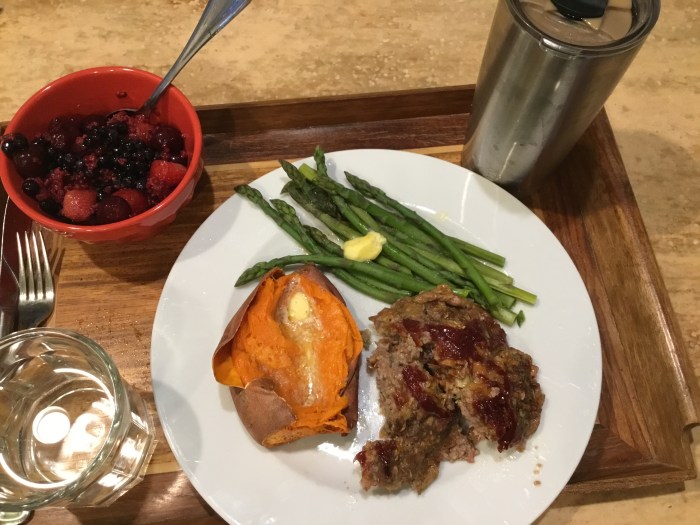
Here’s a meatloaf dinner with thawed frozen berries for dessert (with some maple syrup or special honey from DIL Tami).
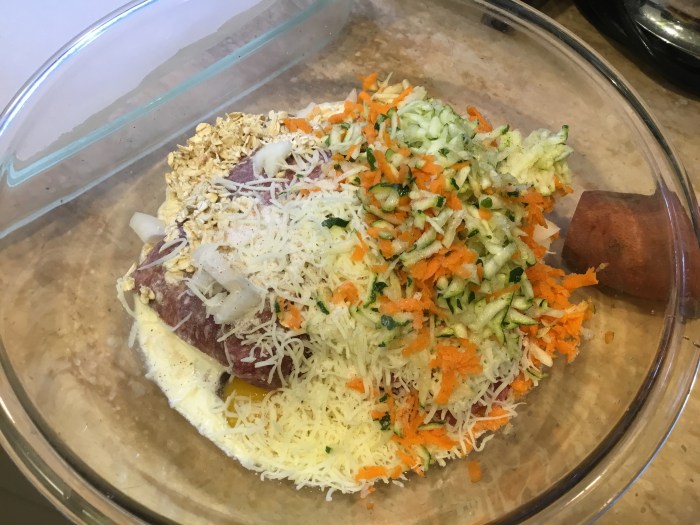
Here’s how this meatloaf started out:
Two pounds of ground meat (this one was local grass-fed hamburger and lamb), a handful of oats, two duck eggs because I can get duck eggs locally and do better with them, grated carrots and zucchini, some red onion, some grated mozzarella cheese, some herbs, some salt, and a bit of milk to help combine it all. The grated veggies and cheese keep the meatloaf moist.
Here it is ready to cook—with some tomato ketchup drizzled over. I can’t always do the ketchup, but today I could:
Half of this meatloaf is in the freezer. I started to really freeze seriously in case I did get a bad case of the virus. So I will not hurry to eat this saved food quite yet.
My food is simple—and filled with herbs. (Yes, I miss spices.). Because the ingredients are local and fresh and clean, they taste really good. But, I have to say that my food does not need a lot of spices to jazz it up because it has not lost its own “good.”
I’m lucky.
PS: Look for the upcoming post on roast chicken—it’s the backbone of many meals.
I really look forward to my lunch everyday. It’s the first meal of the day that I eat.
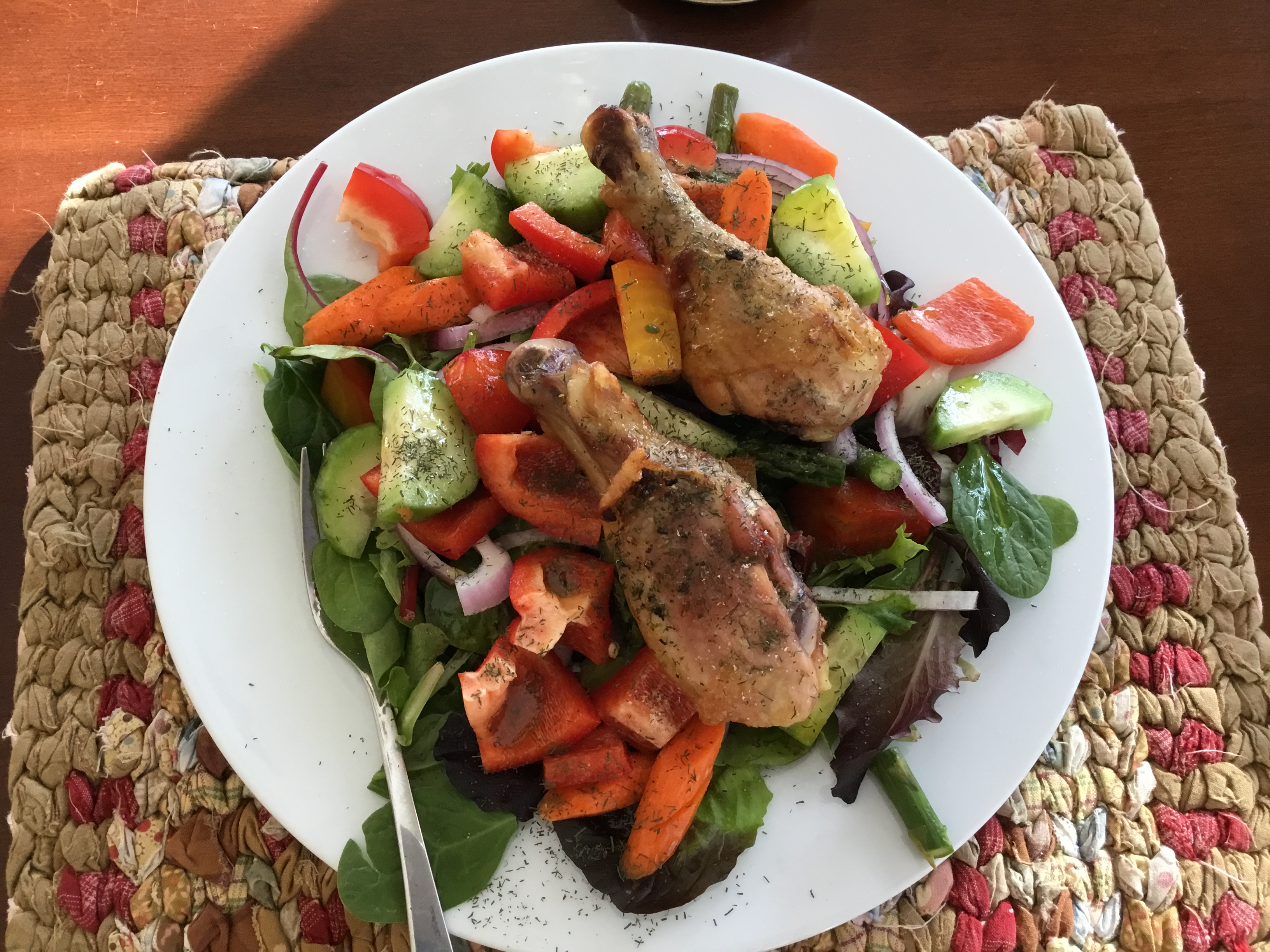
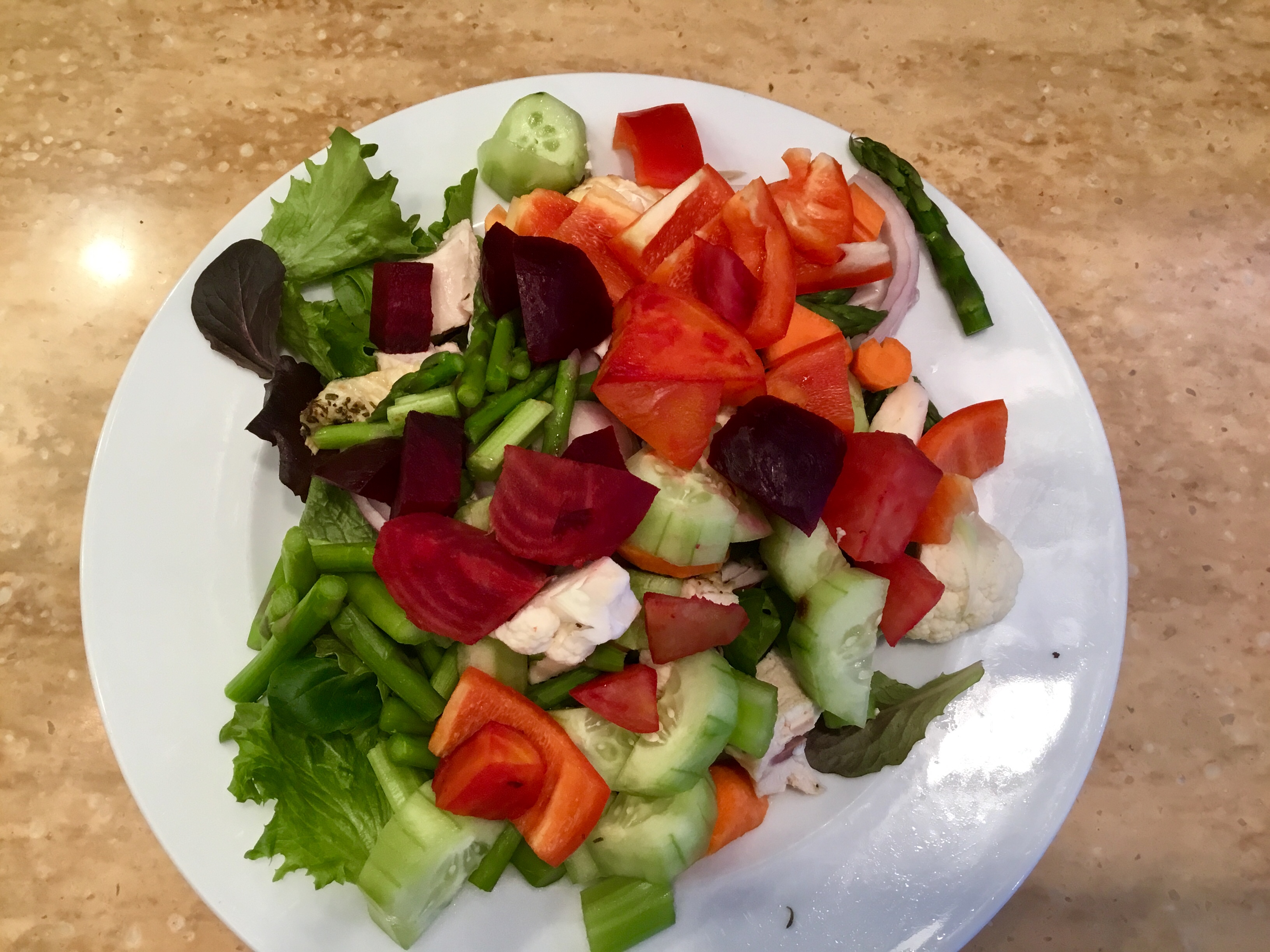
I really like to make a big salad with LOTS of fresh and roasted veggies—and some protein. I use what I have on hand.
This one has a bed of organic lettuce that includes hearty greens and some herbs , roasted beets, roasted asparagus, red peppers, carrots, cucumbers, red onion, and is sprinkled with Penzey’s dried dill and sea salt.
With my histamine intolerance issues, I can’t do vinegar. I drizzle with an organic, first pressed, olive oil. I’ve learned to really taste the veggies over these past years. The peppers, beets, and carrots are so sweet.
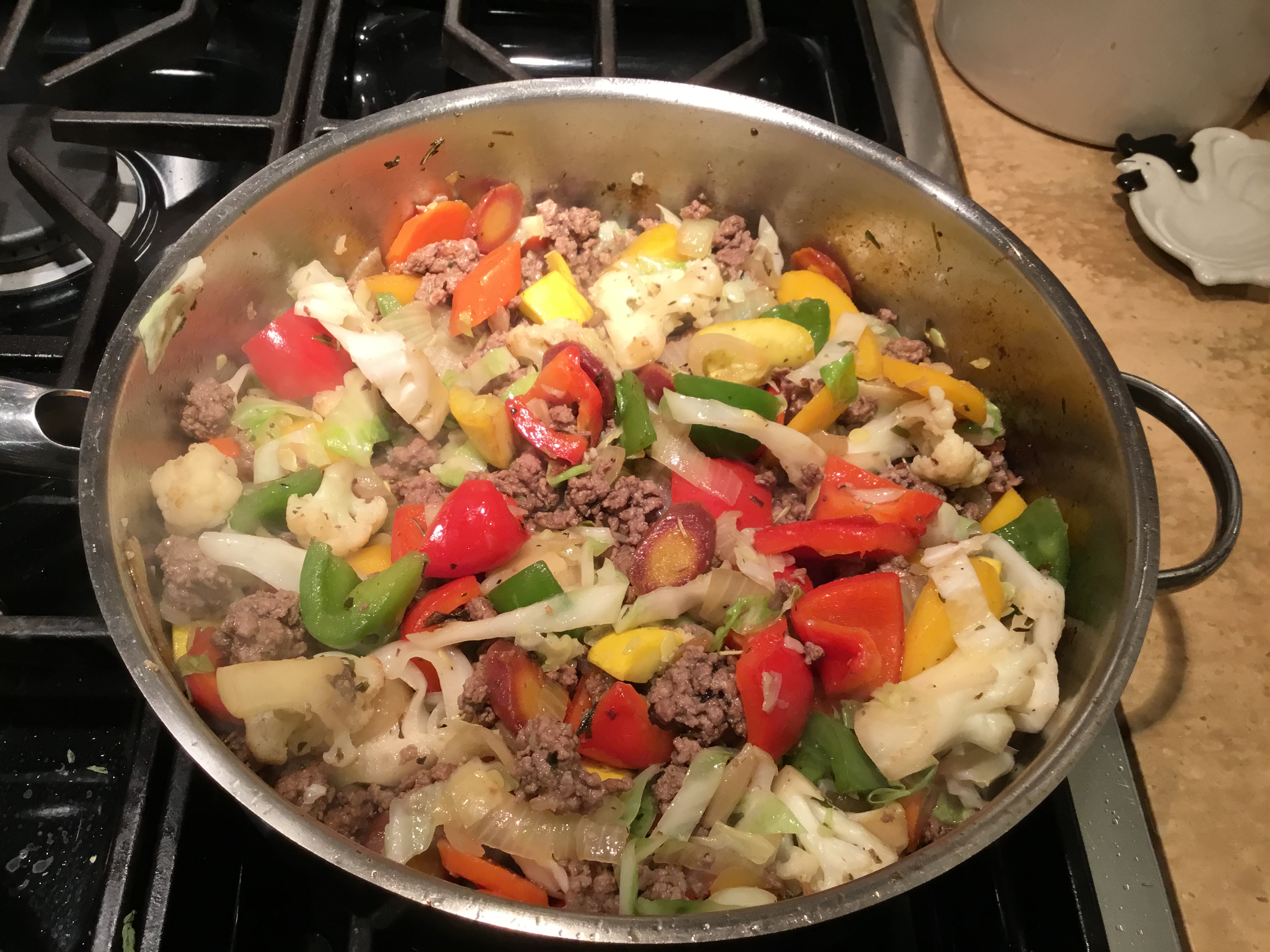
I love to make a stir-fry meal with LOTS of fresh, organic, local-when-possible veggies and a healthy meat.
Just look at this beautiful mixture: onion, three colored carrots (orange, white, red), cauliflower, green and red sweet peppers, yellow squash, and garlic are in this mix. I added sea salt, crumbled dried mint that I dried from my garden, and an herb mixture I like (Penzey’s Herbs de Provence which has lavender included). I can’t do spices with my Histamine Intolerance, if I could I would like the Indian spices, like cumin, cardamon, tumeric, etc. And some pepper heat. Basically I use the veggies I have on hand and start to “sweat” them in a little beef or duck fat. I don’t use olive oil as it is too delicate and fractures under heat, which isn’t good for us to eat.
This time I added a lean ground lamb when the veggies start to brown on the bottom of the pan. The addition of the meat adds more fat and some moisture, which helps to cook the veggies without burning. When the meat is almost done, I added, this time, slivered raw cabbage.
Here is the meal finished and ready to eat. I will get several meals from this cooking expedition. Note that I don’t like my veggies to get too limp—which means that when I reheat some of the mixture for a meal (covered and add a few tablespoons of water to keep things moise), the veggies don’t get overdone. Reheating from a cold oven takes no more than 20 minutes. I use an oven-proof glass bowl, a stray glass top I have that sits loosely on the top, and, often just slide the bowl on a plate and eat from the bowl.
With this method, I can also use cubed left-over meat from other meals—added at the last minute just to heat through. And if I want, I can put the mixture over rice or, for me, rice noodles. I don’t do that often though as all I have to do is look at rice forms to put on weight. I like a sprouted, color mixed, organic rice from Trader Joe’s best of all, and when I make a run to Portland, I stop in and replenish my supply. Sprouted grains make their nutrients more available for our bodies to use.
I’ve wanted to replace plastic baggies and plastic wraps for some time.
A conversation with fellow quilters revealed that there are silicone products that can replace plastic. Thanks Tori Manzi!!
So this week, I ordered some products to try: silicone bowl tops and baggies and some grocery bags meant to replace plastic bag use in the grocery store. These items are available in lots of places, so just google what you might want to try. I deemed them affordable in the long run.
The three packages I ordered arrived this week, and I’m really liking them so far.
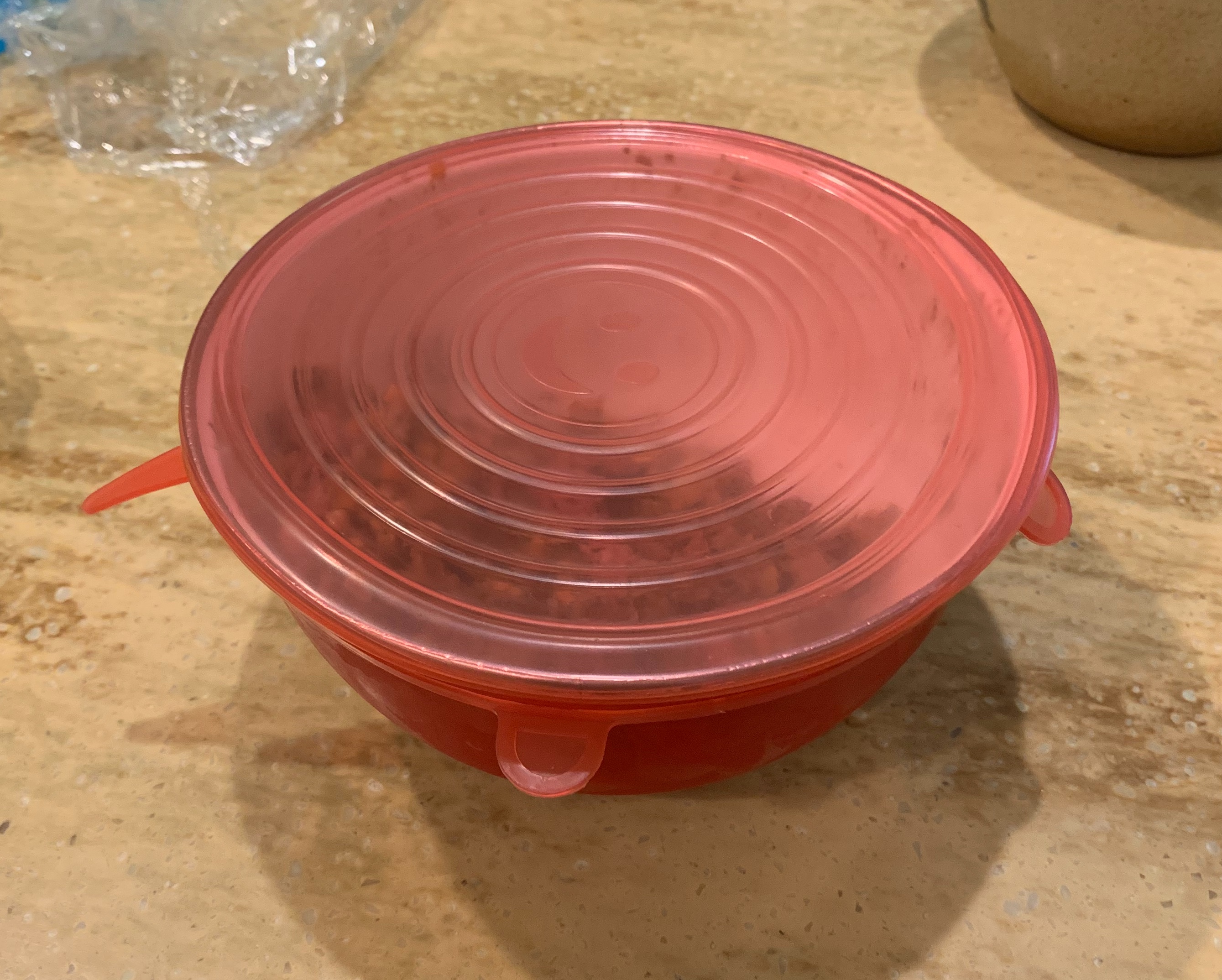
Here are the plastic tops meant to cover bowls—they stretch so can cover differently sized containers. The pink items are a collapsible funnel and a tool meant to take the skin off of garlic as you roll the garlic cloves inside it.
The tops work well and are easy to put over bowls. You might have to dry off outside moisture if a bowl has been in the refrigerator.
The tops would not work on a bowl like the one on the right front that has extensions built in.
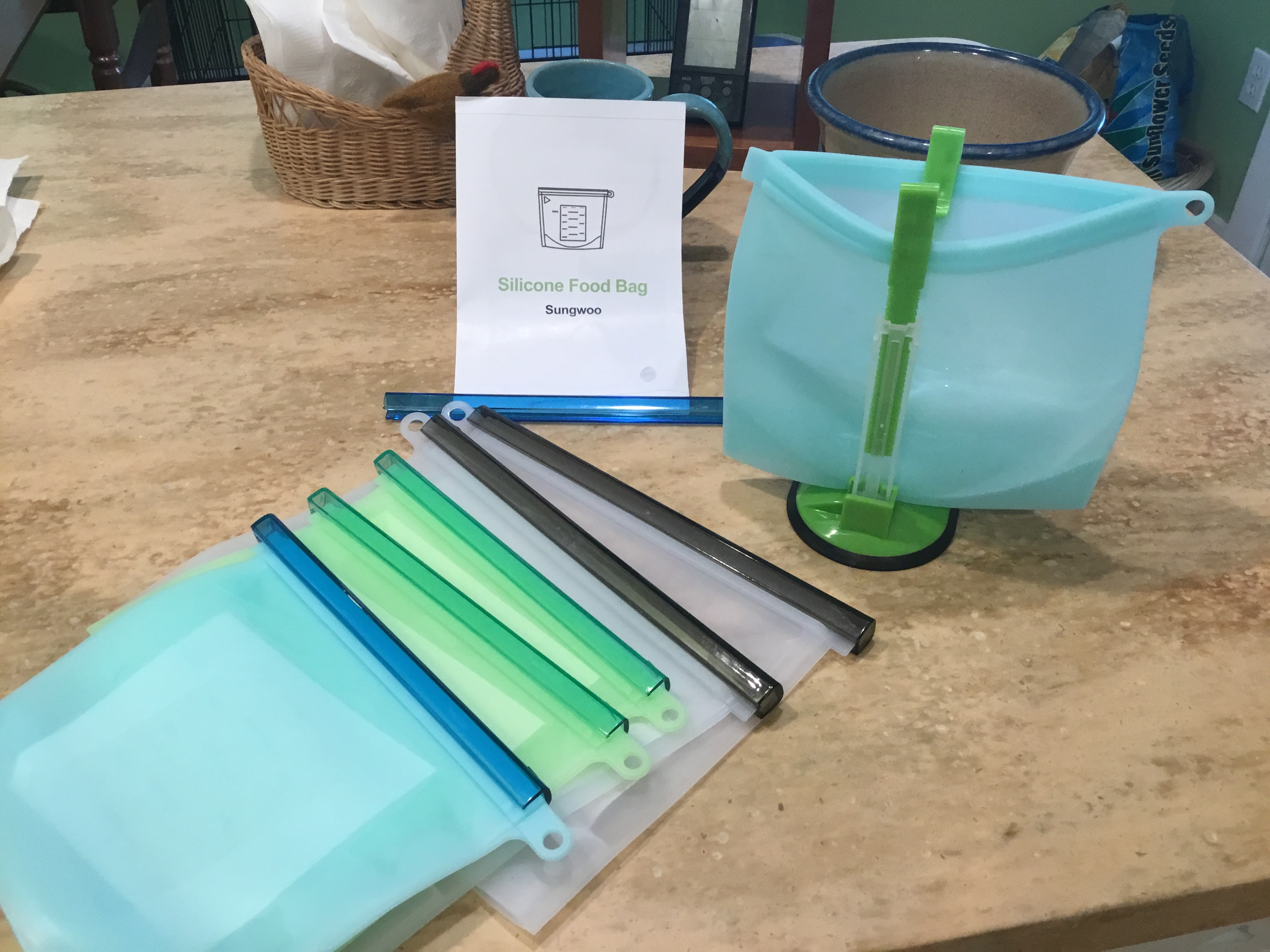
The silicone bags are awesome as well:
They are air-tight, can freeze, etc., etc. They will work in a sous vide pot as they can take the heat. The plastic slides (yikes on the plastic) fit over the top of the filled bag to seal everything tight. When filled they can stand up on their own. They came with instructions and a stand which helps support them while you fill them. Comments online say they hold soup just fine with no leakage. There are three sizes. The smallest holds up to 4 cups. The big one is…big.
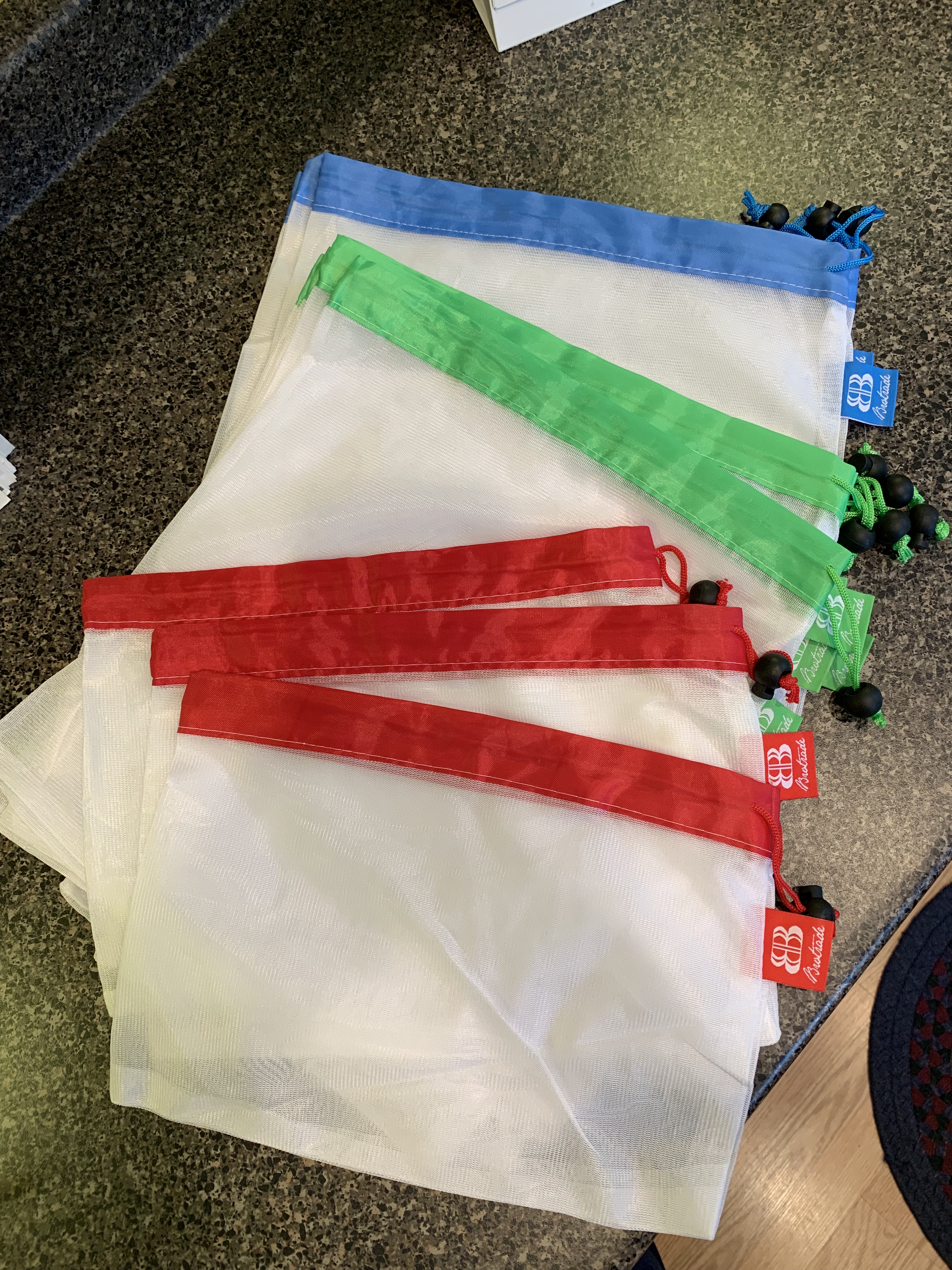
In addition, I ordered produce bags that will go to the grocery store with me and that are washable, etc. They are meant to go right into the refrigerator, are washable, and will work to replace plastic bags. They are a fine mesh. I may have to wrap something like fragile lettuce in some damp paper towels, but…we’ll see.
I’ll keep you posted, but…
…I think it’s all going to work.
I can already see I might need more of the silicone bowl cover tops down the road.
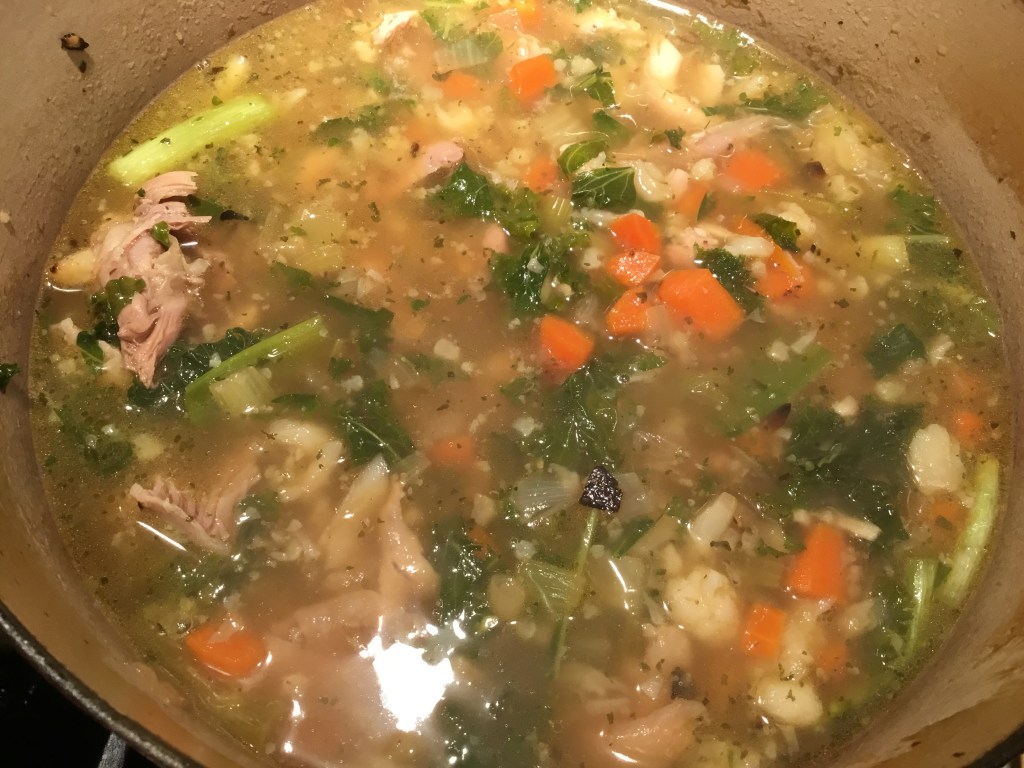
Roasted chicken always means making soup broth. With the Histamine Intolerance, I can’t make bone broths that cook for 24 hours any more—long cooking equals too much histamine in the food. But I’ve been able to make a quick broth with the bones and carcass that cooks about an hour.
I am so happy because I really love soup!
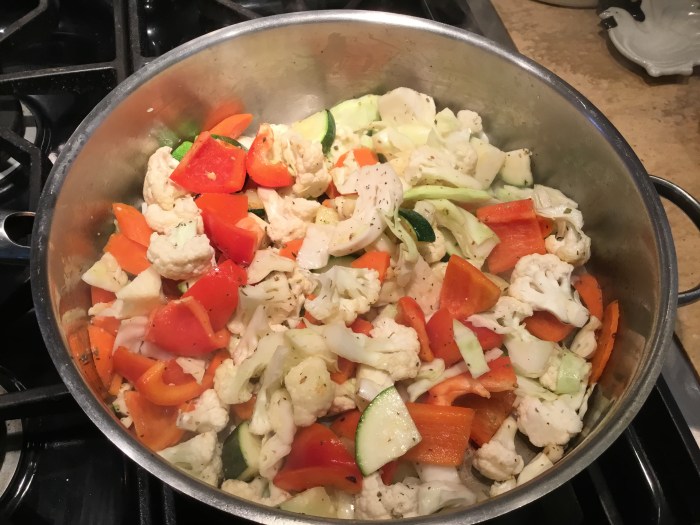
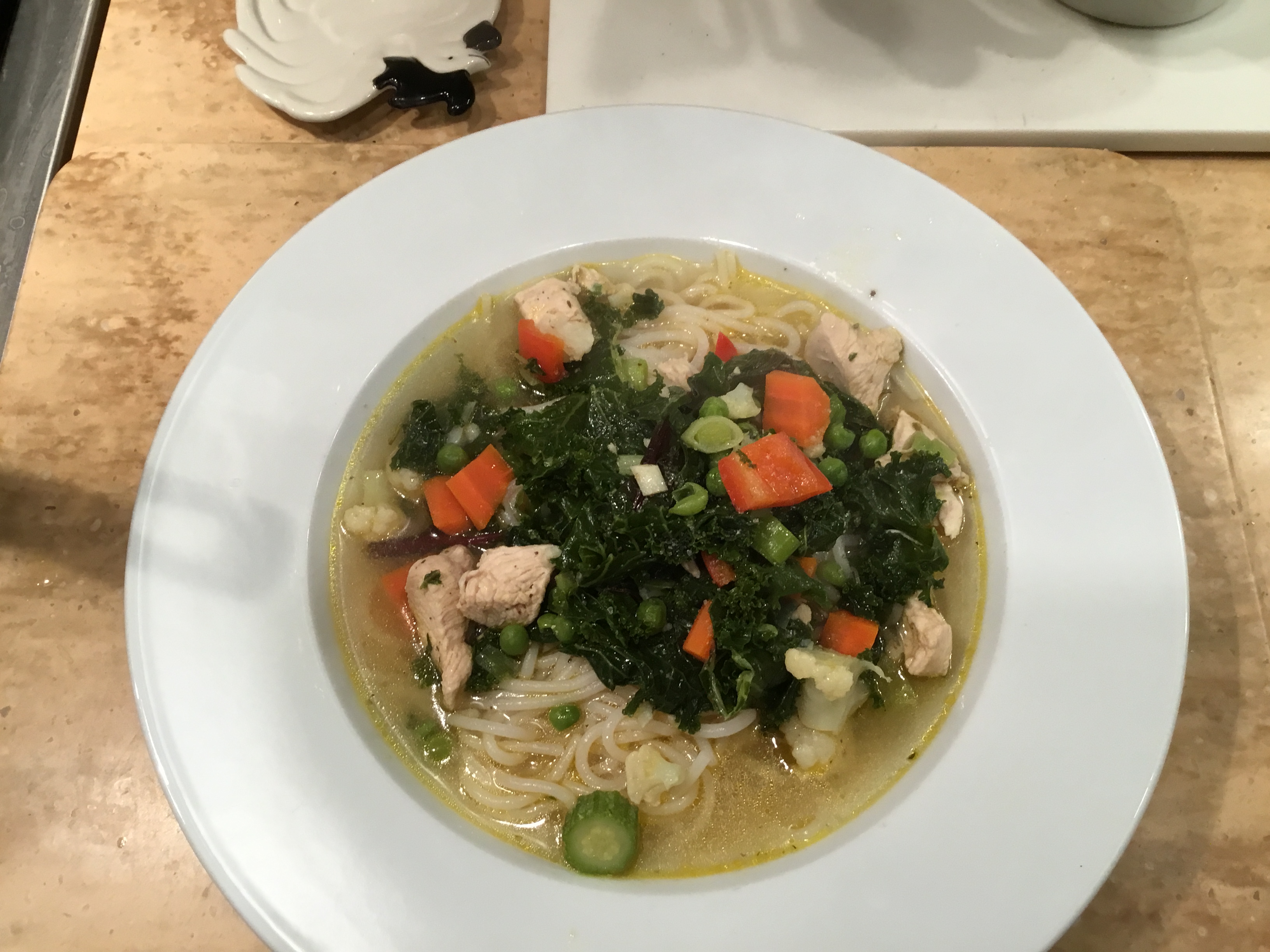
This soup is filled with local veggie goodies and two boneless chicken breasts cut into pieces. I had some cooked kate to add, some peas from the spring pea crop I blanched and froze, carrots, red peppers, leeks, cauliflower, the tiny last baby zucchini from my garden, and fresh garlic. These veggies all cook really quickly after being sweated for a bit in the pan to add more flavor.
I added some rice noodles that I cooked separately in the bottom of my soup bowl.
Yes, a yummy soup dinner and leftovers for lunch the next day.
















 Louisa Enright's Blog