Interesting Information: “Antiperspirants Can Make You Smell Worse”

Interesting Information:  February 20, 2015

“Antiperspirants Can Make You Smell Worse”

Like many of you, I suspect, I have been using a “natural,” aluminum-free deodorant for well over fifteen years now.  My current brand has been a Tom’s “long-lasting” product.

I’ve never had much body odor.

And I don’t sweat a whole lot, and I’m past the “hot flashes” stage.

So, about two years ago, I began to notice that at night when I woke up, I had really, really strong body odor under my arms.

And, for about two years, I’ve had some off and on swelling of the lymph nodes under my left arm.  (I worked with my local homeopath on this issue.  We’d clear it, but it would come back–especially in the winter.  Think layers of clothes, including lots of wool, and less showers.)

I LOVE sleeping in a cool bedroom with a lot of heavy cover on top.  I’ve been known to crack the bedroom window right at my head when the temps are in the 20s.  I crave the clean, clear, crisp Maine air–as long as there is enough cover.  But, at some point, the cover is too much, and I wake up sweating in my warm cocoon.   And, stinking…

It took me quite a while to connect the dots.  The Tom’s was causing the odor.  And, maybe the swelling.  And it was worse on the left side because I’m right-handed and was likely putting more of the deodorant under my left arm.

I stopped the Tom’s and went back to a very light dusting of some baking soda mixed with a bit of corn starch (which cuts the baking soda’s scratchiness).  I have this mixture in a small glass jar in the bathroom, put two fingers into it, and just lightly dust under my arms.  I don’t think I even have to do it every day…

The odor immediately stopped.

The swelling stopped and is gone.

For good measure, I stopped wearing a bra around the house, too.

(Saw a bit of a story on tv about young women wearing the most constrictive “body shapers” under their clothes and wanted to cry for them.  Back to the Victorian age…  And it all has to do with all this form-fitting clothing today where athletic clothes are now dressed up for every day.)

Within a few days, I got a Mercola post on the importance of our bodies’ surface microbiome and how important it is to good health.  (That’s a great example of synchronicity–which I’ll talk about in another post.) And you can read the Mercola below.  DO READ IT.

In addition, the post discusses the fact that we are washing away our bodies’ first line of defense when we use so many commercial soapy products every day.

For a long time now, when I shower, I don’t use soap.  I might take a loofah product and give my skin a scrub–it seems to like that stimulation.  But I don’t use soap unless I have gotten really dirty outside.

So many of these commercial products have really seriously bad chemicals in them–from cleansers to scent chemicals.  They dry our skin.  They kill the microbiome colonies.  They are just bad for us.  And, apparently, with the deodorant, they are causing odor, not curing it.

When I came back from Charleston on my last trip, I went for a haircut.  My hairdresser said “have you been swimming in a chlorine pool?  Your hair is so, so dry.”  I had been using a commercial shampoo rather than the baking soda/water “shampoo” and vinegar/water “conditioner.”  It took some weeks for my hair to get its gloss and shine back–a gloss and shine on which people comment.  Lesson learned.

Next time you are in a crowd, take a close look at the hair you see.  How many people have dry, lifeless hair?

Here’s a little quote from the Mercola article:

Science is clearly showing that your body’s microbiome plays a major role not just in your health, promoting or warding off skin diseases for example; it can also dramatically alter things like body odor. So, it’s really in your best interest to work with your microbiome, rather than against it. Doing so could help you avoid all sorts of chemical toxins that most people slather on themselves without thinking twice about what it’s doing to their microbiome, or their health.

Antiperspirants Can Make You Smell Worse.

Go through your cosmetic regime.  Read the labels.  Look for the parabens, the chemicals, and get rid of that stuff.  It’s expensive and dangerous.

I use unheated coconut oil as a moisturizer, Burt’s Bees “lipstick” sticks, baking soda/cornstarch deodorant, and a 1 to 4 baking soda/water ratio for shampoo and about the same with vinegar for a rinse.  I also use baking soda and sea salt as a toothpaste.  I “oil pull” coconut oil for teeth and gum health when I slow down to think about it.  If you want more scent, you can go to the essential oils for support.  Young Living oils are great, but you can find good ones in a health food store or a health food section of something like Whole Foods.

Good Luck!


Books, Documentaries, Reviews: Nina Siegal’s THE ANATOMY LESSON

Books:  February 15, 2015

THE ANATOMY LESSON

NINA SIEGAL

I just finished reading Nina Siegal’s THE ANATOMY LESSON.

IMG_0578

I have mixed emotions about it, but recommend it with some reservations.

It’s derivative, of course.  Picking a painting and creating a novel around it, as in THE GIRL WITH THE PEARL EARRING, apparently works quite well.

But, historical fiction ALWAYS ALREADY tells you more about what we, today/whenever, think than it does about the actual time.  And Siegal falls grandly into this trap with the invention of a young woman who, inexplicably to my way of thinking, loves the man who becomes the subject of the “anatomy lesson.”  Historical fiction ALWAYS ALREADY does a kind of violence to the people involved.  We cannot possibly know their thoughts and feelings.  We are too far removed and bring with us our own, deep cultural codes and behaviors.  This novel is judging that era by our modern codes:  for instance, the hanged man was himself abused, neglected, unloved, confused, and fell into thieving to survive.  Underneath he’s really ok.

Let’s stop for a moment and take a look at the painting itself–done by Rembrandt in 1632.

The Anatomy Lesson of Dr. Nicolaes Tulp – Wikipedia, the free encyclopedia.

When Lauren Hillenbrand wrote SEABISCUIT  and, later, UNBROKEN, she used a horse and a soldier to tell a much larger story about a particular time.  She didn’t need to veer into fiction to create fabulous works.  Siegal, though, muddies up this book with the romance between Flora and the condemned man (he is hanged) who becomes the subject of the “anatomy lesson.”

Having cautioned about historical fiction, I will say that Siegal DOES capture the flavor of this era–and that part of the book is most interesting.

For instance, people are digging into bodies to figure out how they work.  And, they are trying to find out if a tarnished soul (the man in the anatomy lesson is a thief) shows itself in organs that are vile in some way. The man in the painting is a real man:  Adriaen Adriaenszoon.  His body is covered with whipping scars, brands, and his right hand has been severed–all as punishments for thieving.  People of this era believed that if you punished the body sufficiently, you could change behavior.  (The theorist who did such a grand job of reminding us of these “other” times and their very different relationship to the human body was Michel Foucault in DISCIPLINE AND PUNISH.)


Rembrandt is commissioned by Dr. Nicolaes Tulp to paint this “the anatomy lesson,” which was conducted in Amersterdam by Dr. Nicolaes Tulp and which is attended by all the important people who can come (read men) and is followed by a lavish banquet.  There are political overtones to the event:  put on a successful  “lesson,” and you might get elected to be mayor of Amsterdam one day.  Each person in the painting also has paid Rembrandt to put him into the work.  This painting is very large–monumental some might say–and was meant to hang in the medical guild.

The painting becomes Rembrandt’s first really important painting.  And here is where Siegal’s story becomes interesting–for she muses on how Rembrandt decides to deviate from paintings of anatomy lessons previous to this event–which are graphic and display bodies with open chest cavaties, etc.  Rembrandt paints Adriaen fully restored–no scars, no stump with a missing hand.  The light in the picture is directed onto the whole, clean body, not on Dr. Tulp.  And, Siegal poses, this is the line between art and just painting what is there.

She’s probably right.  The analysis of the painting is interesting.  The descriptions of life in Amsterdam in 1632 is interesting, too.  And Siegal’s writing is lovely.


Interesting Information: “10 Banned Foods Americans Should Stop Eating”

Interesting Information:  February 15, 2015

10 Banned Foods Americans Should Stop Eating

Mercola Web Site Infographic


Shopping and eating gets more difficult every day.  We have to read all the labels, know the food issues, be careful about what we buy, feel sad and frustrated, etc., etc., etc.

It’s all just a mess.

But, here’s a good infographic from the Mercola web site.  At least it simplifies information a little.  Thanks, Julie Monahan for originally posting this information on Facebook.

10 Banned Foods Americans Should Stop Eating – Infographic.

Turkey Tracks: Inside the Chicken Coop February 2015

Turkey Tracks:  February 15, 2015

Inside the Chicken Coop:  February 2015

The sun just came out for a few minutes.

The wind gusts have stopped.

Blizzard 2 of 2015 veered 50 or so miles to the east, which made it mostly miss us in the Camden, Maine, area.

We got blowing snow with only about 4 to 5 inches accumulation and high winds.  The storm hit southern Maine and the Bar Harbor area north of us pretty hard though.

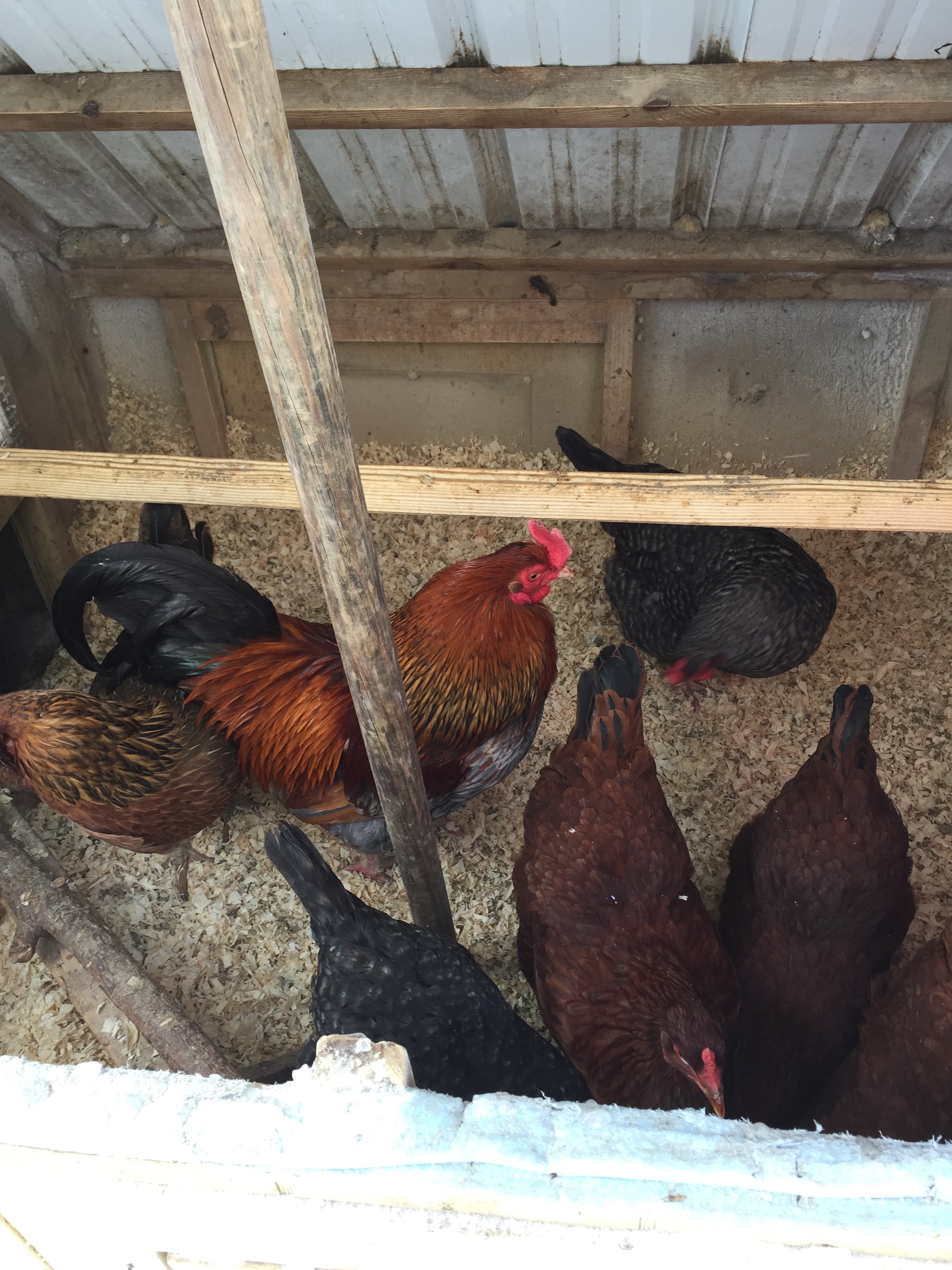
I took my chickens a bowl of warm food a bit ago.  Here’s a video of them inside the coop:

You can see that the bedding is really beat up.  I keep adding more, but I have no where to put old bedding at the moment.  Clean up of the cage/coop is going to be a tough job this spring.  The door to the left leads into their cage.  And you can also see that the frost bite on the roosters comb has almost healed.

This coop is getting really beat up.  I’m hoping Stephen Pennoyer will help me repair it this spring…

Or we will come up with a different kind of coop–maybe placed up against the side of the house…

IMG_0160


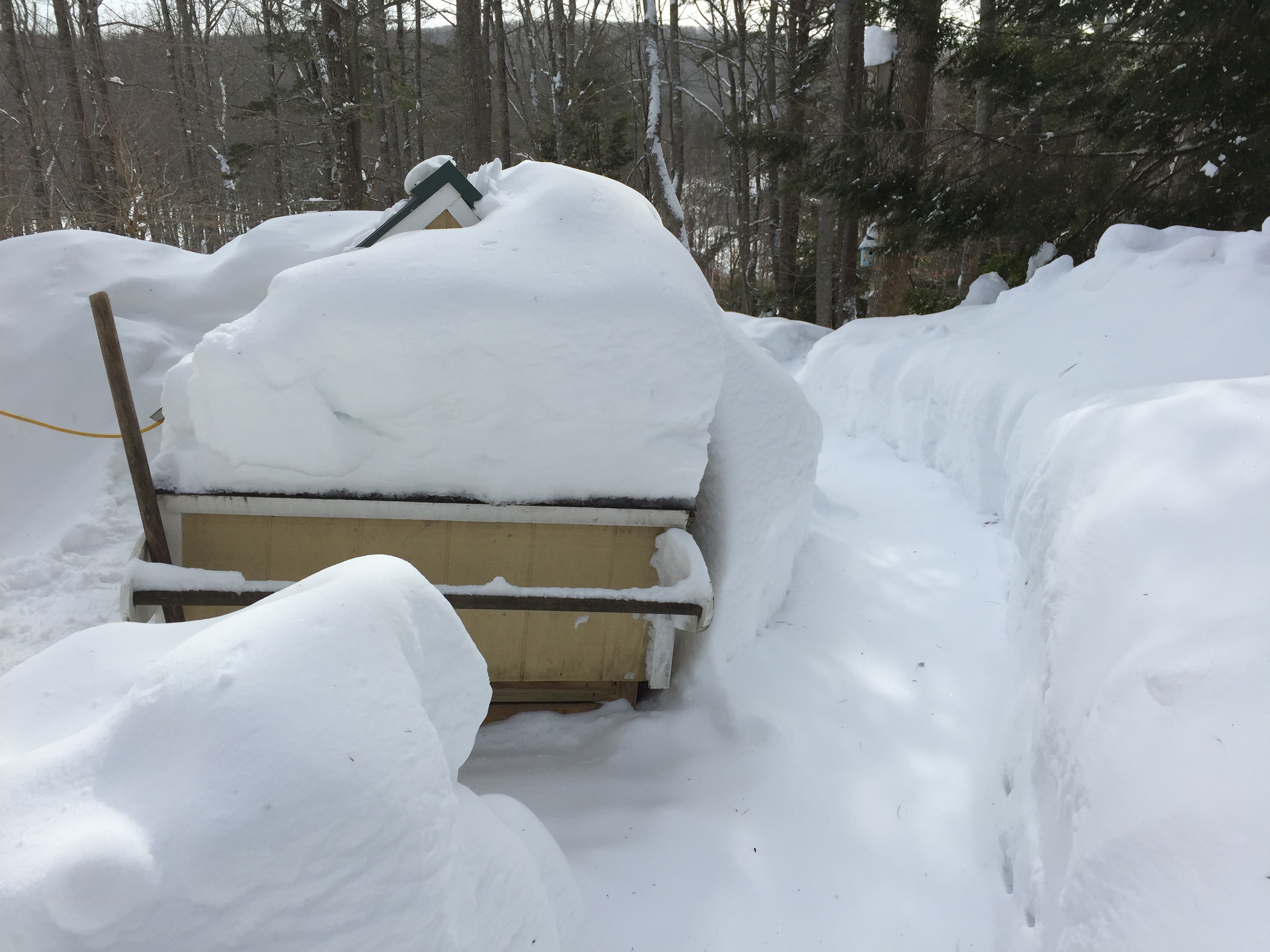
Here’s a pic of all the snow around and on the coop:

IMG_0165

And here are the eggs you just saw in the coop.  Aren’t they pretty?

IMG_0166

One (or more?) of the hens is occasionally laying a tiny egg.  I have not seen this before now.  I broke one open, and there was a tiny, tiny yellow yolk in the white inside.

IMG_0546

Interesting Information/Books: Tetyana Obukhanych’s THE VACCINE ILLUSION

Interesting Information and Books:  February 14, 2015

Tetyana Obukhanych’s

THE VACCINE ILLUSION:

How Vaccination Compromises Our Natural Immunity and What We Can Do To Regain Our Health

Yesterday’s post on vaccines sparked a spirited discussion on Facebook between two of my nieces.  I promised them–and have been intending to do so anyway–to post the links to Tetyana Obukhanych’s book THE VACCINE ILLUSION.

As I said yesterday, the news is full of vaccine stories lately, mostly around the recent measles outbreak.  These stories often uncritically repeat (mindlessly) the same old crop of myths.  Clearly, the media is not remotely doing good journalism.  Instead, as is the case these days, the media is creating sensation and fear, rather than trying to uncover and share the many, complicated facets of our current vaccine policy.  This situation, too, is how the market works.

For me, vaccine policy is a poster child for Cultural Studies work–my field.  Current vaccine policy is mostly all about the needs of the market–not about the needs of humans.  And plenty of well meaning, kind, caring folks are caught up in promulgating the current general vaccine knowledge.  But that knowledge is simplistic and terribly flawed.  There is a place for vaccines–especially if one is going to a foreign nation where diseases exist that are not in our ancestral template (as friend Meg Barclay puts it).  There may be a place for other kinds of vaccines as well.  But there are, also, genuine and terrible risks–which are being ignored.  Worse, there are many, many unintended consequences to vaccines that are not being thoughtfully explored.

That’s where Tetyana Obukhanych, a stone-cold scientist in immunology comes in.  (See her credentials below.) Her little book is clear, blessedly easy to read and understand, and cuts to the chase of what is wrong on a number of fronts.  She wrote it to help parents think about what to do about vaccines and is very clear that these are decisions parents have to make and with which they have to be willing to live.  She also blows the whistle on the box that the field of immunology finds itself enclosed–a box that will not allow for genuine exploration and discovery.

The biggest thing that needs to be discovered is exactly how naturally acquired immunity to diseases occurs.  (There is no money in the system for this work–which is, in my terms, another effect of the market at work.) Obukhanych argues, also, that we need to recognize that our current vaccine policy not only cannot simulate naturally acquired immunity, it only provides a short-term “fix”–leaving teenagers open to getting the “childhood” diseases when these diseases are more serious for them.  She argues, too, that the vaccine policy is creating the unintended consequence of disrupting the maternal imuno-protection of infants–which is why some are getting measles.  And, there is much, much more.  She discusses the history of the development of vaccines and explains that vaccines derive from flawed theory that has never been adequately tested.  She discusses the dangers of using aluminum in vaccines as alum is famous for producing allergic reactions (another unintended consequence) and may be a root cause of all the allergic reactions our children have today–1 in 13 children today has a serious food allergy.  Aluminum in vaccines can produce skin eruptions, esophagus problems, asthma, and anaphylactic shock (a blood reaction).  She also discusses the fact that vaccines target certain strains of a disease, but that diseases are biodiverse so that other strains get stronger as one strain is diverted.  I suppose it’s a bit like the superweeds and superbugs that have evolved in response to herbicides and pesticides.   

Here’s a quote from the book with Obukhanych’s credentials:

Tetyana Obukhanych earned her Ph.D. in Immunology at the Rockefeller University in New York, NY with her research dissertation focused on understanding immunologic memory, perceived by the mainstream biomedical establishment to be crucial to vaccination and immunity.

During her subsequent involvement in laboratory research as a postdoctoral fellow within leading biomedical institutions, such as Harvard Medical School and Stanford University School of Medicine, Dr. Obukhanych realized the flaws and limitations of current immunologic paradigms. Key to her realization was taking a broader look at scientific findings from many related disciplines, rather than confining her search, as customary in her professional circles, strictly to basic immunologic literature.

After parting with the mainstream biomedical establishment and dissolving her prior allegiance to its doctrines, Dr. Obukhanych continues her independent in-depth analysis of peer-reviewed scientific findings related to vaccination and natural mechanisms of immunity. Her aim is to bring a scientifically- substantiated and dogma-free perspective on vaccination and natural immuno-enhancing approaches to parents and health care practitioners involved in making vaccination decisions. Dr. Obukhanych has been a frequent guest speaker on natural immunity and vaccines and is available for private consultations to share her accumulated knowledge.

I hope that before you or your children get one more vaccine, that you read this book, which takes less than an hour.  And I hope that you share it.  Obukhanych is very, very brave to take on this issue.  And she is already being demonized.  (Remember this familiar pattern from the cigarette industry.)  Ask yourself WHO is denigrating Obukhanych’s work, what are their credentials, who is paying them or supporting the web site.  There are a number of so-called “scientific” web sites that are nothing more than shills for industry.  So, beware…

The Vaccine Illusion: How Vaccination Compromises Our Natural.

Turkey Tracks: Chicken Love, Lovey Love

Turkey Tracks:  February 14, 2015

Chicken Love, Lovey Love

It was -15 on friend Gail’s garden thermomenter this morning.  She’s in Camden, which is lower than where I love.  Just the kind of “valley” place where the temps were predicted to be the lowest.

It was -8 on my thermometer when I went to bed last night.  And -3.5 when I got down to the kitchen around 8.  The girls and I snugged in a big longer.  I didn’t want to open the chicken coop until the temps had come up a bit anyway.  All the turkeys were in the yard paths when I went out to dip some sunflower seeds on the front deck.

The sun was out–which brought the temps up quickly.  When I went to the garage to get more chicken food and down the hill to the mailbox, it was about 15–which felt almost warm.  Ah, the relativity of…low temps.

Now, the sky is snow white.

Snow is coming hard off and on…

I took the chickens some “love” early morning:  a big bowl filled with some old bacon I had that needed frying, all the grease from the fried bacon, some raw hamburger, and some warmed milk.

Nothing says love to chickens in the cold like warm food–something I have learned from Rose Thomas, aka “Chicken Rose” in my family as I am the lucky friend of TWO Rose’s.

Then I came in and made myself, aka Lovey, a hearty breakfast:  a delicious grapefruit half, two fresh eggs, fabulous local bacon, real butter on the GF toast, and homemade blackberry jam from blackberries picked last summer.

I am one happy woman this morning.

IMG_0577


Happy Valentine’s Day Everyone!


Turkey Tracks: Blizzard 2 of 2015

Turkey Tracks:  February 13, 2015

Blizzard 2 of 2015

The other night on the local news I heard that Portland, Maine, has had 6 feet and 1 inch of snow–that total has climbed as it snowed more on Wednesday and Thursday.

Here in Camden, which is just under two hours further north, we’ve sometimes had more snow (much more) and sometimes a bit less.  So, it’s pretty safe to say we’ve had at least 6 feet of snow this past winter–and most of it landed in the last three weeks.

We’re all braced for the blizzard that will start tomorrow afternoon late.  Predictions are for up to 24 or so inches of light, blowing snow.  None of us has a clue about where we’ll put another two feet of snow.

I’ve had a go-round with the electricity in the chicken coop, but that’s solved now.  I have TWO lines going out there from different outside outlets.  The water heater is working again.  Our temps tonight are dropping to -14 degrees.  That’s NOT wind chill.  Or, that’s the prediction anyway.  So getting electricity back to the chicken coop was really important.

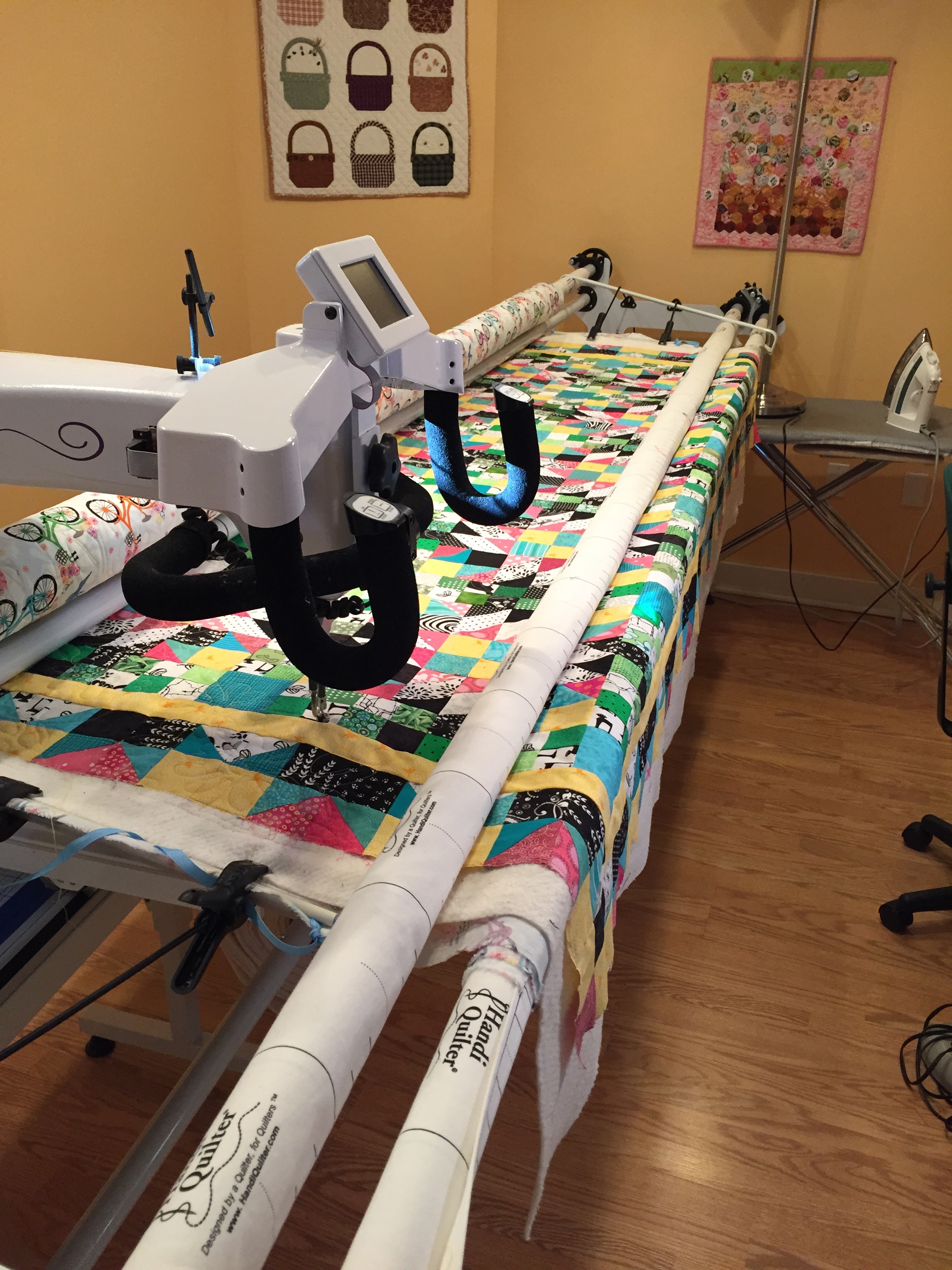
I have two more longarm passes on the Bonnie Hunter 2014 Mystery Quilt, Grand Illusion.  So, I will be binding that quilt later today.  It’s always so much fun to unwind a finished quilt and to see the whole of the quilting in it.

IMG_0150

I finished two knitted wool hats last night–made to go with wool scarves I made last year.  I went a little crazy with buttons.

I put pics of this cowl (infinity scarf) up last year.

IMG_0148


And:

IMG_0145

There is a good match with the hat yarn in the lighter yarn in the scarf–it just isn’t showing in this picture.

Here’s the quilt-in-progress on the design wall–a streak of lightening pattern.  This fabric is the leftover from the other two scrappy quilts I recently made from my 2 1/2 strip bin.  I was left with some shorter pieces, so I cut 2 1/2by 4 1/2-inch rectangles.

IMG_0142

I’ll use an inner border that’s about an 1 1/2 inches and put on a wider border of some sort–yet to be determined.  This quilt will look very traditional when I’m finished.  Simple and useful.  This quilt will join its sisters in the downstairs tv/sitting room–replacing sturdy but ugly couch dog blankets.  So far, so good in terms of looks and wear.

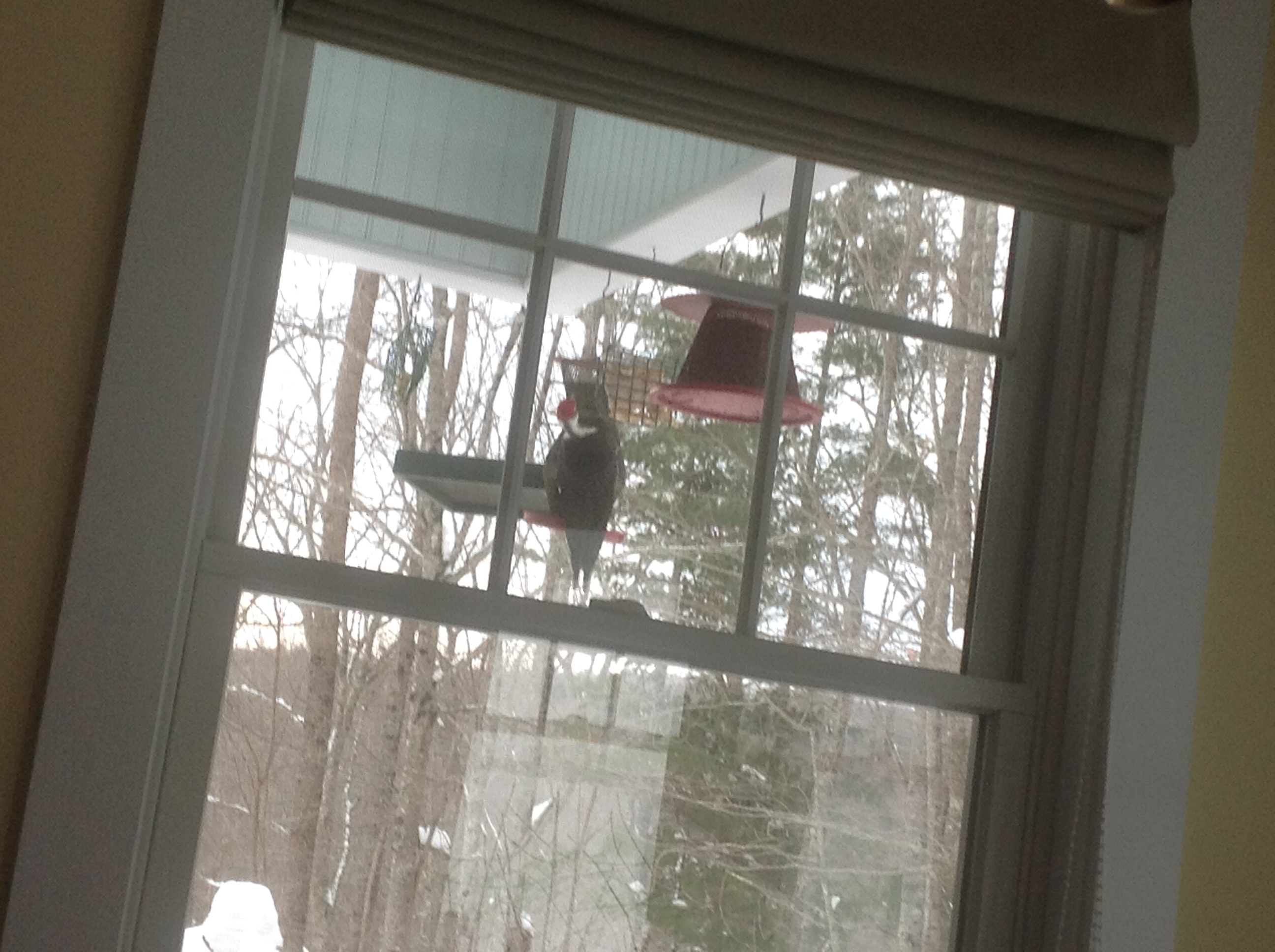
I wondered why the suet feeders were disappearing so fast.  Then I saw this guy yesterday:

IMG_0572

It’s the best picture I could get in a series.  The Pileated Woodpeckers are HUGE and very jittery and scary.  He’s been around off and on all winter, but today he treated me to quite a show.  At one point he sat in the middle of the flat green feeder and just rocked himself back and forth.  As long as I didn’t move a muscle, he stayed around.

Stephen Pennoyer has been working on more pour over coffee stands.   Here’s the most recent picture he sent me:

IMG_0144

I see a two-hole in this picture…

OK, bring on the blizzard.  I’m ready.

Interesting Information: “Studies Show that Vaccinated Individuals Spread Disease”

Interesting Information:  February 13, 2015

“Studies Show that Vaccinated Individuals Spread Disease”

The measles epidemic and vaccines are all over the news at the moment.

Rampant among the many news stories is the mindless repeating of vaccine myths.  The media is simply NOT doing its job with regard to the vaccine issue.  Neither are the local doctors who mean well, but are uncritically accepting what they are being told.  There is plenty, plenty of research out there that throws up red flags about vaccines in many ways.

Here’s a statement put out by the Weston A. Price Foundation, refuting the myth that unvaccinated children are somehow infecting vaccinated ones.

Folks!!  The real culprits spreading measles are anyone who got a recent vaccine AND, possibly, all the adults who have not had boosters…ever.

Here’s a quote–those numbers are footnotes to studies which are listed at the end of the article:

Scientific evidence demonstrates that individuals vaccinated with live virus vaccines such as MMR (measles, mumps and rubella), rotavirus, chicken pox, shingles and influenza can shed the virus for many weeks or months afterwards and infect the vaccinated and unvaccinated alike.1,2,3,4,5,6,7,8,9,10

Furthermore, vaccine recipients can carry diseases in the back of their throat and infect others while displaying no symptoms of a disease.11,12,13

Let’s be clear that babies are at risk for getting measles.  Why?  Their mothers are no longer passing along their (the mother’s) natural immunity–which is new in history.

There have been no measles deaths in the United States for ten years.  Zero.  Nada.  And maybe these babies getting measles will be, in the end, lucky since they will acquire an immunity that will protect them in their adolescent years, when measles is much more severe.

By the way, the other dirty little secret is that none of these vaccines has lasting protection,and the protected time might be just a few years.  Vaccines do not work at all for some people–and that might be due to a specific vaccines ingredients.

And then there is the issue of what strain of a disease is in a vaccine and the effect those choices are making on the wild disease viruses…

Studies Show that Vaccinated Individuals Spread Disease | Weston A Price.

Poems: “I Know Her”

Poems:  February 12, 2015

Rose sent me this poem the other day.  It had been sent to her.

Thanks, Rose!


I KNOW HER

Someone asked me if I knew you.

I laughed, and said, Ha! That’s funny!

I adore that woman!

She’s blessed, caring, loving, sweet, beautiful, a woman of spirit.

And she’s reading this message right now.

I love her!!

Be the kind of woman that when your feet hit the floor each morning the devil says:

“Oh crap, she’s up!!!!!”

Author Unknown

Turkey Tracks: Stephen Pennoyer: Snow Removal and Pour Over Coffee Stands

Turkey Tracks:  February 9, 2015

Stephen Pennoyer:

Snow Removal and Pour Over Coffee Stands


Stephen called me yesterday afternoon and said “how about a cup of coffee?  You put on the water, and I’ll be up in five minutes.”

We had talked about his making a pour over coffee stand for my pour over cup some time back when he was working here.

This kind of stand lets you see how much liquid is going into your coffee cup without having to lift up the pour over cup.

Stephen came in with three different ones he had been designing.  He had a tall one for a tall mug or for a taller portable coffee cup.  He had a fancy one of about medium height.  And he had this one, which I liked best for my coffee cup.  (Why, oh why didn’t I take pics of the other two?)  Here’s how the stand works, though there is no cone filter or coffee in the filter.


IMG_0568

In this pic you can see how the coffee will drip through the hole and into your cup.

IMG_0569


Stephen is such a fine craftsman.  I love to see what he makes.

I hope he offers these stands (and more) for sale in some of our local coffee places.

Wouldn’t a gift basket/bundle of one of these stands (he could make them long with several holes too), the pour over cup (or cups), the cone filters, and some coffee make a great gift?  If you are making pour over coffee for two people, it’s much faster to have two cups.

I challenge you to google amazon to see what they are charging for pour over coffee stands.  It’s unbelievable and just plain crazy!!!  Would people really pay this much for one of these stands???

Stephen looked around at all my snow and said I’m going home and getting the snow blower a neighbor lent me.  I’ll be right back.  The next thing I knew, he had made big wide paths around my house and had cleared three feet of snow from the top of the hot tub and cleared the snow around it so I can actually open the lid again.

IMG_0566


Stephen is a very, very special friend!  He’s an angel in my life.

His mother, Mary Sue Bishop is pretty nice too.