Turkey Tracks: Pea Soup Fog

Turkey Tracks:  May 13, 2013

Pea Soup Fog

Friend and old neighbor (Falls Church, VA,where I lived for nearly 40 years) Gina Caceci visited this weekend.  It was so great to see her.  And I let her get out of here without getting one single picture of her.  But, I think we talked nonstop for three days.  And did a little driving around to see the sights.

We had “soft” days while she was here–and they were badly needed.  It has been soooo dry here, with fire warnings and “no burning” allowed for weeks now.

May and June can be quite foggy on the coast, and we’ve had a fog bank sitting on the coast for about a week now.  I have always been fascinated with how the fog can move in and out, like a slowly flapping curtain in the wind.   Sometimes as you are driving along the coast road, the fog will start to come across the road, moving in with long, white fingers.  And sometimes it’s really dense, so that visibility is only a hundred feet or so.  That would be called a “pea soup” fog, and that’s what we’ve had off and on for two weeks now.

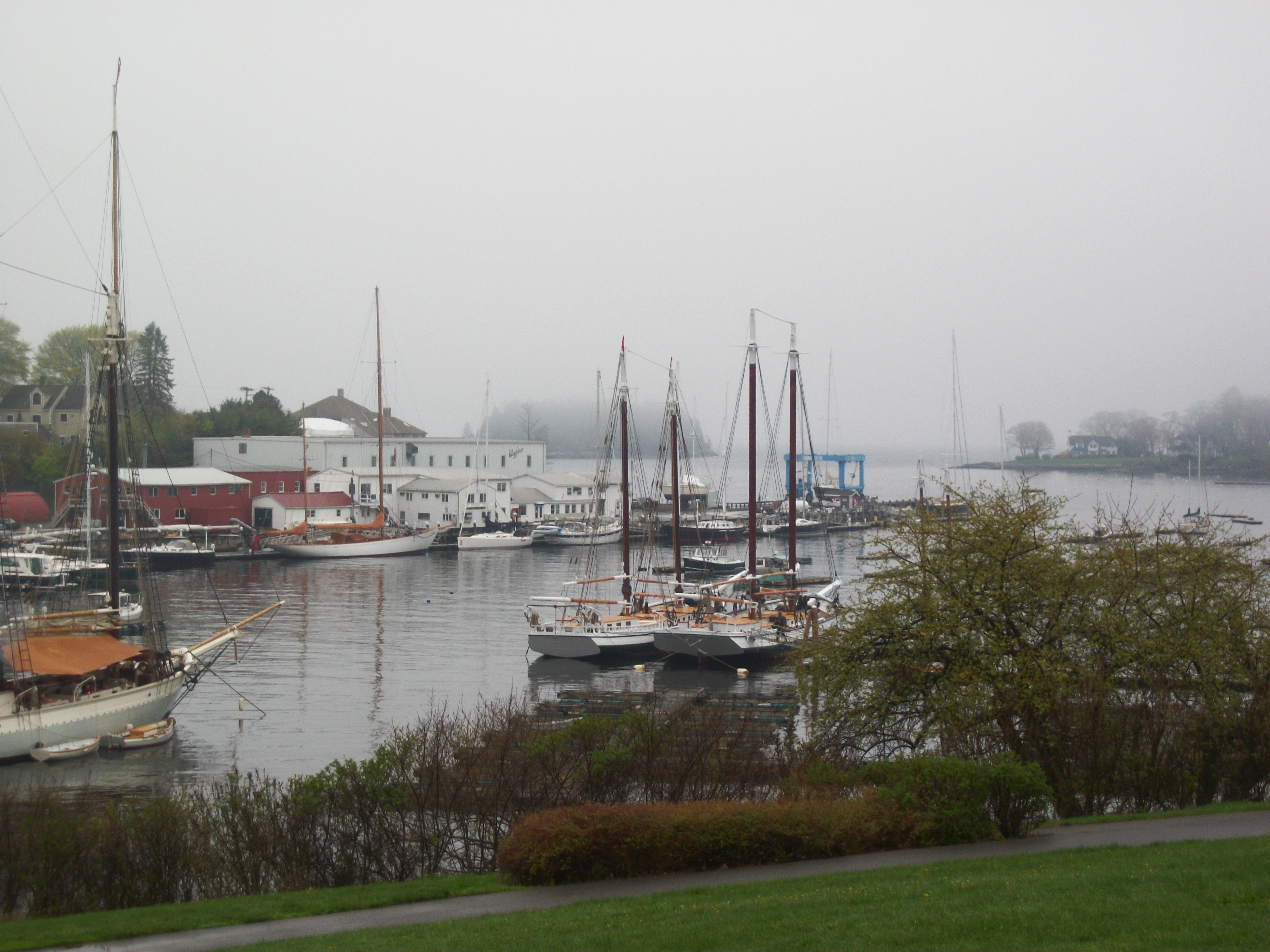
I tried to get some pictures.  Here’s Camden Harbor–can you see the island at the mouth of the harbor?  Beyond is a solid white bank where you can’t see a thing.  And there are islands and boats all out there in the white.

Camden Harbor, Pea Soup Fog

To contrast, here’s a picture I took of Rockland Harbor one day last week.  There is nothing so blue as Maine water when the sun is shining.  See the light house at the end of the breakwater?  That breakwater is a mile long, and people walk it for fun.  The white balls in the water are boat moorings, so you can see that boats are not yet back in the water in any force.

Rockland harbor and lighthouse

Here’s a video of Rockport harbor in the pea soup fog:

And, here’s another, which features lobster traps being staged for use.  I love the lone dorry (I think that’s right) tied up to the float.

I love the “soft” days of spring.  I don’t know how to describe our Maine woods in spring except to say that tree tops look “fluffy” and soft with the emerging green leaves–that spring green that is probably my favorite color.  I didn’t get a good picture this year of a lone tree with the green leaves against the blue sky.  Those leaves are like lace clusters.  And, I suspect, the moment has passed for the year.

Here’s a picture of a budding tree draping over the Camden Library amphitheater entrance.  The picture I took of the library itself came out wonky.  I probably had a wrong setting by accident.  I’ll get one soon.  Our library is gorgeous and has gorgeous views of the harbor.

Camden Library Ampitheater Entrance

This picture of our Main Street, taken from the northern end of town, just below the library, is nice.  See the church steeple and the trees of the village green at the south end of the street.  Camden is a beautiful little New England town.  But we are surrounded by little towns that are each beautiful and special.

Main Street from the library

 So, happy spring everyone!

Turkey Tracks: “Blossom,” the wedding quilt

Turkey Tracks:  May 13, 2013

“Blossom,” the wedding quilt

Daughter-in-law Tamara Kelly Enright and I wanted to make bride Ashley Malphrus (now White) a wedding quilt.  The wedding was April 21, 2013, and it was gorgeous.  The ceremony was held with one of the low country rivers as a backdrop–green lawns, big house, big white tent.  It was lovely.  Ashley and her mother, Allison Malphrus, had thought of so many thoughtful, sweet touches all during the wedding.  I’m always in awe of that kind of thoughtfulness as I’m not good at it.

Last Thanksgiving, Tami and I picked out contemporary, colorful Kaffe Fasset fabrics–and Mainely Quilting shopowner Marge Hallowell cut us a big array of the Kaffe Fasset prints.  With a “layer cake” design, one starts with a 10-inch square (in our case), cuts off four borders, which leaves a central square.   Different borders are put onto different squares, and the result–after using these bright modern prints–is a very contemporary, colorful quilt.

I finished hand sewing the binding just before the wedding and mailed the quilt to Tami.  It’s BIG, and I didn’t want to carry it on the plane.  Tami and I delivered it the Friday before the wedding, as I didn’t want to have it at the wedding tent.  I also wanted to explain that the quilt is an heirloom quilt, to be used and loved, but also to be cherished in the way of being a little careful with it.

Here’s “Blossom”–and it’s not a great picture of it.  But you can see how big it is.

Blossom 1

Here’s some blocks close up.  I quilted it with a bright pink thread, and that is wonderful on both the back and the front.   I used a “Sweet Pea” pantograph, but both sides are busy enough that you don’t really see the pattern.  It will catch Ashley, some day, when the light falls just right on the quilt.  I did the best job ever on the quilting.

Blossom block

Here’s the backing and binding–so you can see how they play with the blocks:

Blossom backing and binding 2

And here’s what “Blossom” might look like folded on the foot of a bed:

Blossom at foot of bed 2

The name “Blossom” describes the quilt, yes, but it’s also meant to wish, for Ashley, that she blossoms with her marriage, that her marriage blossoms, that the blossoming creates fruit, that in turn, blossoms, and on and on and on…

Interesting Information: Bees, Bees, Bees

Interesting Information:  May 8, 2013

Bees, Bees, Bees

April in Charleston, SC, where my two sons live with their families, is a very busy month for bees.

Tamara Kelly Enright is a beekeeper.

She has two hives in her yard and is teaching her children how to care for them.  She helps manage ten other hives with Tara Derr Webb at Deux Peuces Farm in Awendaw, SC.  And she supervises two hives at a local school for rescued children, where learning how to care for bees is part of their emotional development via a deep connection to nature.  She is deeply involved in placing demonstration bee hives into local schools–a practice started and funded by the Savannah Bee Company.

Tami and Kelly suited up one sunny Sunday afternoon to check the two bee hives in her yard.

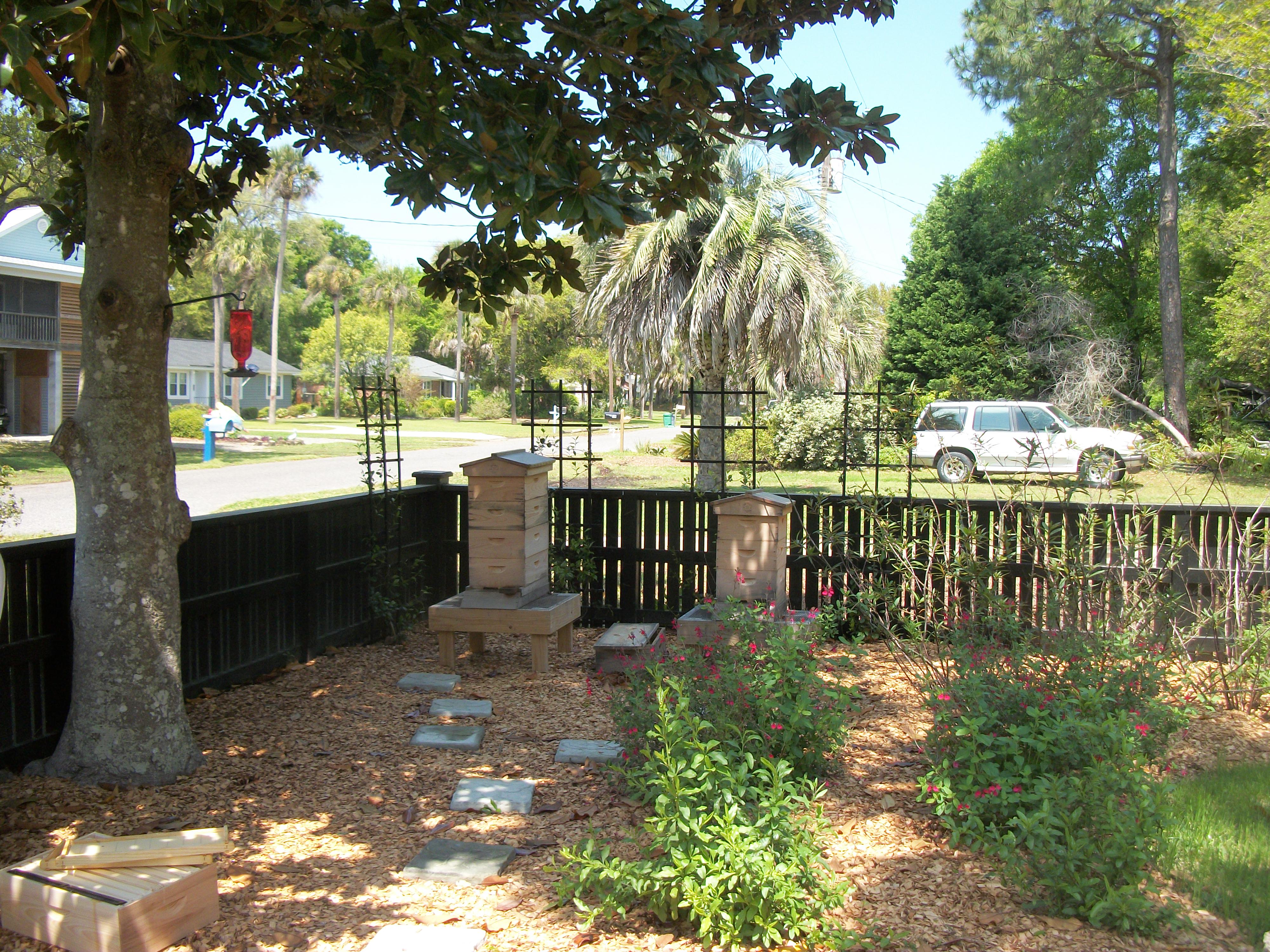
Here are the hives, tucked into a corner of the yard.  Tami has planted jasmine on the lattices behind the hives, which the bees are going to love.

Bees, Two Hives

Here’s a video of Tami and Kelly telling you what they are going to do:

Here are Tami and Kelly opening the bee hive.  They have to break the insert loose–it is sealed by the bees with a waxy substance called propolis–which has amazing healing properties.

Bees, opening the hive

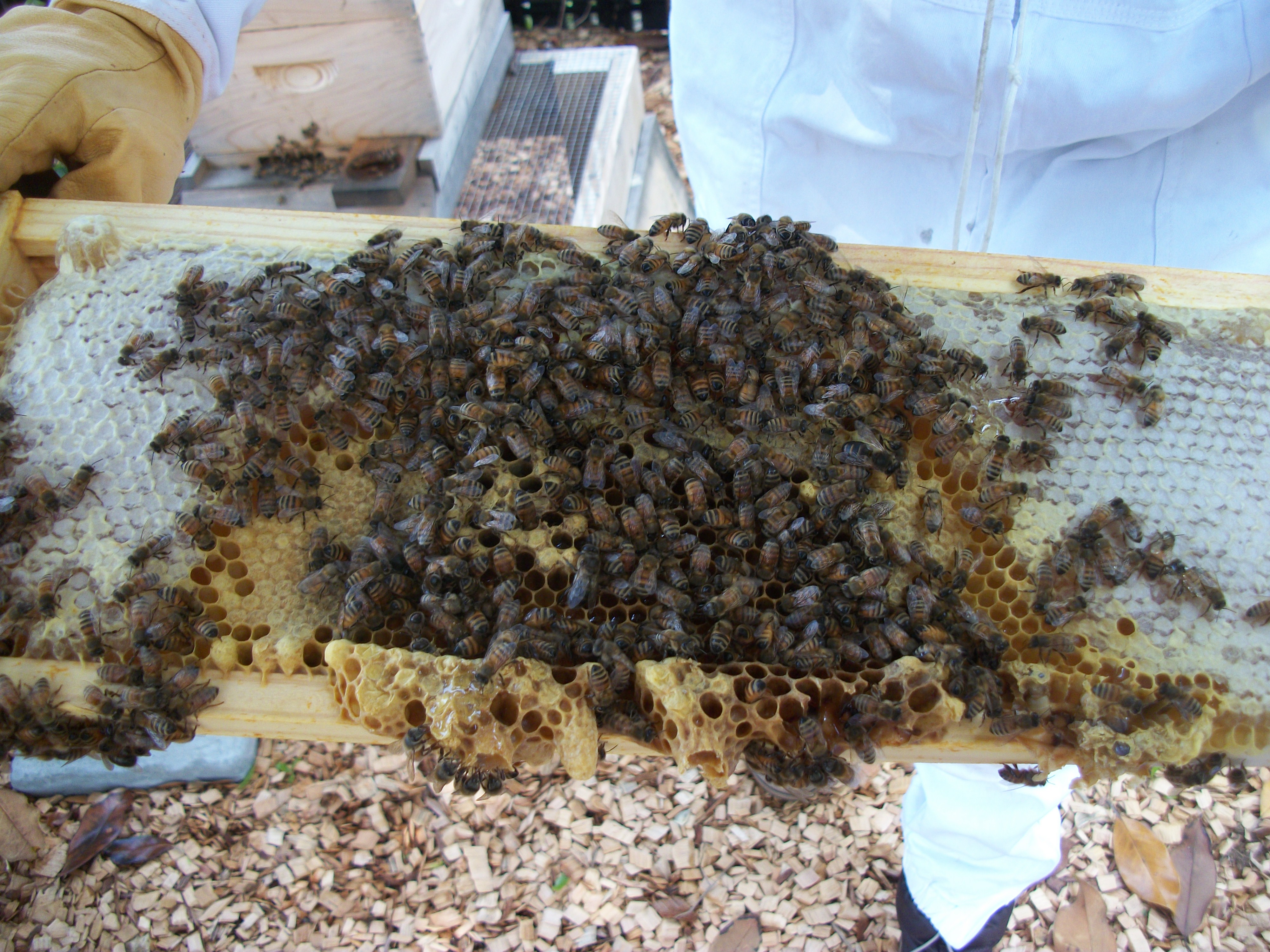
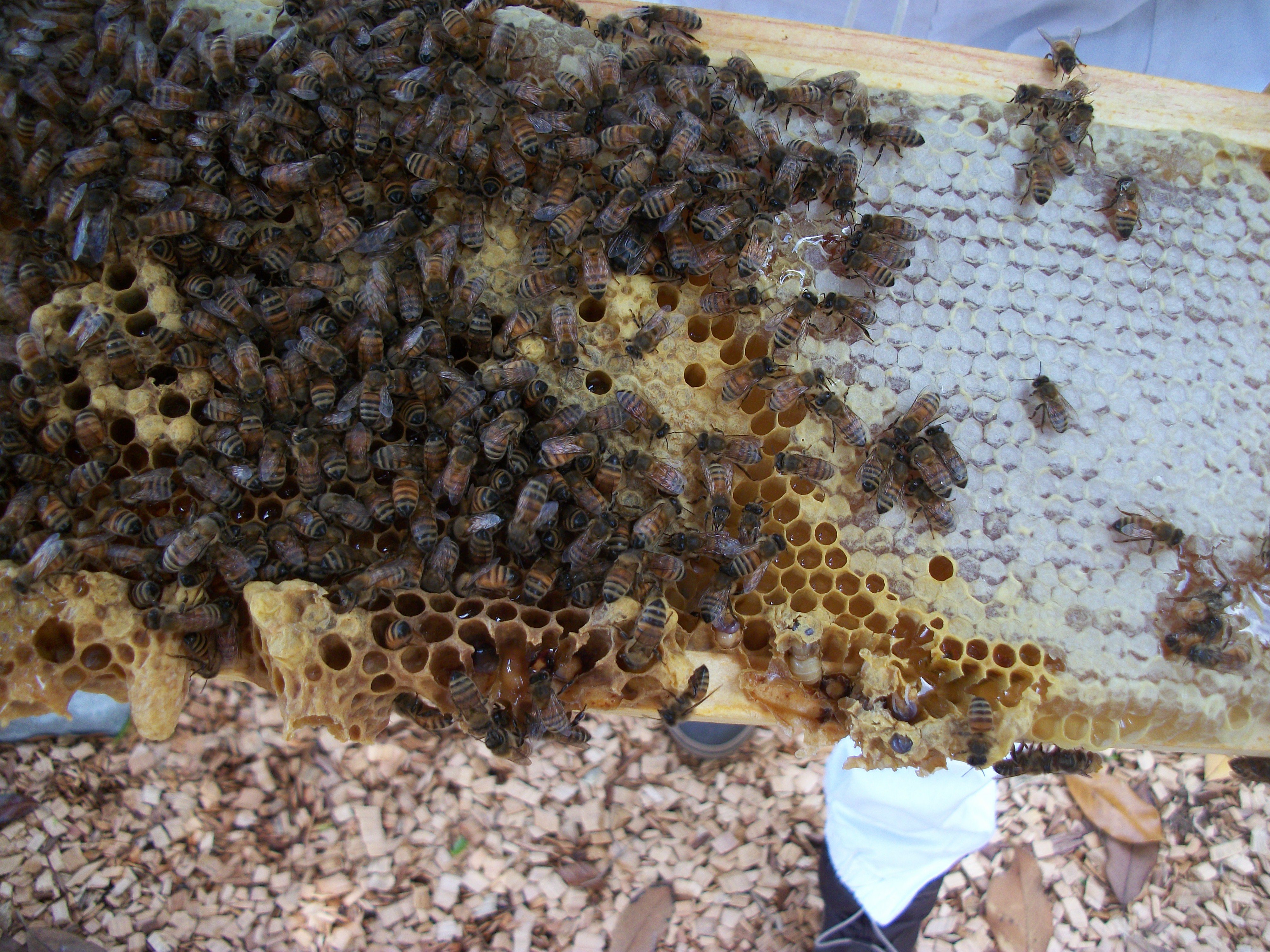
Here’s a close-up of one of the inserts.  You can see the waxed cells and the “brood,” which are the cells holding baby bees and developing bees in the foreground.  The second picture shows the brood even better.

bees up close

You can see the cells with baby bees hatching in the center front of this picture.

bees up close 2

Here’s another video up close so you can see what it feels like to work inside the hive and its panels:

During the time I was in Charleston, Tami rescued two swarms of bees.  One swarm came from one of the demonstration hives in Talula and Mina’s school.  The school staff sent out a call for help to local beekeepers, and Tami went and rescued the hive.  She brought it home and used it to repopulate one of the ten hives on Deux Peuces Farm–which had lost three queens–rendering three of the hives inoperable.

The second swarm Tami rescued landed up next to a local pool.  The pool people were going to call an exterminator, but agreed to let Tami come at night and get the swarm, which she did.

A friend told me today that he just heard that America alone has lost over 43% of their bee population.  I don’t know if that figure is correct, but I do know that it is a very serious problem for our food supply.  Yet we continue to allow chemicals to be used that kill bees.  The European Union, while I was in Charleston, banned one of the greatest offender chemicals for two years to see if it helped preserve the bees.

Turkey Tracks: Chickens Gone

I am back from Charleston, SC.  I tried to post to the blog on the ipad from there, and the interface was just too clunky.  Friend Giovanna McCarthy told me there was an app for “WordPress,” so I downloaded that a few days ago, but have not yet tried it out.  I LOVE the ipad.  It’s so easy and light when traveling.  So, the blog below was written on April 26, just before I came home on the 29th. 


Turkey Tracks:  April 26, 2013

Chickens Gone

I’m in Charleston celebrating the arrival of a new granddaughter, a family wedding, and visiting with my children and grandchildren.

I left the chickens free-ranging and unfenced–as I have for the past few springs.  They had such a long, hard winter this year.

Just got word that FOX has eaten all of my chickens but one black hen, who is now locked up in the coop and cage.


May 8, 2013

Update:  the surviving black chicken was Rosie, the purebred Maran hen.  What a lovely surprise.  Now if I can find another Maran rooster…

My dear friend Rose Thomas has gifted me with three of her hens–all in the Americauna line.  They are very busy laying the most beautiful eggs.  Pictures will follow when they’ve settled down. 

Right now they think I’m the devil since I had to dust them all and coat their legs with vaseline to halt any of the lice-like bugs that get under the scales of their legs.  Dusting involves holding them upside down by their legs, and it scared them to death.  Of course.  In a large flock like Rose has, it’s really hard to organically control lice and mites in the flock.  I am tempting them each day with many treats so they begin to associate me with nice things.

***

I am sorry not to have posted on this blog sooner, but I have been so busy “catching up” here.  Today David Hannan came and we worked from 8 a.m. until 2 p.m. when I quit for the day.   He kept working until 3.  I am so grateful to him for coming to help me with the spring tasks.  David picked up the winter boardwalk that Mike put down last fall.  And, together (but mostly David), we brought out all the lawn furniture and pot stands and wind chimes and hummingbird feeders and temporary fencing from the top of the garage and put all in their spaces on the three porches and in the yard.  We put up the summer chicken fence and fenced the garden with the new green metal rods I bought this week.  Part of this fence will become permanent.  And, David showed me how to use a crow bar to dig a hole–which he did–to sink the pea poles deeper into the ground.  David did more clean-up, like the path to the meadow and odd raking back of stones that have slid around over the winter.  And he blew off all the stones and grit from the driveway so that when it rains tonight and tomorrow, the driveway will get all clean.

He has promised to come next week to help me pot up and plant all the flower containers and to carry the pots to their places around the porches.  One more day should finish up the spring clean-up.  I will mow the lawn as soon as the rain stops.

YEAH!!!!  So many really hard tasks completed today!!!!  And it is always fun


Turkey Tracks: The Kiddos’ Quilts in Charleston

Hello Everyone!

I am back from Charleston, SC.  I tried to post to the blog on the ipad from there, and the interface was just too clunky.  Friend Giovanna McCarthy told me there was an app for “WordPress,” so I downloaded that a few days ago, but have not yet tried it out.  I LOVE the ipad.  It’s so easy and light when traveling.  So, the blog below was written on April 23.


Turkey Tracks:  April 23, 2013

The Kiddos’ Quilts in Charleston

I make them.

Than most of them I give away.

The grandchildren have quite a few of them.  There were the baby quilts.  Then the “big bed” quilts.  And, in a few cases, a wall quilt.

Imagine my delight to see some of the quilts in use in a bedroom that can sleep four of the kiddos in bunks, freeing up a bedroom for a guest–like me!

image

I love both of those wall quilts and had such fun making them.  Both came from now-famous patterns.  The one on the left is called “Over By the Pond” if I’m not mistaken.  The “jar” block is pretty standard, but I’m sure I bought this pattern as a kit that came with the buggy fabrics.  I wanted my kiddos to be deeply connected to nature, and I love and am fascinated with bugs.

The little blue churn dash quilt was made for my first grandchild, Bowen.  It has some Maine blueberry fabrics in it.

The red-bound quilt was also Bowen’s, his “big bed” quilt.  All these children have special quilts, not just Bowen.

Here’s a better view of “Over By The Pond.”

image

Turkey Tracks: Elver Eels Per Pound

Turkey Tracks:  April 10, 2013

Elever Eels Per Pound

Ok, so I know more about Elever eels.

First, they sell for a whopping $2000 a pound.

Second, they are tiny, tiny when caught here in the spring–like a piece of angel hair pasta.

Third, they are coming from the bay and are trying to go up the river.  They are likely coming from the Sargasso Sea area.  At this stage they are called glass eels as they are translucent.

Forth, they are sold live and raised to be big before being eaten.

The $2000 explains why people are being fined for netting them without having proper permits.

Turkey Tracks: Dogs Being Dogs

Turkey Tracks:  April 7, 2013

Dogs Being Dogs

First, watch this video I took the other day outside Boynton McKay, a favorite lunch and/or coffee spot here in Camden, Maine.  Local people often tie their dogs outside, where they wait patiently for their owners to eat.  The lighter lab I see frequently.  S/he behaves impeccably to passers-by.

So, what you have here is dogs doing what dogs do.  I didn’t see the second, dark lab as I came toward Boynton McKay.  But surely the woman walking the dog did.  So,what you have is TWO dogs waiting outside.  TWO equals trouble.  They will now back each other up.  Add in that they are feeling insecure because their owner is inside and they are in that big wide open world outside all alone.   Add in a third dog, a big dog, too, and you get…what you see in the video.  Even the best of dogs will behave this way.

Lesson:  if you are walking a dog and come upon TWO tied dogs outside of a store, give them a wide berth.  Stop above them as well and speak reassuringly to them.

Interesting Information: BAG IT: Paper or Plastic?

Interesting Information:  April 7, 2013

BAG IT:  Paper or Plastic?

Assuming I’m not carrying my own bags, I’ve never been sure which bag to ask for–paper or plastic.  I’ve read arguments for both.

After watching the 2010 documentary BAG IT,  I’m now sure.  Ask for PAPER.

Why?  Paper degrades in landfills, can be recycled, is often recycled already, and gets recycled/reused ten times more than plastic bags.

BAG IT explores the above question by using an everyday, normal “everyman” who is seeking an answer to the paper/plastic question.

Here’s a synopsis from the web site:

Americans use 60,000 plastic bags every five minutes–single-use disposable bags that we mindlessly throw away. But where is “away?”   Where do the bags and other plastics end up, and at what cost to our environment, marine life and human health? Bag It follows   “everyman” Jeb Berrier as he navigates our plastic world. Jeb is not a radical environmentalist, but an average American who decides  to take a closer look at our cultural love affair with plastics.  Jeb’s journey in this documentary film starts with simple questions:   Are plastic bags really necessary? What are plastic bags made from? What happens to plastic bags after they are discarded? Jeb looks  beyond plastic bags and discovers that virtually everything in modern society–from baby bottles, to sports equipment, to dental sealants, to personal care products–is made with plastic or contains potentially harmful chemical additives used in the plastic-making process.   When Jeb’s journey takes a personal twist, we see how our crazy-for-plastic world has finally caught up with us and what we can do about it.   Today. Right now.

Here are some of the ideas I took away from the movie:

Plastic bags were created to be thrown away, but they don’t go away.  Plastic doesn’t break down in land fills.  Much of today’s plastic finds its way into our oceans, the life blood of this planet, where it is creating huge, floating toxic soups that ocean critters are eating, and, then, dying.  If we eat these fish, we are getting some of the chemicals they have ingested.  We are bombarded all day long with chemicals.  Tiny amounts of these chemicals can cause endocrine system disruptions that have radical repercussions for us, especially around reproduction and cancer formation.  Chemicals are changing how our children are constructed.  The sperm counts in males is dropping dramatically these days.

Plastic bags came about through the concept of “disposable living.”  They are meant to be used once and thrown away.

Plastic bags are being banned across the world.  But, the American plastic industry is suing towns that try to create laws that ban plastic the shopping bags.  The American Chemistry Council leads this effort.

Bottled water is one of the biggest plastic problems in the environment.

We are using enormous amounts of energy creating new goods that we are sending on a one-way trip to a landfill.  Landfills are contaminating our groundwater.  So simplify.  Try to recycle, reuse, repurpose, or do without.

One of the biggest scams in recycling plastic is that while some of us separate our trash by the numbers on the bottom of the plastic, only Numbers 1 & 2 get recycled routinely.  The rest of the numbers just make us think something is being done with the rest of the plastic trash.

Start checking labels on all kinds of products, especially body-care products.  Many are oil based.

Our grandparents didn’t have all these products.

The movie promotes some steps each of us can take:

Cut back on single-use disposable products.

Don’t drink bottled water.

Bring your own container.

Remove packaging in stores.

Choose products with less packaging.

Buy used.

Buy less “stuff.”

Simplify your life.

Remember that nature solves problems.  If we are a problem, nature is certainly going to solve us.

***

Where am I on this journey?

The two oil-based plastic products I have not been able to let go of are plastic wrap and plastic bags.  So that’s my new goal.  I can use glass containers, use plates on top of bowls in the refrigerator, use cheese cloth to wrap produce, and so forth.  I’ll start by not buying new bags or new rolls of plastic.

I don’t use oil-based cosmetics.  I use a waxy natural lipstick, coconut oil for moisture, and don’t do all the skin foundation cosmetic stuff.  (Healthy vibrant skin comes from eating healthy, nutrient dense foods.)  I have natural shampoos and conditioners.  I use baking soda and salt, flavored with an essential oil of peppermint or lemon, for toothpaste.

I’ve been successful at not using aluminum foil, which is terribly toxic.  Parchment paper works fine for baking or topping a dish I’m taking somewhere.

I hardly ever use paper napkins or paper towels.  But I do, some.  The napkins are mostly for guests since they seem to panic if we don’t have them.  Bacon grease in the cast-iron frying pan is where I’m likely to use paper towels.  I could use newspaper…  I’ll try that.  And newspaper could also clean glass…  The rest of the cleaning could be done with rags.

But, there’s still toilet paper…

Anyway, I invite you to join me on this journey.  Do it for the children you love.

Turkey Tracks: Current Projects

Turkey Tracks:  April 6, 2013

Current Projects

Spring is on the move, but we’ve had a chilly, if sunny, week.

One of my current projects is to practice taking more videos in order to learn what works and what doesn’t.  I erased quite a few for various reasons.  One reason is that it is very hard to hold the cameras steady.  Here’s one of the Camden Harbor at low tide, with the spring-full river pouring into it.  At high tide, the water would rise to a foot or two below the docks.  The wind is high and the noise of it and of the river interferes a bit with what I’m saying.

It’s elver season, and people trap them at the mouths of rivers–as near as I can determine.  Elvers are little eels that fetch the most astonishing prices per pound.  These little guys are sold alive to the Japanese, mostly, who then raise them to be much bigger before eating them.

Have you ever eaten eel?  It’s delicious actually.  You could try it in a sushi restaurant.  It’s cooked with a sweet sauce of some sort.

Anyway, here’s the video:

I’ve almost finished a pair of socks for my sister-in-law, Maryann Enright.  She chose the yarn just before John died.  We had a nice visit one day around early December to our newest yarn shop in Rockland, Maine, called Over The Rainbow.  It’s a fabulous yarn shop, and we are so lucky to have it.  I think these socks might be a bit wilder than Maryann imagined, but she will rise to the occasion with them.  The yarn does not have black in it, but deep navy and dark plum and a tiny bit of dark brown.

Maryann's socks

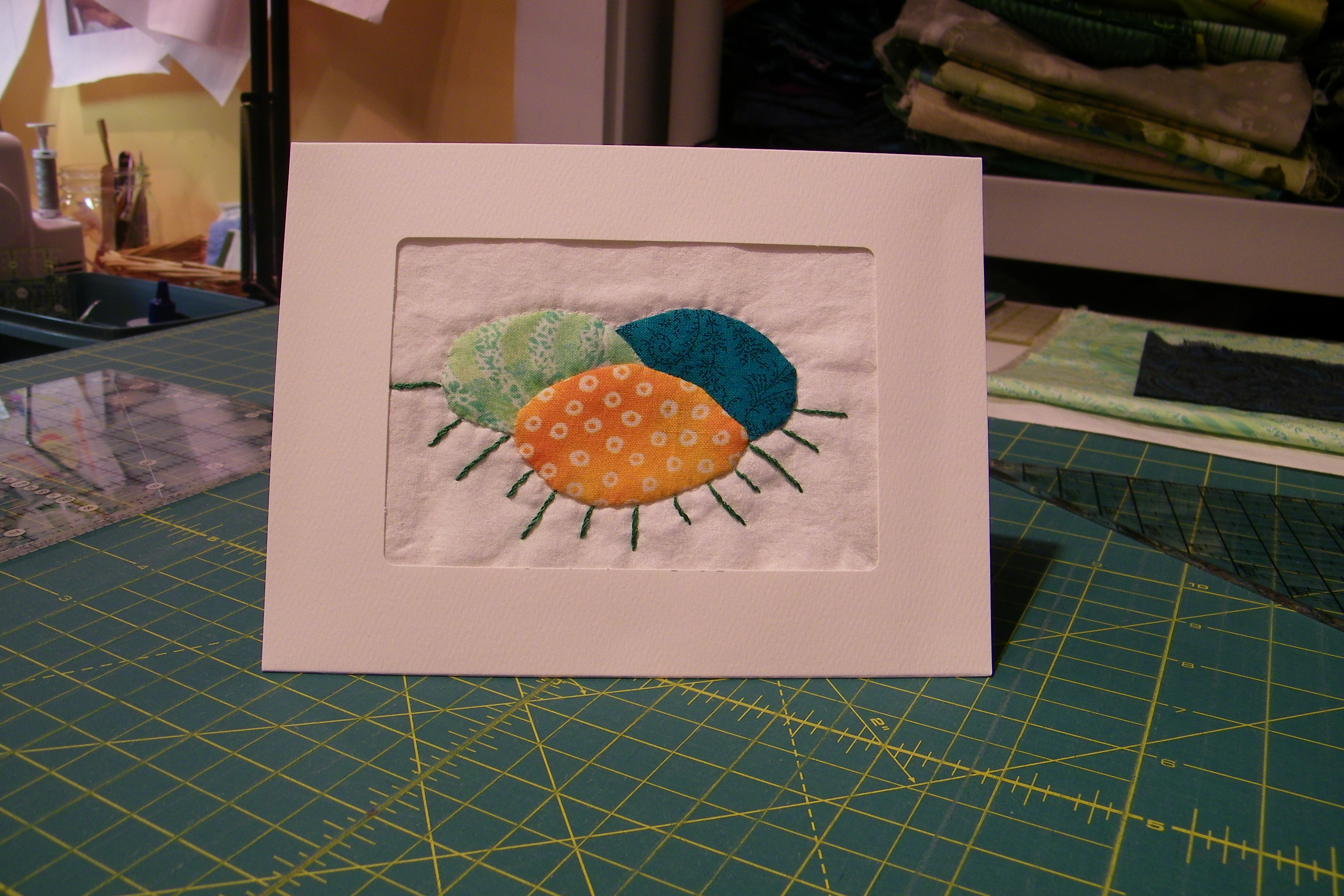
I am working on an applique quilt made with big blocks of green turtles.  I have not done any applique in some time and am very slow at it, so I refreshed my skills (ha! that’s a joke) with this little Easter Card for Maryann–in a class at Coastal Quilters taught by Barb Melchiskey, who is a master appliquer.  If I were doing this card again, I’d chose either a colored card or a colored background.  The two whites aren’t working so well together, and I don’t like the lines running away from the eggs.  But the eggs!  Ah, the eggs.  Perfect for this very eggy household.

Egg Applique

The turtle applique quilt will get a lot of quilting to bring out texture in the blocks–on the domestic machine.  But, here’s one block ready to go.  Now I need to do more.  I have not decided whether to do 6 or 9 blocks…
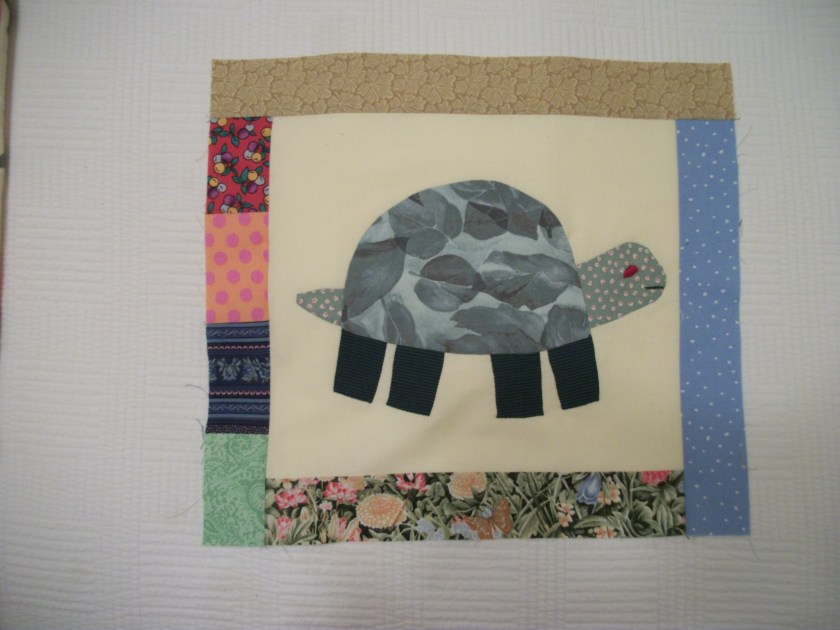
Green Turtle block

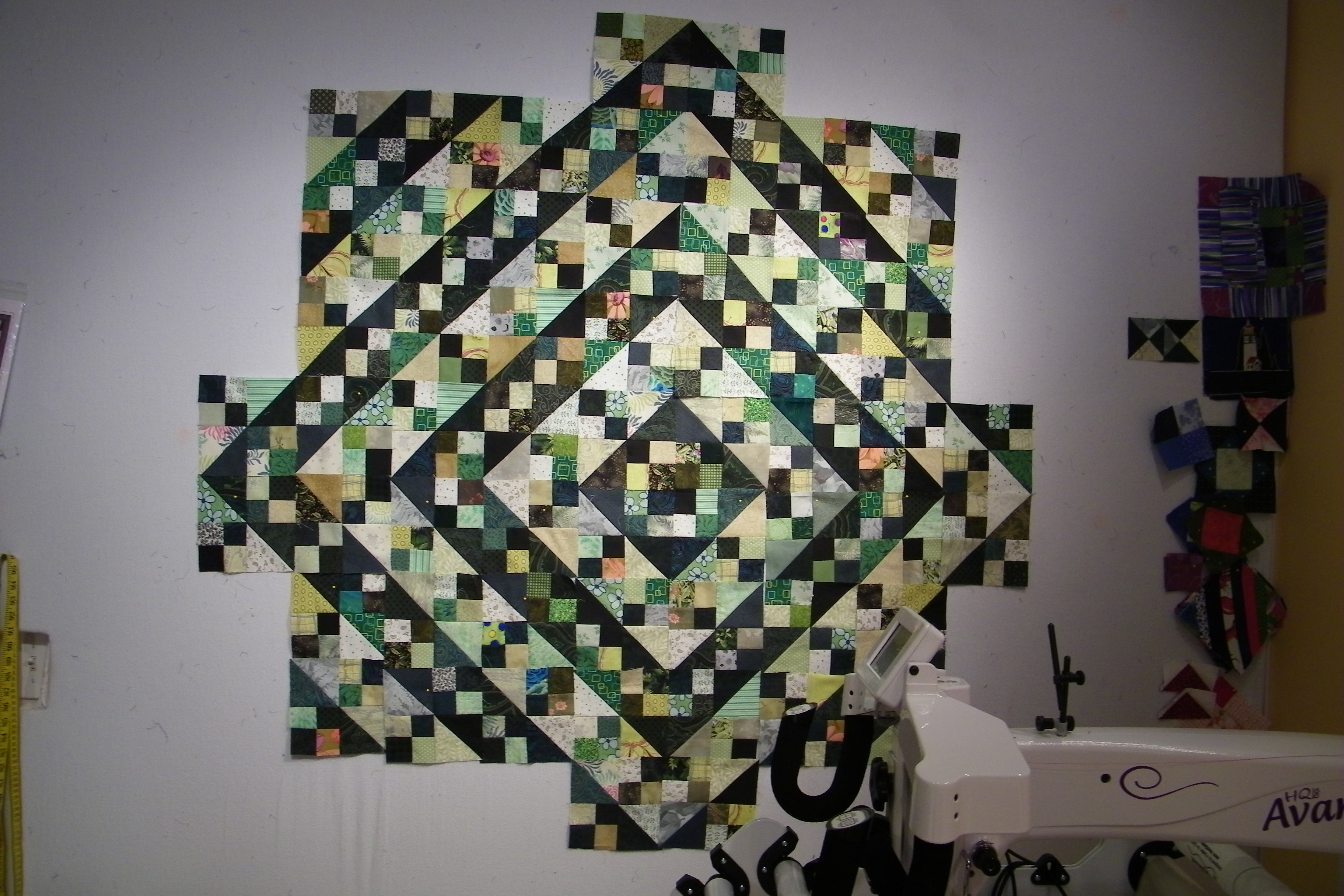
What is really drawing me is the scrap quilt taking shape on the design wall.  This one calls me from other rooms to work on it.  I have fallen in love with Bonnie Hunter and ALL of her books:  LEADERS AND ENDERS, SCRAPS AND SHIRTTAILS I AND II, and STRING FLING.  She embodies the kind of work I love best to do–make functional quilts that people can curl up under or into and use as much of the stash fabrics as possible.

Bonnie’s motto is reuse, repurpose, recycle.  She has a monthly column in QUILTMAKERS and her web site is awesome.  There must be 50 free quilting patterns on that web site.  She’s coming in May to our state guild, Pine Tree Quilting Guild, on May 5th, and I will be there to see her quilts and meet her, God willing and the creek don’t rise.

Bonnie Hunter also promotes Victoria Findlay Wolfe’s new book:  15 MINUTES OF PLAY , which is so much fun.  Both Hunger and Wolfe are having way too much fun with their quilts, and both employ string piecing methods to great advantage and fun in their quilts.

Anyway, Hunter uses a method that I really like.  She cuts any pieces of fabric in her stash smaller than a fat quarter, or at the biggest, a half yard, into strips:  3 1/2 inches, 2 1/2 inches, 2 inches, 1 1/2 inches.  (I also cut 5 inches as I have rather a lot of those now and want to make a broken dishes block with them.)  These measurements work well together.  She divides these strips into light and dark piles.  When she starts a project, she’s already done a lot of cutting.  And she can cut the strips further down with rulers, like the Easy Angle ruler, into the shapes she wants.  (She also likes the Tri Rec ruler set.)  I’ve been using the Easy Angle ruler, and it makes PERFECT half square triangles, as long as you have an accurate 1/4 inch sewed seam.

This quilt started using Bonnie’s method described in LEADERS AND ENDERS, where you keep a basket next to your machine with some block parts in it–like two-inch squares.  When you would need to cut thread on another project, instead, you just feed a light and dark set of squares through the machine and cut off the piece you wanted to free on the back side of the needle.   In no time, you have a pile of sets of two squares sewn together.  You can finger press those and sew them to another set for a four-square–and so on.

Well!

Here’s what happened in short order at my sewing machine–the idea came from Hunter’s LEADERS AND ENDERS.  And it’s putting a real hurt on my green stash fabrics!!!!  I’m no longer just piecing squares  through the machine while working on another project.  I’m making time to make as many blocks as I can.

Quilt in Progress

Here’s the block:  a form of a Jacob’s Ladder block, depending on where you locate the dark and light of the half-square triangles.

Quilt block

I iron the half-square triangle blocks along the way, but I don’t iron the whole block until I’ve finished it.  I’ve had to trim up very, very few of them.  All have been a bit too big–with stretching from ironing mostly I think.  None have been too small.  Most are perfect.

The squares quickly overflowed from the basket as I cut into my stash.

Quilt squares

The basket got filled with half-square triangle pieces:

Quilt triangles

And I have a pile of strips all cut and ready to be cut further–and separated by value–so Bonnie is right that just a bit of cutting each day delivers a lot of sewing for days to come.  She also says that she groups medium and dark values together and relies on the REALLY light fabrics to create contrast in a quilt like this one.

Quilt strips

I finished and mailed a beautiful quilt for a beautiful bride, Ashley Malphrus, who will be married in Charleston later this month.  I will put up pictures when I get home from Charleston, and the bride has seen the quilt.  But I am delighted with it.

So, I will leave you with this picture:  the last bouquet of flowers from our CSA, Hope’s Edge, last summer.  Those days are coming around again.  Look at all that green in the windows.
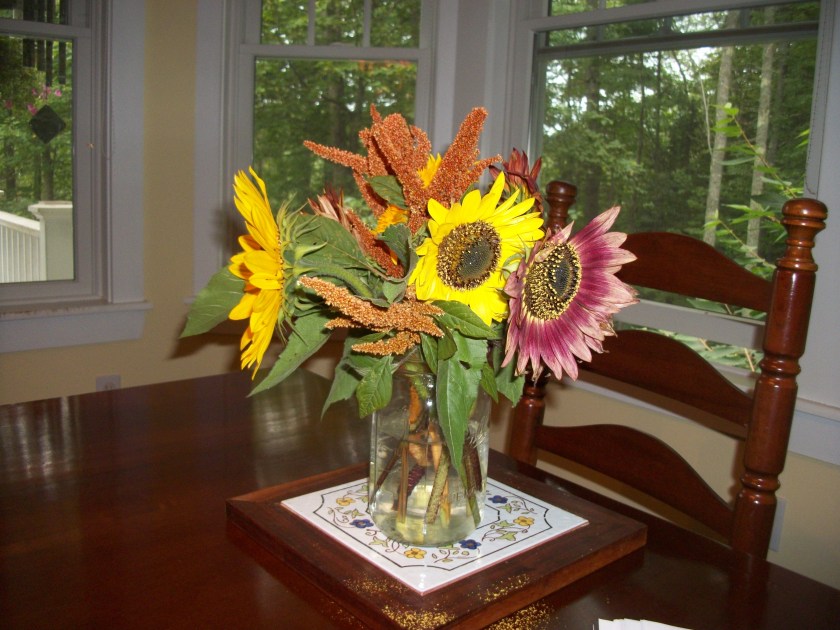
Hope's Edge, last boquet, Sept. 2012

Interesting Information: Homing Bees

Interesting Information:  April 2, 2013

Homing Bees

Old friends Leighton and Tara Derr Web are working with bee master Tamara Kelly Enright (my daughter-in-law) to start ten hives on Deux Peuces Farm in Awendaw, SC.

Leighton oversaw the building of the ten hives.  Here’s Tami trying her hand at cutting some of the hive wood:

And here are Tami and Leighton “homing” the 50,000 bees in the ten hives.  Tami is setting up a hive by installing the pieces which the bees will use to build the interior of the hive.  I presume Tara is the photographer.

Tami’s honey is called “Talula Bee Honey,” and it is highly prized in the Charleston, SC, area.

And you can see much more information about Tara and Leighton and their farm on THE FARMBAR web site, which is linked on this blog.  See the right sidebar to click over to The Farmbar.  There are some gorgeous articles and pictures on The Press section of Tara’s blog.